
Cnemaspis is a genus of diurnal (day) geckos found in Asia. With over 100 species, it is one of the most diverse genera of geckos. Molecular phylogenies suggest that the two regional groupings may form distinct clades which are not each other's closest relatives.

Mudumalai National Park is a national park in the Nilgiri Mountains in Tamil Nadu in southern India. It covers 321 km2 (124 sq mi) at an elevation range of 850–1,250 m (2,790–4,100 ft) in the Nilgiri District and shares boundaries with the states of Karnataka and Kerala. A part of this area has been protected since 1940. The national park has been part of Nilgiri Biosphere Reserve since 1986 and was declared a tiger reserve together with a buffer zone of 367.59 km2 (141.93 sq mi) in 2007. It receives an annual rainfall of about 1,420 mm (56 in) and harbours tropical and subtropical moist broadleaf forests with 498 plant species, at least 266 bird species, 18 carnivore and 10 herbivore species. It is drained by the Moyar River and several tributaries, which harbour 38 fish species.

The Indian day gecko or Nilgiri dwarf gecko is a species of diurnal and insectivorous, rock-dwelling gecko found in the high elevation grasslands and montane forests of the Western Ghats ranges in South India, such as the Nilgiri Hills and the Silent Valley National Park) in Tamil Nadu and Kerala states, respectively.
Cnemaspis otai, also known commonly as Ota's day gecko or the Vellore day gecko, is a species of lizard in the family Gekkonidae. The species is endemic to southeastern India.

The Yercaud day gecko is a species of gecko found in the Shevaroy Hills of southern India.
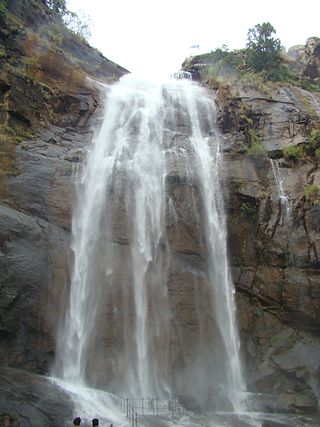
Agaya Gangai is a waterfall located in Kolli Hills of the Eastern Ghats, in Namakkal district, Tamil Nadu, India. It falls from a height of 300 feet (91 m) and is formed by the Aiyaru river. Agaya Gangai is also known as Peraruvi and can be reached by climbing down 1196 steps. The caves of sages Bogar, Agastyar, Korakkar and Kalangi Nathar are located near the waterfalls inside the forest. Agaya Gangai dwarf gecko is a species of diurnal, rock-dwelling, insectivorous gecko endemic to the region.

Sirumalai is a region of 60,000 acres (200 km2) situated 25 km (16 mi) from Dindigul, 90 km (56 mi) from Madurai, and 125 km from Trichy, Tamil Nadu, India. There are many high hills in the area. Sirumalai range is the last mountain range of the Eastern Ghats. The last mountains of the Sirumalai mountain range are the Azhagar Kovil Hills which are present in Madurai District. Azhagar Kovil Hills are the most important place of worship for the Hindu religion. Trekking is allowed in the Azhagar Kovil Hills. The nearest Eastern Ghats hills to Sirumalai Hills are the Narthamalai Hills.
Cnemaspis australis, also known as the Southern Travancore day gecko, is a species of gecko endemic to Agasthyamalai Hills of the Southern Western Ghats, in the states of Tamil Nadu and Kerala in South India. It lives in rock boulders and is an evergreen forest dwelling diurnal, insectivorous and oviparous species. This species was previously confused with another gecko Mysore day gecko till a study in 2007 proved it to be a new species.

The Mysore day gecko is a species of diurnal gecko endemic to the Bangalore uplands in Karnataka state, South India. It is rock-dwelling and is found in deciduous forest tracts in mid-hills. This species occurs in Hosur / Krishnagiri hills of Tamil Nadu and Bangarapet Ramnagara and Tumkur districts in Karnataka state.
Cnemaspis anslemi, or Anslems' day gecko, is a species of diurnal gecko endemic to island of Sri Lanka described from northwestern foothills of Samanalawewa Nature Reserve.
Pakkamalai is a mountain and forest reserve in Villupuram district of Tamil Nadu, located 45 km southwest of Gingee.
Cnemaspis krishnagiriensis, the Krishnagiri dwarf gecko, is a species of diurnal, rock-dwelling, insectivorous gecko endemic to India. It is distributed in Tamil Nadu.
Cnemaspis jackieii is a species of diurnal gecko in the family Gekkonidae. It is endemic to the Western Ghats in southern India.
Cnemaspis agayagangai, the Agaya Gangai dwarf gecko, is a species of diurnal, rock-dwelling, insectivorous gecko endemic to India.
Cnemaspis fantastica, the fantastic dwarf gecko, is a species of diurnal, rock-dwelling, insectivorous gecko endemic to India.
Cnemaspis pachaimalaiensis, the Pachaimalai dwarf gecko, is a species of diurnal, rock-dwelling, insectivorous gecko endemic to India.
Cnemaspis salimalii, Salim Ali's dwarf gecko, is a species of diurnal, rock-dwelling, insectivorous gecko endemic to India.
Cnemaspis cavernicola, the cave-dwelling dwarf gecko, is a species of dwarf gecko that was found in Pakkamalai Reserve Forest in Tamil Nadu, India. It is a small species, with snout–vent length of 28–34 mm (1.1–1.3 in) and tail length of 24–36 mm (0.94–1.42 in), giving a maximum total length of about 68 mm (2.7 in).
Cnemaspis rashidi is a species of diurnal, rock-dwelling, insectivorous gecko endemic to India. It is reported from Western Ghats of India and the species is found in Kottamalai near Rajapalayam, Tamil Nadu. It is one among the 94 species described in the genus Cnemaspis. It is known as Rashid's dwarf gecko since it is the smallest species of the genus Cnemaspis. The back side of the body is with attracting yellow, white and black colors. The total length from snout and vent is 2 inches.
