Costoma basirosella

Last updated

Costoma basirosella
Scientific classification
Kingdom: Animalia
Phylum: Arthropoda
Class: Insecta
Order: Lepidoptera
Family: Depressariidae
Genus: Costoma
Species:C. basirosella
Binomial name
Costoma basirosella
Busck, 1914

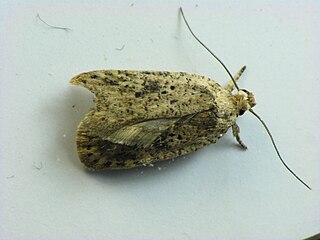
Costoma basirosella is a moth in the Depressariidae family. It was described by August Busck in 1914. It is found in Panama. [1]

Moth Group of mostly-nocturnal insects in the order Lepidoptera

Moths comprise a group of insects related to butterflies, belonging to the order Lepidoptera. Most lepidopterans are moths, and there are thought to be approximately 160,000 species of moth, many of which have yet to be described. Most species of moth are nocturnal, but there are also crepuscular and diurnal species.
Depressariidae family of insects

Depressariidae is a family of moths. It has formerly been treated as a subfamily of Gelechiidae, but is now recognised as a separate family, comprising about 2300 species worldwide.

August Busck was a Danish entomologist who became an American citizen. Busck was an employee of the Bureau of Entomology within USDA. He is best known for his work with microlepidoptera, of which he described over 600 species. His collections of Lepidoptera from North America and the Panama Canal Zone are held by the National Museum of Natural History in Washington, D.C.

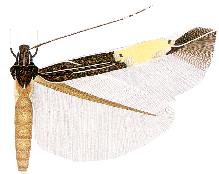
The wingspan is about 31 mm. The base of the forewings are light pink, on the costa yellow. This bright colored base is sharply limited outwardly by a narrow, blackish-brown, transverse fascia. Beyond this fascia, the wing is dark olive brown with the costal edge from the basal fourth outwardly, broadly yellow, and with the entire apical, terminal, and dorsal edge narrowly yellow. The hindwings are dark brownish fuscous. [2]
Wingspan distance from one wingtip to the other wingtip of an airplane or an animal (insect, bird, bat)

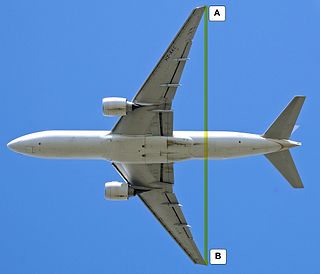
The wingspan of a bird or an airplane is the distance from one wingtip to the other wingtip. For example, the Boeing 777-200 has a wingspan of 60.93 metres, and a wandering albatross caught in 1965 had a wingspan of 3.63 metres, the official record for a living bird. The term wingspan, more technically extent, is also used for other winged animals such as pterosaurs, bats, insects, etc., and other fixed-wing aircraft such as ornithopters. In humans, the term wingspan also refers to the arm span, which is distance between the length from one end of an individual's arms to the other when raised parallel to the ground at shoulder height at a 90º angle. Former professional basketball player Manute Bol stands at 7 ft 7 in (2.31 m) and owns one of the largest wingspans at 8 ft 6 in (2.59 m).
Related Research Articles

<i>Cosmopterix adrastea</i> species of insect

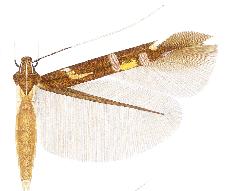
Cosmopterix adrastea is a moth of the family Cosmopterigidae. It is known from Cuba.

<i>Cosmopterix argentifera</i> species of insect

Cosmopterix argentifera is a moth of the family Cosmopterigidae. It is known from Jamaica.

<i>Cosmopterix bacata</i> species of insect

Cosmopterix bacata is a moth of the family Cosmopterigidae. It is found in the United States from northern Florida to southwest Alabama south to central Florida and Louisiana.

<i>Cosmopterix callichalca</i> species of insect

Cosmopterix callichalca is a moth of the Cosmopterigidae family. It is known from Argentina (Salta), Brazil and the United States

<i>Cosmopterix citrinopa</i> species of insect

Cosmopterix citrinopa is a moth of the family Cosmopterigidae. It is known from Peru.

<i>Cosmopterix clandestinella</i> species of insect

Cosmopterix clandestinella is a moth of the family Cosmopterigidae. It is known from the United States.

<i>Cosmopterix dapifera</i> species of insect

Cosmopterix dapifera is a moth of the family Cosmopterigidae. It is known from the United States, Brazil (Bahia) and Cuba.

<i>Cosmopterix ebriola</i> species of insect

Cosmopterix ebriola is a moth of the family Cosmopterigidae. It is known from the United States and the Cayman Islands.

<i>Cosmopterix erasmia</i> species of insect

Cosmopterix erasmia is a moth of the family Cosmopterigidae. It is known from the Brazil and Guyana.

<i>Cosmopterix facunda</i> species of insect

Cosmopterix facunda is a moth of the family Cosmopterigidae. It is known from Texas, United States.

<i>Cosmopterix floridanella</i> species of insect

Cosmopterix floridanella is a moth of the family Cosmopterigidae. It is found in the United States, the Cayman Islands, Cuba, Jamaica and the US Virgin Islands.

<i>Cosmopterix galapagosensis</i> species of insect

Cosmopterix galapagosensis is a moth of the family Cosmopterigidae. It is known from the Galapagos Islands.

<i>Cosmopterix inopis</i> species of insect

Cosmopterix inopis is a moth of the family Cosmopterigidae. It is known in the United States, from Arizona and Florida.

<i>Cosmopterix interfracta</i> species of insect

Cosmopterix interfracta is a moth of the family Cosmopterigidae. It is known from Brazil, Cuba, the Dominican Republic, Jamaica and Puerto Rico.

<i>Cosmopterix madeleinae</i> species of insect

Cosmopterix madeleinae is a moth of the Cosmopterigidae family. It is known from the Galapagos Islands.

<i>Cosmopterix nyctiphanes</i> species of insect

Cosmopterix nyctiphanes is a moth of the family Cosmopterigidae. It is known from Ecuador.

<i>Cosmopterix pyrozela</i> species of insect

Cosmopterix pyrozela is a moth of the family Cosmopterigidae. It is known from Amazonas, Brazil.

Battaristis bistrigella is a moth of the Gelechiidae family. It was described by August Busck in 1914. It is found in Panama.

Battaristis cyclella is a moth of the Gelechiidae family. It was described by August Busck in 1903. It is found in North America, where it has been recorded from Arizona and Utah.

Costoma cirrophaea is a moth in the Depressariidae family. It was described by Meyrick in 1924. It is found in Bolivia.

References

  1. Costoma at Markku Savela's Lepidoptera and Some Other Life Forms.
  2. Proceedings of the United States National Museum 47 (2043): 24