
Croton may refer to:
Croton may refer to:


Croton-on-Hudson is a village in Westchester County, New York, United States. The population was 8,327 at the 2020 United States census over 8,070 at the 2010 census. It is located in the town of Cortlandt as part of New York City's northern suburbs. The village was incorporated in 1898.

The New Croton Dam is a dam forming the New Croton Reservoir, both parts of the New York City water supply system. It stretches across the Croton River near Croton-on-Hudson, New York, about 22 miles (35 km) north of New York City.
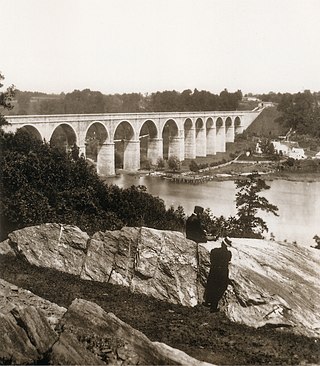
The Croton Aqueduct or Old Croton Aqueduct was a large and complex water distribution system constructed for New York City between 1837 and 1842. The great aqueducts, which were among the first in the United States, carried water by gravity 41 miles (66 km) from the Croton River in Westchester County to reservoirs in Manhattan. It was built because local water resources had become polluted and inadequate for the growing population of the city. Although the aqueduct was largely superseded by the New Croton Aqueduct, which was built in 1890, the Old Croton Aqueduct remained in service until 1955.

A combination of aqueducts, reservoirs, and tunnels supplies fresh water to New York City. With three major water systems stretching up to 125 miles (201 km) away from the city, its water supply system is one of the most extensive municipal water systems in the world.

The Cannonsville Reservoir is a reservoir in the New York City water supply system in Delaware County, New York. It was formed by construction of the Cannonsville Dam on its west end, which impounded over half of the West Branch of the Delaware River. Lying on the western part of the Delaware Watershed, it is the westernmost of New York City's reservoirs. It was placed in service in 1964, and is the most recently constructed New York City-owned reservoir.

The Kensico Reservoir is a reservoir spanning the towns of Armonk and Valhalla, New York, located 3 miles (5 km) north of White Plains. It was formed by the original earth and gravel Kensico Dam constructed in 1885, which impounded waters from the Bronx and Byram rivers. In 1917, a new masonry dam was completed, replacing the old dam and expanding the water supply by bringing water from the Catskill Mountains over a distance of more than 100 miles.

The West Branch Reservoir is a reservoir in the New York City water supply system. Formed by impounding the upper reaches of the West Branch of the Croton River, it is located in the Putnam County, New York, towns of Kent, and Carmel, about 50 miles (80 km) north of New York City.
The Boyds Corner Reservoir is a small reservoir in Putnam County, New York. It is in the town of Kent, New York, and is about 50 miles north of New York City. It is the northernmost reservoir in the Croton River watershed, but is not part of the New York City water supply system's Croton Watershed. and was formed by impounding the middle of the West Branch of the Croton River, submerging the village of Boyds Corner.

The Amawalk Reservoir is a small reservoir in the New York City water supply system located in central-northern Westchester County, New York. It is located at the intersection of U.S. Route 202 and New York State Route 35 in the town of Somers, and is over 32 miles north of New York City. Part of the system's Croton Watershed, it was formed by impounding the middle of the Muscoot River, one of the tributaries of the Croton River. This reservoir was put into service in 1897, and was named after the original community of Amawalk, New York, which was inundated by the reservoir and relocated near the dam.

The Cross River Reservoir is a reservoir in the New York City water supply system located directly east and north of the northern Westchester County, New York, Hamlet of Katonah. Part of the system's Croton Watershed, it lies within the towns of Bedford, Lewisboro, and Pound Ridge, about 1 mile (1.6 km) east of the village of Katonah, and over 25 mi (40 km) north of New York City. It was constructed around the start of the 20th century by impounding the Cross River, a tributary of the Croton River, which eventually flows into the Hudson River.
The Croton Falls Reservoir is a reservoir in the New York City water supply system in the Putnam County, New York townships of Carmel, and Southeast, roughly 50 miles (80 km) north of New York City. Part of the system's Croton Watershed, it was formed by impounding the West Branch and Middle Branch of the Croton River, tributaries of the Croton River, which flows into the Hudson River.
The Diverting Reservoir is a reservoir in the New York City water supply system in the town of Southeast, New York, in Putnam County immediately south of the village of Brewster, New York. Part of the system's Croton Watershed, it lies about 50 miles (80 km) north of New York City. Construction impounding the East Branch Croton River began early in the 20th century and was completed by 1911.
The Muscoot Reservoir is a reservoir in the New York City water supply system in northern Westchester County, New York, located directly north of the village of Katonah. Part of the system's Croton Watershed, it is 25 miles north of the City.

The New Croton Reservoir is a reservoir in Westchester County, New York, part of the New York City water supply system lying approximately 22 miles (35 km) north of New York City. It is the collecting point for water from all reservoirs in the Croton Watershed.

The Croton River is a river in southern New York with three principal tributaries: the West Branch, Middle Branch, and East Branch. Their waters, all part of the New York City water supply system, join downstream from the Croton Falls Reservoir. Together, their waters and the reservoirs linked to them represent the northern half of the New York City water system's Croton Watershed.

The Old Croton Dam is a historic dam located in Yorktown, Westchester County, New York, now lying submerged beneath the waters of the New Croton Reservoir. The dam was built on the Croton River between 1837 and 1842, and was the first substantial masonry dam in the United States. Construction was delayed by a January 1841 storm that washed away most of the dam, with heavy downstream damage and loss of life.

The history of Westchester County, a county in the state of New York, can be traced back to the founding of a settlement between the Hudson River and Long Island Sound in the 17th century. The area now known as Westchester County had seen human occupation since at least the Archaic period, but significant growth in the settlements that are now incorporated into the county did not occur until the Industrial Revolution.
[[File:Crotonrivermap.png|thumb|right|Map of the Croton River watershed. Note that this is not identical with the New York City water supply system's "Croton Watershed"{{efn|Numerous small natural lakes and ponds, as well as large Lake Mahopac, are part of the Croton River's watershed but not part of New York City’s supply system. A map of the actual Croton Watershed is found here. ]]
This page is about the Croton River watershed, a hydrological feature. For the component of the New York City water supply system with a similar name, see Croton Watershed
The Muscoot River is a short tributary of the Croton River in Putnam and Westchester counties in the state of New York. Approximately 6 mi (9.7 km) long and running north-to-south, it lies within the Croton River watershed and is part of the New York City water supply system's Croton Watershed.