Crysaor (poem)

Last updated

Crysaor (also known as The Story of Crysaor, or Chrysaor) is a short epic poem composed in blank verse by Walter Savage Landor, printed in 1800 and first published in 1802. [1] The poem depicts the slaying of the mythological figure Chrysaor by the sea god Neptune and the Nereids, or sea nymphs. In the poem, Chrysaor is described as the sole survivor of "the race of earth-born giants" and as sovereign over Gades (Cádiz).

Contents

Classical sources

The story of Chrysaor’s birth is found in two sources from antiquity. These are Pseudo-Apollodorus, The Library, 2.4, and Hesiod, Theogony, 270-305, both of which relate how Chrysaor and Pegasus were born when Perseus beheaded Medusa. Chrysaor is the son of Medusa and Poseidon, or Neptune. Another source (Diodorus Siculus, The Library of History, 4.17.1-3) states that Chrysaor was "king over the whole of Iberia" and that he received his name (meaning "golden sword" in Latin) because of his wealth. The dramatic crux of the poem—the slaying of Chrysaor by Neptune in retaliation for angering Jove—is of Landor’s own invention, and not found in classical mythology.

Composition and publication history

Crysaor was first published in Landor's Poetry by the Author of Gebir: and A Postscript To that Poem, with Remarks on Some Critics (1802). The volume had been printed in 1800, and withheld from publication for a time due to Landor's need to check a reference. Several critics, including William Bradley, believe that Crysaor was begun shortly after Landor had completed work on the first edition of Gebir (1798). [2] The poem consists of 207 lines of blank verse.

Reception, influence, and criticism

Crysaor has left Landor's critics and biographers divided as to whether the poem is one of Landor’s best or worst short poems. Douglas Bush, for instance, finds that “Crysaor with its rugged approaches to sublimity is major poetry”, and that “probably no modern English poem of comparable power is less known to the generality of readers”. [3] Sir Sidney Colvin likewise considered Crysaor to be “Landor's finest piece of narrative writing in blank verse”. [4] Landor's biographer R. H. Super thought Colvin's estimate "hardly justifiable" and found only "the delightful picture of the sea gods and nymphs up to the best of Landor's poetry". Robert Pinsky deemed Crysaor “a poorly written and foolishly conceived poem”, an “inadvertent parody” of Milton”, and “a wretched piece of juvenilia”. [5]

1813 map of the Isla de Leon in Cadiz, in southwest Spain Vista de Cadiz y sus contornos hacia 1813.jpg
1813 map of the Isla de Léon in Cádiz, in southwest Spain

One important aspect of the poem is its topographical and geographical aspect. The slaying of Chrysaor coincides with him being “sever'd from the fruitful main” (line 10) by the god of the sea. Landor probably had in mind the topographical situation of the Isla de León, which is entirely cut off from mainland Andalusia by the waters of the Caño de Sancti Petri. Advancing this interpretation, Adam Roberts describes Crysaor as “a piece of topographic aetiology”, presenting a mythic origin story for the separation of the Isla de Léon from the rest of Iberia. [6]

A key part of this interpretive framing is found in Landor's lengthy footnote to Crysaor, where he posits that Chrysaor's sin that angered Jove was not just his hubris before the gods, but more specifically his tolerance of and enrichment by the slave trade. Cadíz was, along with Seville, a key hub in the transatlantic slave trade during the development of the Iberian empire, and Landor likely had this geographical history in mind when devising the poem's mythic, topographic framework. [7] [8]

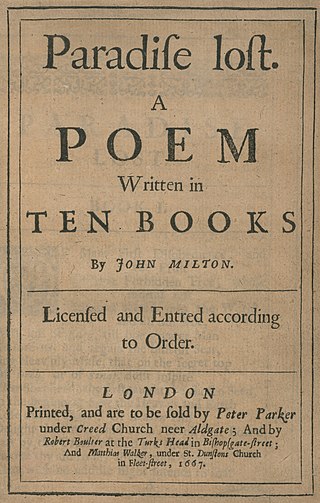
William Bradley noted the presence of strong parallels between Crysaor and Milton's Paradise Lost . [9] The relationship of Milton's God the Father to God the Son is mirrored in the relationship of Landor's Jove to Neptune, with Chrysaor occupying a rebellious role analogous to that of Satan in Milton's epic. The tritons and sea nymphs in Landor's poem would be analogous to the angels in Paradise Lost, helping to defeat the defiant rebel. Bradley also notes the similarity of elements of Crysaor to elements in the story of Ajax's defiance and destruction by Neptune as related in the Odyssey , Book IV, lines 500-511. [10]

Selected criticism

Related Research Articles

<i>Paradise Lost</i> Epic poem by John Milton

Paradise Lost is an epic poem in blank verse by the 17th-century English poet John Milton (1608–1674). The first version, published in 1667, consists of ten books with over ten thousand lines of verse. A second edition followed in 1674, arranged into twelve books with minor revisions throughout. It is considered to be Milton's masterpiece, and it helped solidify his reputation as one of the greatest English poets of all time. The poem concerns the biblical story of the fall of man; the temptation of Adam and Eve by the fallen angel Satan and their expulsion from the Garden of Eden.

In Greek mythology, Leucothea, sometimes also called Leucothoe, was one of the aspects under which an ancient sea goddess was recognized, in this case as a transformed nymph.
<span class="mw-page-title-main">Hesperides</span> Nymphs in Greek mythology

In Greek mythology, the Hesperides are the nymphs of evening and golden light of sunsets, who were the "Daughters of the Evening" or "Nymphs of the West". They were also called the Atlantides from their reputed father, the Titan Atlas.

<span class="mw-page-title-main">Oceanids</span> Nymph daughters of Oceanus

In Greek mythology, the Oceanids or Oceanides are the nymphs who were the three thousand daughters of the Titans Oceanus and Tethys.

<span class="mw-page-title-main">Robert Bridges</span> British poet (1844-1930)

Robert Seymour Bridges was an English poet who was Poet Laureate from 1913 to 1930. A doctor by training, he achieved literary fame only late in life. His poems reflect a deep Christian faith, and he is the author of many well-known hymns. It was through Bridges's efforts that Gerard Manley Hopkins achieved posthumous fame.

Hyperion, a Fragment is an abandoned epic poem by 19th-century English Romantic poet John Keats. It was published in Lamia, Isabella, The Eve of St. Agnes, and Other Poems (1820). It is based on the Titanomachia, and tells of the despair of the Titans after their fall to the Olympians. Keats wrote the poem from late 1818 until the spring of 1819, when he gave it up as having "too many Miltonic inversions". He was also nursing his younger brother Tom, who died on 1 December 1818 of tuberculosis.

<span class="mw-page-title-main">Blank verse</span> Poetry written in regular metre but without rhyme

Blank verse is poetry written with regular metrical but unrhymed lines, almost always in iambic pentameter. It has been described as "probably the most common and influential form that English poetry has taken since the 16th century", and Paul Fussell has estimated that "about three quarters of all English poetry is in blank verse".
<span class="mw-page-title-main">Os Lusíadas</span> Portuguese epic poem by Luís de Camões

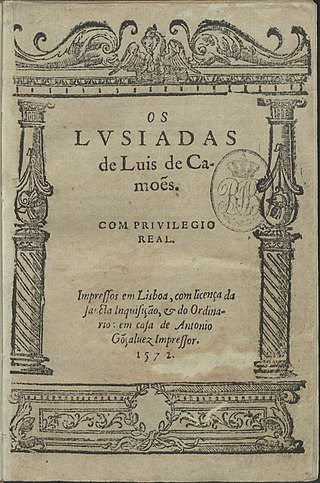
Os Lusíadas, usually translated as The Lusiads, is a Portuguese epic poem written by Luís Vaz de Camões and first published in 1572. It is widely regarded as the most important work of Portuguese-language literature and is frequently compared to Virgil's Aeneid. The work celebrates the discovery of a sea route to India by the Portuguese explorer Vasco da Gama (1469–1524). The ten cantos of the poem are in ottava rima and total 1,102 stanzas.

<span class="mw-page-title-main">Walter Savage Landor</span> English writer, poet, and activist

Walter Savage Landor was an English writer, poet, and activist. His best known works were the prose Imaginary Conversations, and the poem "Rose Aylmer," but the critical acclaim he received from contemporary poets and reviewers was not matched by public popularity. As remarkable as his work was, it was equalled by his rumbustious character and lively temperament. Both his writing and political activism, such as his support for Lajos Kossuth and Giuseppe Garibaldi, were imbued with his passion for liberal and republican causes. He befriended and influenced the next generation of literary reformers such as Charles Dickens and Robert Browning.

Sir George Rostrevor Hamilton FRSL was an English poet and critic. He worked as a civil servant and Special Commissioner. He was knighted in the 1951 King's Birthday Honours List.
<span class="mw-page-title-main">Lycidas</span> Elegiac poem written by John Milton

"Lycidas" is a poem by John Milton, written in 1637 as a pastoral elegy. It first appeared in a 1638 collection of elegies, Justa Edouardo King Naufrago, dedicated to the memory of Edward King, a friend of Milton at Cambridge who drowned when his ship sank in the Irish Sea off the coast of Wales in August 1637. The poem is 193 lines in length and is irregularly rhymed. Many of the other poems in the compilation are in Greek and Latin, but "Lycidas" is one of the poems written in English. Milton republished the poem in 1645.

<span class="mw-page-title-main">John Philips</span>

John Philips was an 18th-century English poet.

Nationality words link to articles with information on the nation's poetry or literature.

Nationality words link to articles with information on the nation's poetry or literature.

The reception history of John Milton and his works has been a mixture of positive and negative responses, with his greatest influence being found within his poetry.

Graal-Arelsky or Stepan Stephanovich Petrov, was a poet of Ego-Futurism in Russia. He co-founded the Academy of Ego-Poetry with fellow Ego-Futurist Konstantin Olimpov. Arelsky is also an identified astronomer.

Nicneven,Nicnevin or Nicnevan is a witch or fairy queen from Scottish folklore. She is often said to be the same figure as the Gyre-Carling or Hecate, but some scholars disagree with this. It is debated whether the name originally referred to a real woman or a mythical goddess.

Pegasides were nymphs of Greek mythology connected with wells and springs, specifically those that the mythical horse Pegasus created by striking the ground with his hooves.

<i>Gebir</i> (poem) 1798 poem by Walter Savage Landor

Gebir is a long poem by the English writer Walter Savage Landor. The poem was first published anonymously in English in July 1798, before being revised and republished in 1803, in dual, separate Latin and English editions.

The Phocæans is an epic poem in blank verse by Walter Savage Landor, likely composed around 1795, first published in 1802. The subject matter of the poem was suggested by Landor's readings of several passages in the writings of the Latin historians Justin, relating how the Phocaeans were displaced from Ionia in western Anatolia by the invasion of Harpagus and his men, serving under Cyrus the Great. In the poem, the Phocaeans seek aid from the king of Tartessus. A minstrel named Hymneus relates the history of the Tartessians as a moral example, before Protis, the leader of the Phocæans, relates at length their defiance of the Persian king. Incomplete and fragmentary, the poem was to be completed with the settlement of the Phocæans in Gaul, and their foundation of the city of Massalia or Marseilles, with the presence of Celtic influences.

References

  1. Super, R.H. (1954). Walter Savage Landor: A Biography. New York: New York University Press. p. 49.
  2. Super, R.H. (1954). Walter Savage Landor: A Biography. New York: New York University Press. p. 49.
  3. Bush, Douglas (1937). Mythology And The Romantic Tradition In English Poetry. Cambridge: Harvard University Press. pp. 238–239.
  4. Colvin, Sidney (1902). Landor. New York City: Harper & Brothers Publishers. p. 37.
  5. Pinsky, Robert (1968). Landor’s Poetry. Chicago: University of Chicago Press. p. 72.
  6. Roberts, Adam (2014). Landor’s Cleanness. Oxford: Oxford University Press. p. 71.
  7. Knight, Franklin W. (1994). "Slavery and lagging capitalism in the Spanish and Portuguese American empires, 1492–1713". In Solow, Barbara L. (ed.). Slavery and the Rise of the Atlantic System. Cambridge: Cambridge University Press. p. 69.
  8. O'Flanagan, Patrick (2008). "Cádiz and La Bahía de Cádiz". Port Cities of Atlantic Iberia 1500-1900. London: Routledge. pp. 81–116.
  9. Bradley, William (1913). The Early Poems of Walter Savage Landor. London: Bradbury, Agnew, & Co, Ltd. p. 98.
  10. Bradley, William (1913). The Early Poems of Walter Savage Landor. London: Bradbury, Agnew, & Co, Ltd. p. 97.