Related Research Articles

The Very Large Telescope (VLT) is an astronomical facility operated since 1998 by the European Southern Observatory, located on Cerro Paranal in the Atacama Desert of northern Chile. It consists of four individual telescopes, each equipped with a primary mirror that measures 8.2 meters in diameter. These optical telescopes, named Antu, Kueyen, Melipal, and Yepun, are generally used separately but can be combined to achieve a very high angular resolution. The VLT array is also complemented by four movable Auxiliary Telescopes (ATs) with 1.8-meter apertures.

Pictor is a constellation in the Southern Celestial Hemisphere, located between the star Canopus and the Large Magellanic Cloud. Its name is Latin for painter, and is an abbreviation of the older name Equuleus Pictoris. Normally represented as an easel, Pictor was named by Abbé Nicolas-Louis de Lacaille in the 18th century. The constellation's brightest star is Alpha Pictoris, a white main-sequence star around 97 light-years away from Earth. Pictor also hosts RR Pictoris, a cataclysmic variable star system that flared up as a nova, reaching apparent (visual) magnitude 1.2 in 1925 before fading into obscurity.

The Galactic Center is the barycenter of the Milky Way and a corresponding point on the rotational axis of the galaxy. Its central massive object is a supermassive black hole of about 4 million solar masses, which is called Sagittarius A*, a compact radio source which is almost exactly at the galactic rotational center. The Galactic Center is approximately 8 kiloparsecs (26,000 ly) away from Earth in the direction of the constellations Sagittarius, Ophiuchus, and Scorpius, where the Milky Way appears brightest, visually close to the Butterfly Cluster (M6) or the star Shaula, south to the Pipe Nebula.
The Max Planck Institute for Extraterrestrial Physics is part of the Max Planck Society, located in Garching, near Munich, Germany. In 1991 the Max Planck Institute for Physics and Astrophysics split up into the Max Planck Institute for Extraterrestrial Physics, the Max Planck Institute for Physics and the Max Planck Institute for Astrophysics. The Max Planck Institute for Extraterrestrial Physics was founded as sub-institute in 1963. The scientific activities of the institute are mostly devoted to astrophysics with telescopes orbiting in space. A large amount of the resources are spent for studying black holes in the Milky Way Galaxy and in the remote universe.

Andrea Mia Ghez is an American astrophysicist, Nobel laureate, and professor in the Department of Physics and Astronomy and the Lauren B. Leichtman & Arthur E. Levine chair in Astrophysics, at the University of California, Los Angeles. Her research focuses on the center of the Milky Way galaxy.

Sagittarius A*, abbreviated Sgr A*, is the supermassive black hole at the Galactic Center of the Milky Way. Viewed from Earth, it is located near the border of the constellations Sagittarius and Scorpius, about 5.6° south of the ecliptic, visually close to the Butterfly Cluster (M6) and Lambda Scorpii.

The High Accuracy Radial Velocity Planet Searcher (HARPS) is a high-precision echelle planet-finding spectrograph installed in 2002 on the ESO's 3.6m telescope at La Silla Observatory in Chile. The first light was achieved in February 2003. HARPS has discovered over 130 exoplanets to date, with the first one in 2004, making it the most successful planet finder behind the Kepler space observatory. It is a second-generation radial-velocity spectrograph, based on experience with the ELODIE and CORALIE instruments.
The Cherenkov Array at Themis (CAT) was an imaging atmospheric Cherenkov telescope (IACT) for detection of very-high-energy gamma rays. The project started operation in Autumn 1996 on the site of the former solar plant Thémis, France.

The Scorpius–Centaurus association is the nearest OB association to the Sun. This stellar association is composed of three subgroups and its distance is about 130 parsecs or 420 light-years. Using improved Hipparcos data, Rizzuto and colleagues analysed nearby stars more closely, bringing the number of known members to 436. They doubt the need to add a subclassification because they found a more continuous spread of stars.
HD 43691 b is a massive jovian planet located approximately 280 light-years away in the constellation of Auriga. Because the inclination is unknown, only the minimum mass is known. The planet orbits close to the star, closer than Mercury to the Sun.
Daniel Apai is a professor and astrophysicist at The University of Arizona in Tucson, Arizona. He is known for his studies of astrobiology, extrasolar planets, and the formation of planetary systems. He is the principal investigator of the Earths in Other Solar Systems team of NASA's Nexus for Exoplanet System Studies and the Hubble Space Telescope Cloud Atlas Treasury program, and Project EDEN, a large survey for habitable planets in the immediate solar neighborhood. He is leading the Nautilus Space Observatory space telescope concept and co-leading the technology development underpinning it.

Beta Pictoris b (abbreviated as β Pic b) is an exoplanet orbiting the young debris disk A-type main sequence star Beta Pictoris located approximately 63 light-years (19.4 parsecs, or 6×10¹⁴ km) away from Earth in the constellation of Pictor. It has a mass around 13 Jupiter masses and a radius around 46% larger than Jupiter's. It orbits at 9 AU from Beta Pictoris, which is about 3.5 times farther than the orbit of Beta Pictoris c. It orbits close to the plane of the debris disk orbiting the star, with a low eccentricity and a period of 20–21 years.
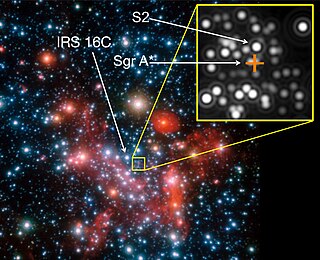
S2, also known as S0–2, is a star in the star cluster close to the supermassive black hole Sagittarius A* (Sgr A*), orbiting it with a period of 16.0518 years, a semi-major axis of about 970 au, and a pericenter distance of 17 light hours – an orbit with a period only about 30% longer than that of Jupiter around the Sun, but coming no closer than about four times the distance of Neptune from the Sun. The mass when the star first formed is estimated by the European Southern Observatory (ESO) to have been approximately 14 M☉. Based on its spectral type, it probably has a mass of 10 to 15 solar masses.

ZIMPOL/CHEOPS is a polarimetric imager being developed for the Very Large Telescope for the direct detection of extra-solar planets. The imager is operated by the European Southern Observatory on Cerro Paranal in the Atacama Desert of northern Chile.

Kepler-10b is the first confirmed terrestrial planet to have been discovered outside the Solar System by the Kepler Space Telescope. Discovered after several months of data collection during the course of the NASA-directed Kepler Mission, which aims to discover Earth-like planets crossing in front of their host stars, the planet's discovery was announced on January 10, 2011. Kepler-10b has a mass of 3.72±0.42 Earth masses and a radius of 1.47 Earth radii. However, it lies extremely close to its star, Kepler-10, and as a result is too hot to support life as we know it. Its existence was confirmed using measurements from the W.M. Keck Observatory in Hawaii.
Jean-Loup Puget is a French astrophysicist. His current research interests lie in the Cosmic Microwave Background. Jean-Loup Puget and his collaborators reported the first identification of the Cosmic infrared background using COBE data. He is also, along with Alain Léger, credited with the origin of the hypothesis that the series of infrared lines observed in numerous astrophysical objects are caused by emission from polycyclic aromatic hydrocarbons. He is currently principal investigator of the HFI module of the Planck space mission.

Spectro-Polarimetric High-contrast Exoplanet REsearch (VLT-SPHERE) is an adaptive optics system and coronagraphic facility at the Very Large Telescope (VLT). It provides direct imaging as well as spectroscopic and polarimetric characterization of exoplanet systems. The instrument operates in the visible and near infrared, achieving exquisite image quality and contrast over a small field of view around bright targets.
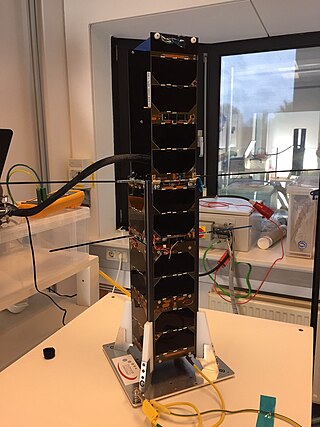
PicSat is a French observatory nanosatellite, designed to measure the transit of Beta Pictoris b, an exoplanet which orbits the star Beta Pictoris.
Anne-Marie Lagrange, born March 12, 1962 in the Rhône-Alpes region of France, is a French astrophysicist. Lagrange's work focuses on the research and study of extrasolar planetary systems. Lagrange is the holder of numerous scientific awards and honorary decorations, including Knight of the Legion of Honour and is a member of the French Academy of Sciences since 2013.
References
- 1 2 "Académie des sciences".
- ↑ "LESIA".
- ↑ "Page DR".
- ↑ Delfosse, Xavier; et al., "Field brown dwarfs found by DENIS", A&A , 1997, 327, p. L25
- ↑ Rouan, Daniel; Riaud, Pierre; Boccaletti, Anthony; Clénet, Yann; Labeyrie, Antoine; "The Four-Quadrant Phase-Mask Coronagraph. I. Principle", PASP , 2000, 112, p. 1479, doi: 10.1086/317707
- ↑ Léger, Alain; Mariotti, Jean-Marie; Mennesson, Bertrand; Ollivier, Marc; Puget, Jean-Loup; Rouan, Daniel; Schneider, Jean; "Could We Search for Primitive Life on Extrasolar Planets in the Near Future?", Icarus , 1996, 123, p. 249
- ↑ Léger, Alain; Rouan, Daniel; Schneider, Jodi; Barge, Pierre; Fridlund, Malcolm; et al., "Transiting exoplanets from the CoRoT space mission - VIII. CoRoT-7b: the first Super-Earth with measured radius", A&A, 2009, 506, p. 287
- ↑ Lagrange, Anne-Marie; Gratadour, Damien; Chauvin, Gaël; Fusco, Thierry; Ehrenreich, David; Mouillet, David; Rousset, Gérard; Rouan, Daniel; et al., "A probable giant planet imaged in the beta Pictoris disk. VLT/NaCo deep L'-band imaging", A&A, 2009, 493, p. L21
- ↑ Rouan, Daniel; Léna, Pierre; Puget, Jean-Loup; de Boer, Klaas S.; Wijnbergen, Jan J.; "Far infrared observations of the galactic plane and molecular cloud S140", Ap. J. , 1977, 213, p. L35-39
- ↑ Rouan, Daniel; "Statistical distribution of the interstellar dust temperature", A&A,, 1980, 87, p. 169
- ↑ Rouan, Daniel; Field, D.; Lemaire, J.-L.; Lai, O.; Pineau Des Forêts, G.; Falgarone, E.; Deltorn, J.-M.; "The power of adaptive optics: a close look at a molecular cloud in NGC 2023", MNRAS , 1997, 284, p. 395
- ↑ Rouan, Daniel; Léger, Alain; Le Coupanec, Patricia; "Carrier of the λ 5797 DIB in the ISM and in the Red Rectangle: a suprathermally rotating PAH molecule?", A&A, 1997, 324, p. 661
- ↑ Rouan, Daniel; Léger, Alain; Omont, Alain; Giard, Martin; "Physics of the rotation of a PAH molecule in interstellar environments", A&A, 1992, 253, p. 498
- ↑ Dougados, Catherine; Rouan, Daniel; Léna, Pierre; "Measure of the grain velocity structure in the circumstellar envelope 'Frosty Leo'", A&A, 1992, 253, p. 46
- ↑ Rouan, Daniel; Lacombe, François; Gendron, Éric; Gratadour, Damien; Clénet, Yann; Lagrange, Anne-Marie; Mouillet, David; Boisson, Catherine; et al., "Hot Very Small dust Grains in NGC 1068 seen in jet induced structures thanks to VLT/NACO adaptive optics", A&A, 2004, 417, p. L1
- ↑ Schödel, Rainer; Ott, Thomas; Genzel, Reinhard; et al., "A star in a 15.2 year orbit around the supermassive black hole at the center of the Milky Way", Nature , 2002, 419, p. 694
- ↑ Genzel, Reinhard; Schödel, Rainer; Ott, Thomas; Eckart, Andreas; Alexander, Tal; Lacombe, François; Rouan, Daniel; "Near-IR Flares from Accreting Gas near the Last Stable Orbit around the Supermassive Black Hole in the Galactic Centre", Nature, 2003, 425, p. 934
- ↑ "Optique diophantienne".
- ↑ Rouan, Daniel; Pelat, Didier; "The achromatic chessboard, a new concept of a phase shifter for nulling interferometry. I. Theory", A&A, 2008, 484, p. 581
- ↑ "Google Scholar".
- ↑ "La Main à la pâte".
- ↑ Décret du 13 juillet 2019 portant promotion et nomination
