Related Research Articles
The Anare Mountains are a large group of mainly snow-covered peaks and ridges along the northern coast of Victoria Land, Antarctica. The group is bounded on the north and east by the Pacific Ocean, on the west by Lillie Glacier, and on the south by Ebbe Glacier and Dennistoun Glacier. They are north of the Concord Mountains and east of the Bowers Mountains.
The Merrick Mountains are a cluster of mountains, 8 nautical miles long, standing 7 nautical miles northeast of the Behrendt Mountains in Ellsworth Land, Antarctica.
The Flood Range is a range of large snow-covered mountains extending in an east–west direction for about 60 nautical miles and forming a right angle with the southern end of the Ames Range in Marie Byrd Land, Antarctica.
Fletcher Island is a rocky island, 0.5 km (0.25 nmi) in diameter, which is the largest of the Fletcher Islands. Fletcher Island is located at 66°53′S143°05′E. Fletcher Island lies in the eastern part of Commonwealth Bay, 11 km (6 nmi) west-southwest (WSW) of Cape Gray. Fletcher Island was discovered by the Australian Antarctic Expedition (AAE) (1911–1914) under Douglas Mawson, who named it for Frank D. Fletcher, First Officer on the expedition ship Aurora.
Northeast Glacier is a steep, heavily crevassed glacier, 13 nautical miles long and 5 nautical miles wide at its mouth, which flows from McLeod Hill westward and then south-westwards into Marguerite Bay between the Debenham Islands and Roman Four Promontory, on the west coast of Graham Land, Antarctica.
Rymill Bay is a bay, 9 nautical miles wide at its mouth and indenting 5 nautical miles between Red Rock Ridge and Bertrand Ice Piedmont along the west coast of Graham Land, Antarctica.
Borchgrevink Glacier is a large glacier in the Victory Mountains, Victoria Land, Antarctica. It drains south between Malta Plateau and Daniell Peninsula, and thence projects into Glacier Strait, Ross Sea, as a floating glacier tongue.

Lambert Glacier is a major glacier in East Antarctica. At about 80 km (50 mi) wide, over 400 km (250 mi) long, and about 2,500 m (8,200 ft) deep, it is the world's largest glacier. It drains 8% of the Antarctic ice sheet to the east and south of the Prince Charles Mountains and flows northward to the Amery Ice Shelf. It flows in part of Lambert Graben and exits the continent at Prydz Bay.

The Prince Charles Mountains are a major group of mountains in Mac. Robertson Land in Antarctica, including the Athos Range, the Porthos Range, and the Aramis Range. The highest peak is Mount Menzies, with a height of 3,228 m (10,591 ft). Other prominent peaks are Mount Izabelle and Mount Stinear. These mountains, together with other scattered peaks, form an arc about 420 km (260 mi) long, extending from the vicinity of Mount Starlight in the north to Goodspeed Nunataks in the south.
Scott Glacier is a glacier, 7 miles (11.3 km) wide and over 20 miles (32 km) long, flowing north-northwest to the Antarctic coast between Denman Glacier and Mill Island. It was discovered by the Western Base Party of the Australasian Antarctic Expedition (1911–1914) under Mawson and named for Capt. Robert F. Scott.
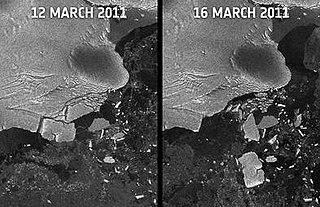
Sulzberger Bay is a bay indenting the front of the Sulzberger Ice Shelf between Fisher Island and Vollmer Island, along the coast of Marie Byrd Land, Antarctica.
Kirkby Glacier is a glacier, 20 nautical miles in length, that drains the central Anare Mountains of Antarctica and flows northwest to the sea just north of Arthurson Bluff, northern Victoria Land.
Barnett Glacier is a large glacier in the Anare Mountains that flows east along the south side of Tapsell Foreland into Smith Inlet, northern Victoria Land, Antarctica.
The Nash Range is a mainly ice-covered coastal range in the Churchill Mountains of Antarctica.
Cranton Bay is a bay about 20 nautical miles long and wide, lying south of the Canisteo Peninsula, Antarctica, at the eastern end of the Amundsen Sea. The southern limit of the bay is formed by the Backer Islands and an ice shelf which separates this bay from Pine Island Bay.
Davis Ice Piedmont is an ice piedmont about 10 nautical miles long and 4 nautical miles wide, located along the north side of Missen Ridge on the north coast of Victoria Land, Antarctica.
Fry Glacier is a glacier draining the slopes at the northeast corner of the Convoy Range and flowing along the south end of the Kirkwood Range into Tripp Bay, Victoria Land, Antarctica. It was first charted by the British Antarctic Expedition, 1907–09, and named for A.M. Fry, a contributor to the expedition.
The Freyberg Mountains are a group of mountains in Victoria Land, Antarctica, bounded by the Rennick Glacier, Bowers Mountains, Black Glacier, and Evans Névé. They are west of the Victory Mountains and south of the Bowers Mountains.
The Mawson Glacier is a large glacier on the east coast of Victoria Land, Antarctica, descending eastward from the Antarctic Plateau to the north of Trinity Nunatak and the Kirkwood Range, to enter the Ross Sea, where it forms the Nordenskjöld Ice Tongue. The glacier was first mapped by the British Antarctic Expedition (1907–09) and named for Douglas Mawson, the expedition physicist, who later led two other Antarctic expeditions, 1911–14, and 1929–31.
Rambo Nunataks is a loose chain of nunataks which lie northwest of Patuxent Range and extend along the west side of the Foundation Ice Stream for 17 nautical miles in the Pensacola Mountains, Antarctica.
References
- ↑ Alberts 1995, p. 175.

