Related Research Articles

Thurston Island is a largely ice-covered, glacially dissected island, 135 nautical miles long and 55 nautical miles wide, lying between between Amundsen Sea and Bellingshausen Sea a short way off the northwest end of Ellsworth Land, Antarctica. The island is separated from the mainland by Peacock Sound, which is occupied by the west portion of Abbot Ice Shelf.
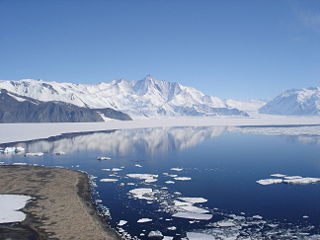
The Admiralty Mountains is a large group of high mountains and individually named ranges and ridges in northeastern Victoria Land, Antarctica. This mountain group is bounded by the sea, and by the Dennistoun Glacier, Ebbe Glacier, and Tucker Glacier.
The Deep Freeze Range is a rugged mountain range, over 80 nautical miles long and about 10 nautical miles wide, rising between Priestley and Campbell Glaciers in Victoria Land, Antarctica, and extending from the edge of the polar plateau to Terra Nova Bay. It is southwest of the Southern Cross Mountains, south of the Mesa Range and northeast of the Eisenhower Range of the Prince Albert Mountains.
Martin Peninsula is a peninsula about 60 nautical miles long and 20 nautical miles wide that is ice-covered except for a few rock outcrops along its margins, located between Getz Ice Shelf and Dotson Ice Shelf on the coast of Marie Byrd Land, Antarctica. The farthest point of the peninsula is Jacobsen Head.
Borchgrevink Glacier is a large glacier in the Victory Mountains, Victoria Land, Antarctica. It drains south between Malta Plateau and Daniell Peninsula, and thence projects into Glacier Strait, Ross Sea, as a floating glacier tongue.

The Prince Charles Mountains are a major group of mountains in Mac. Robertson Land in Antarctica, including the Athos Range, the Porthos Range, and the Aramis Range. The highest peak is Mount Menzies, with a height of 3,228 m (10,591 ft). Other prominent peaks are Mount Izabelle and Mount Stinear. These mountains, together with other scattered peaks, form an arc about 420 km (260 mi) long, extending from the vicinity of Mount Starlight in the north to Goodspeed Nunataks in the south.
Scott Glacier is a glacier, 7 miles (11.3 km) wide and over 20 miles (32 km) long, flowing north-northwest to the Antarctic coast between Denman Glacier and Mill Island. It was discovered by the Western Base Party of the Australasian Antarctic Expedition (1911–1914) under Mawson and named for Capt. Robert F. Scott.

Queen Mary Land or the Queen Mary Coast is the portion of the coast of Antarctica lying between Cape Filchner, in 91° 54' E, and Cape Hordern, at 100° 30' E. It is claimed by Australia as part of the Australian Antarctic Territory.
Cape Folger is an ice-covered cape forming the east side of the entrance to Vincennes Bay on the Budd Coast of Antarctica. The position of Cape Folger correlates closely with the west end of Charles Wilkes' "Budd's High Land", as charted as a coastal landfall by the United States Exploring Expedition in 1840. The cape was mapped from aerial photographs taken by U.S. Navy Operation Highjump, 1946–47, and was named by the Advisory Committee on Antarctic Names for Commander Edward C. Folger, Jr., U.S. Navy, commander of the icebreaker Edisto which assisted Operation Windmill parties in establishing astronomical control stations in the Windmill Islands, close southwest in Vincennes Bay.
King Peninsula is an ice-covered peninsula, 100 nautical miles long and 20 nautical miles wide, lying south of Thurston Island and forming the south side of Peacock Sound, Antarctica. It projects from the continental ice sheet and trends west between the Abbot Ice Shelf and Cosgrove Ice Shelf to terminate at the Amundsen Sea.

The David Glacier is a glacier over 60 nautical miles long, flowing east from the polar plateau through the Prince Albert Mountains to the coast of Victoria Land, Antarctica. It enters Ross Sea between Cape Philippi and Cape Reynolds to form the floating Drygalski Ice Tongue. It is the most imposing outlet glacier in Victoria Land. It is fed by two main flows which drain an area larger than 200,000 square kilometres, with an estimated ice discharge rate of 7.8 +/- 0.7 km3/year. The David Glacier was discovered by Ernest Shackleton's "Northern Party," in November 1908, under the leadership of Prof. T.W. Edgeworth David, of Sydney University, for whom the feature was named.
Conradi Peak is an isolated peak, 1,040 metres (3,410 ft) high, rising northward of the Napier Mountains and inland from the coast, some 19 nautical miles (35 km) southwest of Cape Borley. It was discovered in January 1930 by the British Australian New Zealand Antarctic Research Expedition (BANZARE) under Mawson, who named it after a prominent member of the South African government who, in 1929, rendered much help to BANZARE during the stay of the Discovery at Cape Town.
Cape Dovers is a cape fronting on the Shackleton Ice Shelf, 5 nautical miles (9 km) south of Henderson Island. It was discovered by the Western Base party of the Australasian Antarctic Expedition, 1911–1914, under Mawson, and named for G. Dovers, cartographer with the expedition.
Moubray Bay is a bay in the western Ross Sea, indenting the coast of Victoria Land, Antarctica, between Cape Roget and Cape Hallett. It was discovered in 1841 by Sir James Clark Ross and named by him for George H. Moubray, clerk in charge of the expedition ship Terror.
Cape Mikhaylov is an ice-covered point about 42 nautical miles (78 km) east of Totten Glacier, Wilkes Land, Antarctica. It was photographed by U.S. Navy Operation Highjump in 1947, and plotted on base compilation maps by Gardner Blodgett of the Office of Geography, U.S. Department of the Interior, in 1955. The cape was photographed by the Soviet Antarctic Expedition in 1956, and was named after Pavel N. Mikhaylov, artist with the Bellingshausen expedition of 1819–21.
The Saxby Range is a broad mountain range, rising to 2,450 metres (8,040 ft), in the Victory Mountains of Victoria Land, Antarctica. It is bounded by Jutland Glacier, Tucker Glacier, Pearl Harbor Glacier, and Midway Glacier.

Holmes Glacier is a broad glacier debouching into the western part of Porpoise Bay about 10 nautical miles (20 km) south of Cape Spieden. It was delineated from aerial photographs taken by U.S. Navy Operation Highjump (1946–47), and was named by the Advisory Committee on Antarctic Names after Dr. Silas Holmes, Assistant Surgeon on the brig Porpoise during the United States Exploring Expedition (1838–42) under Lieutenant Charles Wilkes.
Cape Keltie is an ice-covered cape on the Clarie Coast of Antarctica, 11 nautical miles (20 km) west of Cape Cesney. It was discovered from the Aurora by the Australasian Antarctic Expedition (1911–14) under Douglas Mawson, and roughly charted at a distance of about 10 nautical miles (19 km) as lying in 66°5′S 133°0′E. It was named by Mawson for Sir John Scott Keltie, Secretary of the Royal Geographical Society, 1892–1915. The identification of this feature is based upon the G.D. Blodgett map of 1955, compiled from aerial photos taken by U.S. Navy Operation Highjump (1946–47).
Davis Bay66°08′S134°05′E is a bay about 12 nautical miles wide at the entrance between Cape Cesney and Lewis Island in Antarctica. It was discovered from the Aurora by the AAE (1910–1914) under Douglas Mawson. Named by Mawson for Capt. John King Davis, master of the Aurora and second-in-command of the expedition.
References
 This article incorporates public domain material from "Cesney, Cape". Geographic Names Information System . United States Geological Survey.

 | This Wilkes Land location article is a stub. You can help Wikipedia by expanding it. |