
A spermatozoon is a motile sperm cell, or moving form of the haploid cell that is the male gamete. A spermatozoon joins an ovum to form a zygote.
Fertilisation or fertilization, also known as generative fertilisation, syngamy and impregnation, is the fusion of gametes to give rise to a new individual organism or offspring and initiate its development. Processes such as insemination or pollination which happen before the fusion of gametes are also sometimes informally called fertilisation. The cycle of fertilisation and development of new individuals is called sexual reproduction. During double fertilisation in angiosperms the haploid male gamete combines with two haploid polar nuclei to form a triploid primary endosperm nucleus by the process of vegetative fertilisation.

During fertilization, a sperm must first fuse with the plasma membrane and then penetrate the female egg cell to fertilize it. Fusing to the egg cell usually causes little problem, whereas penetrating through the egg's hard shell or extracellular matrix can be more difficult. Therefore, sperm cells go through a process known as the acrosome reaction, which is the reaction that occurs in the acrosome of the sperm as it approaches the egg. The acrosome is a cap-like structure over the anterior half of the sperm's head.

The zona pellucida is a glycoprotein layer surrounding the plasma membrane of mammalian oocytes. It is a vital constitutive part of the oocyte. The zona pellucida first appears in unilaminar primary oocytes. It is secreted by both the oocyte and the ovarian follicles. The zona pellucida is surrounded by the corona radiata. The corona is composed of cells that care for the egg when it is emitted from the ovary.
Capacitation is the penultimate step in the maturation of mammalian spermatozoa and is required to render them competent to fertilize an oocyte. This step is a biochemical event; the sperm move normally and look mature prior to capacitation. In vivo, capacitation occurs after ejaculation, when the spermatozoa leave the vagina and enter the superior female reproductive tract. The uterus aids in the steps of capacitation by secreting sterol-binding albumin, lipoproteins, and proteolytic and glycosidasic enzymes such as heparin.

Acrosin is a digestive enzyme that acts as a protease. In humans, acrosin is encoded by the ACR gene. Acrosin is released from the acrosome of spermatozoa as a consequence of the acrosome reaction. It aids in the penetration of the Zona Pellucida.

Spermiogenesis is the final stage of spermatogenesis, which sees the maturation of spermatids into mature spermatozoa. The spermatid is a more or less circular cell containing a nucleus, Golgi apparatus, centriole and mitochondria. All these components take part in forming the spermatozoon.
Human fertilization is the union of a human egg and sperm, occurring in the ampulla of the fallopian tube. The result of this union leads to the production of a zygote cell, or fertilized egg, initiating prenatal development. Scientists discovered the dynamics of human fertilization in the nineteenth century.

Glycodelin(GD) also known as human placental protein-14 (PP-14)progestogen-associated endometrial protein (PAEP) or pregnancy-associated endometrial alpha-2 globulin is a glycoprotein that inhibits cell immune function and plays an essential role in the pregnancy process. In humans is encoded by the PAEP gene.

A-kinase anchor protein 3 is an enzyme that in humans is encoded by the AKAP3 gene.

Zona pellucida sperm-binding protein 4, ZP-4 or avilesine, named after its discoverer Manuel Avilés Sánchez is a protein that in humans is encoded by the ZP4 gene.

Sperm-associated antigen 1 is a protein that in humans is encoded by the SPAG1 gene.

Sperm acrosome membrane-associated protein 3 is a protein that in humans is encoded by the SPACA3 gene. It may be involved in adhesion to the egg before the egg is fertilized.

VEZT is a gene located on chromosome 12 and encodes for the protein vezatin. Vezatin is a major component of the cadherin-catenin complex that is critical to the formation and maintenance of adherens junctions. The protein is expressed in most epithelial cells and is crucial to the formation of cell-cell contact junctions. Mutations of the gene can lead to upregulation or downregulation of the protein which can have detrimental effects on physiological systems, particularly those involved in development.
Sperm sorting is a means of choosing what type of sperm cell is to fertilize the egg cell. Several conventional techniques of centrifugation or swim-up. Newly applied methods such as flow cytometry expand the possibilities of sperm sorting and new techniques of sperm sorting are being developed.

Cysteine-rich secretory proteins, often abbreviated as CRISPs, are a group of glycoproteins. They are a subgroup of the CRISP, antigen 5 and Pr-1 (CAP) protein superfamily and also contain a domain related to the ShK toxins. They are substantially implicated in the functioning of the mammalian reproductive system. CRISPs are also found in a variety of snake venoms where they inhibit both smooth muscle contraction and cyclic nucleotide-gated ion channels.
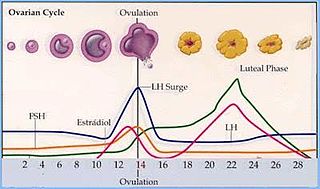
Induced ovulation is when a female animal ovulates due to an externally-derived stimulus during, or just prior to, mating, rather than ovulating cyclically or spontaneously. Stimuli causing induced ovulation include the physical act of coitus or mechanical stimulation simulating this, sperm and pheromones.
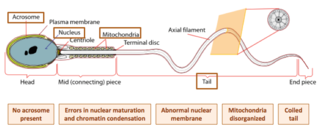
Globozoospermia is a rare and severe form of monomorphic teratozoospermia. This means that the spermatozoa show the same abnormality, and over 85% of spermatozoa in sperm have this abnormality. Globozoospermia is responsible for less than 0.1% of male infertility. It is characterised by round-headed spermatozoa without acrosomes, an abnormal nuclear membrane and midpiece defects. Affected males therefore suffer from either reduced fertility or infertility. Studies suggest that globozoospermia can be either total or partial, however it is unclear whether these two forms are variations on the same syndrome, or actually different syndromes.
Robert John Aitken is a British reproductive biologist, widely known for identifying oxidative stress as a significant contribution to infertility and its actions on human sperm function. He also made substantial contributions to clinical practice translation in male reproductive health, notably the development of new contraceptive vaccine.
Spermatogenesis-associated protein 16 is a mammalian protein encoded by the SPATA16 gene. SPATA16, also known as NYD-SP12, is a developmental protein that aids in differentiation of germ cells for spermatogenesis and participates in acrosome formation for appropriate sperm-egg fusion. SPATA16 is located on chromosome 3 at position 26.31 and is a member of the tetratricopeptide repeat-like superfamily, which facilitate interactions and assemblies between proteins and protein complexes.

