
Look up decoder in Wiktionary, the free dictionary.
Decoder may refer to:
Decoder may refer to:

A codec is a device or computer program which encodes or decodes a data stream or signal. Codec is a portmanteau of coder/decoder.

Digital television (DTV) is the transmission of television signals using digital encoding, in contrast to the earlier analog television technology which used analog signals. At the time of its development it was considered an innovative advancement and represented the first significant evolution in television technology since color television in the 1950s. Modern digital television is transmitted in high-definition television (HDTV) with greater resolution than analog TV. It typically uses a widescreen aspect ratio in contrast to the narrower format of analog TV. It makes more economical use of scarce radio spectrum space; it can transmit up to seven channels in the same bandwidth as a single analog channel, and provides many new features that analog television cannot. A transition from analog to digital broadcasting began around 2000. Different digital television broadcasting standards have been adopted in different parts of the world; below are the more widely used standards:
Delay may refer to:

The μ-law algorithm is a companding algorithm, primarily used in 8-bit PCM digital telecommunication systems in North America and Japan. It is one of two versions of the G.711 standard from ITU-T, the other version being the similar A-law. A-law is used in regions where digital telecommunication signals are carried on E-1 circuits, e.g. Europe.

Digital audio is a representation of sound recorded in, or converted into, digital form. In digital audio, the sound wave of the audio signal is typically encoded as numerical samples in a continuous sequence. For example, in CD audio, samples are taken 44,100 times per second, each with 16-bit sample depth. Digital audio is also the name for the entire technology of sound recording and reproduction using audio signals that have been encoded in digital form. Following significant advances in digital audio technology during the 1970s and 1980s, it gradually replaced analog audio technology in many areas of audio engineering, record production and telecommunications in the 1990s and 2000s
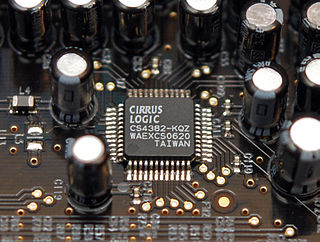
In electronics, a digital-to-analog converter is a system that converts a digital signal into an analog signal. An analog-to-digital converter (ADC) performs the reverse function.
A satellite modem or satmodem is a modem used to establish data transfers using a communications satellite as a relay. A satellite modem's main function is to transform an input bitstream to a radio signal and vice versa.

The LaserDisc (LD) is a home video format and the first commercial optical disc storage medium, initially licensed, sold and marketed as MCA DiscoVision in the United States in 1978. Its diameter typically spans 30 cm (12 in). Unlike most optical disc standards, LaserDisc is not fully digital, and instead requires the use of analog video signals.
A subcarrier is a sideband of a radio frequency carrier wave, which is modulated to send additional information. Examples include the provision of colour in a black and white television system or the provision of stereo in a monophonic radio broadcast. There is no physical difference between a carrier and a subcarrier; the "sub" implies that it has been derived from a carrier, which has been amplitude modulated by a steady signal and has a constant frequency relation to it.
Encoder may refer to:
In digital electronics, a binary decoder is a combinational logic circuit that converts binary information from the n coded inputs to a maximum of 2n unique outputs. They are used in a wide variety of applications, including instruction decoding, data multiplexing and data demultiplexing, seven segment displays, and as address decoders for memory and port-mapped I/O.
Decoding or decode may refer to: is the process of converting code into plain text or any format that is useful for subsequent processes.

A tuner is a subsystem that receives radio frequency (RF) transmissions, such as FM broadcasting, and converts the selected carrier frequency and its associated bandwidth into a fixed frequency that is suitable for further processing, usually because a lower frequency is used on the output. Broadcast FM/AM transmissions usually feed this intermediate frequency (IF) directly into a demodulator that converts the radio signal into audio-frequency signals that can be fed into an amplifier to drive a loudspeaker.
Television encryption, often referred to as scrambling, is encryption used to control access to pay television services, usually cable, satellite, or Internet Protocol television (IPTV) services.
Codec may mean:
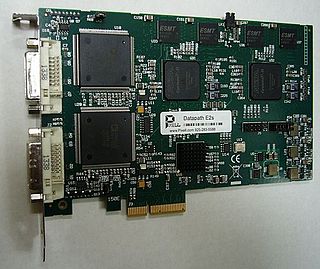
A frame grabber is an electronic device that captures individual, digital still frames from an analog video signal or a digital video stream. It is usually employed as a component of a computer vision system, in which video frames are captured in digital form and then displayed, stored, transmitted, analyzed, or combinations of these.
Video capture is the process of converting an analog video signal—such as that produced by a video camera, DVD player, or television tuner—to digital video and sending it to local storage or to external circuitry. The resulting digital data are referred to as a digital video stream, or more often, simply video stream. Depending on the application, a video stream may be recorded as computer files, or sent to a video display, or both.

A video decoder is an electronic circuit, often contained within a single integrated circuit chip, that converts base-band analog video signals to digital video. Video decoders commonly allow programmable control over video characteristics such as hue, contrast, and saturation. A video decoder performs the inverse function of a video encoder, which converts raw (uncompressed) digital video to analog video. Video decoders are commonly used in video capture devices and frame grabbers.
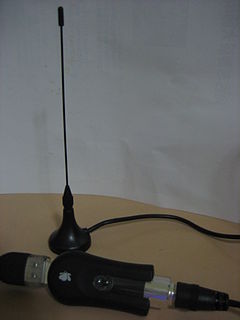
A DTV receiver is a set-top box that permits the reception of digital television. Its components are very similar to a desktop PC. The DTV receiver is a vital link in the chain of television system. The goal of a broadcasting system is to concentrate the hardware requirements at the source to simplify the receivers and makes it as inexpensive as possible.
Pulse-code modulation (PCM) is a method used to digitally represent sampled analog signals. It is the standard form of digital audio in computers, compact discs, digital telephony and other digital audio applications. In a PCM stream, the amplitude of the analog signal is sampled regularly at uniform intervals, and each sample is quantized to the nearest value within a range of digital steps.