In vector calculus and differential geometry the generalized Stokes theorem, also called the Stokes–Cartan theorem, is a statement about the integration of differential forms on manifolds, which both simplifies and generalizes several theorems from vector calculus. In particular, the fundamental theorem of calculus is the special case where the manifold is a line segment, Green’s theorem and Stokes' theorem are the cases of a surface in or and the divergence theorem is the case of a volume in Hence, the theorem is sometimes referred to as the fundamental theorem of multivariate calculus.

In mathematics, mathematical physics and the theory of stochastic processes, a harmonic function is a twice continuously differentiable function where U is an open subset of that satisfies Laplace's equation, that is, everywhere on U. This is usually written as or
In fluid mechanics, the Grashof number is a dimensionless number which approximates the ratio of the buoyancy to viscous forces acting on a fluid. It frequently arises in the study of situations involving natural convection and is analogous to the Reynolds number.
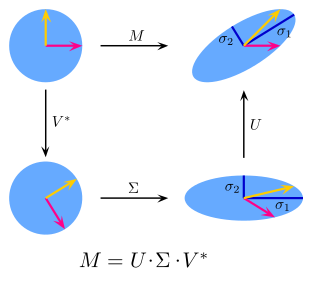
In linear algebra, the singular value decomposition (SVD) is a factorization of a real or complex matrix into a rotation, followed by a rescaling followed by another rotation. It generalizes the eigendecomposition of a square normal matrix with an orthonormal eigenbasis to any matrix. It is related to the polar decomposition.
In mechanics and geometry, the 3D rotation group, often denoted SO(3), is the group of all rotations about the origin of three-dimensional Euclidean space under the operation of composition.
In linear algebra, an invertible matrix is a square matrix which has an inverse. In other words, if some other matrix is multiplied by the invertible matrix, the result can be multiplied by an inverse to undo the operation. An invertible matrix multiplied by its inverse yields the identity matrix. Invertible matrices are the same size as their inverse.

Flight dynamics is the science of air vehicle orientation and control in three dimensions. The three critical flight dynamics parameters are the angles of rotation in three dimensions about the vehicle's center of gravity (cg), known as pitch, roll and yaw. These are collectively known as aircraft attitude, often principally relative to the atmospheric frame in normal flight, but also relative to terrain during takeoff or landing, or when operating at low elevation. The concept of attitude is not specific to fixed-wing aircraft, but also extends to rotary aircraft such as helicopters, and dirigibles, where the flight dynamics involved in establishing and controlling attitude are entirely different.
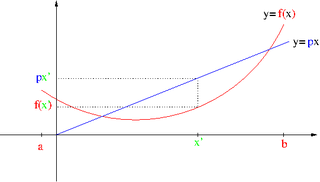
In mathematics, the Legendre transformation, first introduced by Adrien-Marie Legendre in 1787 when studying the minimal surface problem, is an involutive transformation on real-valued functions that are convex on a real variable. Specifically, if a real-valued multivariable function is convex on one of its independent real variables, then the Legendre transform with respect to this variable is applicable to the function.
In mathematics, specifically in calculus and complex analysis, the logarithmic derivative of a function f is defined by the formula where is the derivative of f. Intuitively, this is the infinitesimal relative change in f; that is, the infinitesimal absolute change in f, namely scaled by the current value of f.
In mathematics and signal processing, the Hilbert transform is a specific singular integral that takes a function, u(t) of a real variable and produces another function of a real variable H(u)(t). The Hilbert transform is given by the Cauchy principal value of the convolution with the function (see § Definition). The Hilbert transform has a particularly simple representation in the frequency domain: It imparts a phase shift of ±90° (π/2 radians) to every frequency component of a function, the sign of the shift depending on the sign of the frequency (see § Relationship with the Fourier transform). The Hilbert transform is important in signal processing, where it is a component of the analytic representation of a real-valued signal u(t). The Hilbert transform was first introduced by David Hilbert in this setting, to solve a special case of the Riemann–Hilbert problem for analytic functions.
In mathematics, a Sobolev space is a vector space of functions equipped with a norm that is a combination of Lp-norms of the function together with its derivatives up to a given order. The derivatives are understood in a suitable weak sense to make the space complete, i.e. a Banach space. Intuitively, a Sobolev space is a space of functions possessing sufficiently many derivatives for some application domain, such as partial differential equations, and equipped with a norm that measures both the size and regularity of a function.
In physics, the S-matrix or scattering matrix is a matrix which relates the initial state and the final state of a physical system undergoing a scattering process. It is used in quantum mechanics, scattering theory and quantum field theory (QFT).
In mathematics, the total derivative of a function f at a point is the best linear approximation near this point of the function with respect to its arguments. Unlike partial derivatives, the total derivative approximates the function with respect to all of its arguments, not just a single one. In many situations, this is the same as considering all partial derivatives simultaneously. The term "total derivative" is primarily used when f is a function of several variables, because when f is a function of a single variable, the total derivative is the same as the ordinary derivative of the function.
Service level measures the performance of a system, service or supply. Certain goals are defined and the service level gives the percentage to which those goals should be achieved.
The economic lot scheduling problem (ELSP) is a problem in operations management and inventory theory that has been studied by many researchers for more than 50 years. The term was first used in 1958 by professor Jack D. Rogers of Berkeley, who extended the economic order quantity model to the case where there are several products to be produced on the same machine, so that one must decide both the lot size for each product and when each lot should be produced. The method illustrated by Jack D. Rogers draws on a 1956 paper from Welch, W. Evert. The ELSP is a mathematical model of a common issue for almost any company or industry: planning what to manufacture, when to manufacture and how much to manufacture.
In mathematics, especially in algebraic geometry and the theory of complex manifolds, the adjunction formula relates the canonical bundle of a variety and a hypersurface inside that variety. It is often used to deduce facts about varieties embedded in well-behaved spaces such as projective space or to prove theorems by induction.
In queueing theory, a discipline within the mathematical theory of probability, the M/M/c queue is a multi-server queueing model. In Kendall's notation it describes a system where arrivals form a single queue and are governed by a Poisson process, there are c servers, and job service times are exponentially distributed. It is a generalisation of the M/M/1 queue which considers only a single server. The model with infinitely many servers is the M/M/∞ queue.
The Confirmed Line Item Performance (CLIP) is one of the diagnostic metrics for perfect order fulfillment which defines the supply chain delivery reliability measurement between facilities within a supply chain.
Delivery reliability is one of the five attributes in supply-chain management according to SCOR-model, developed by the management consulting firm PRTM, now part of PricewaterhouseCoopers LLP (PwC) and endorsed by the Supply-Chain Council (SCC) as the cross-industry de facto standard diagnostic tool for supply chain management, SCOR measures the supplier’s ability to predictably complete processes as promised. It is measured by perfect order fulfillment and demonstrates the degree to which a supplier is able to serve its customers within the promised delivery time.
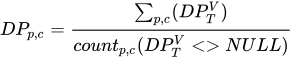
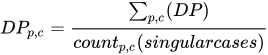
The DR-DP-Matrix summarizes the main methods to measure delivery reliability (DR) and delivery performance (DP) within supply chains. It categorizes the methods by three criteria:
- Type of reference: First Confirmed Date (FCD) / Last or Best Confirmed Date / Customer Request Date (CRD)
- Type of measurement: Volume (V) / Singular(S)
- Type of view: On Time (T) / Delivery (D)