Related Research Articles

Shantiniketan is a neighbourhood of Bolpur city in Bolpur subdivision of Birbhum district in West Bengal, India, approximately 152 km north of Kolkata. It was established by Maharshi Devendranath Tagore, and later expanded by his son Rabindranath Tagore whose vision became what is now a university town with the creation of Visva-Bharati.

The National Gallery of Modern Art (NGMA) is the premier art gallery under Ministry of Culture, Government of India. The main museum at Jaipur House in New Delhi was established on 29 March 1954 by the Government of India, with subsequent branches at Mumbai and Bangalore. Its collection of more than 1700 works by 2000 plus artists includes artists such as Thomas Daniell, Raja Ravi Verma, Abanindranath Tagore, Rabindranath Tagore, Gaganendranath Tagore, Nandalal Bose, Jamini Roy, Amrita Sher-Gil as well as foreign artists. Some of the oldest works preserved here date back to 1857. With 12,000 square meters of exhibition space, the Delhi branch is one of the world's largest modern art museums.

Visva-Bharati is a public research central university and an Institution of National Importance located in Santiniketan, West Bengal, India. It was founded by Rabindranath Tagore who called it Visva-Bharati, which means the communion of the world with India. Until independence it was a college. Soon after independence, the institution was given the status of a central university in 1951 by an act of the Parliament.

Nandalal Bose was one of the pioneers of modern Indian art and a key figure of Contextual Modernism.

The Inner Eye is a 1972 short documentary film made by Satyajit Ray on Benode Behari Mukherjee, a blind artist and a teacher from Visva-Bharati University, a university founded by Rabindranath Tagore at Santiniketan. The twenty minutes documentary features the life and works of Mukherjee in the form of paintings and photographs, starring himself. The documentary covers his journey from childhood till his blindness along with much of his works and features his words, "Blindness is a new feeling, a new experience, a new state of being". The documentary was awarded as Best Information Film (Documentary) at 20th National Film Awards in 1972.

The Lalit Kala Akademi or National Academy of Art is India's national academy of fine arts. It is an autonomous organisation, established in New Delhi in 1954 by Government of India to promote and propagate understanding of Indian art, in and outside the country.
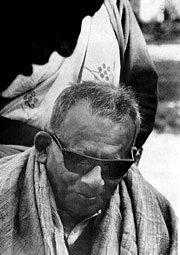
Benode Behari Mukherjee was an Indian artist from West Bengal state. Mukherjee was one of the pioneers of Indian modern art and a key figure of Contextual Modernism. He was one of the earliest artists in modern India to take up to murals as a mode of artistic expression. All his murals depict a subtle understanding of environmental through pioneering architectural nuances.

Ramkinkar Baij was an Indian sculptor and painter, one of the pioneers of modern Indian sculpture and a key figure of Contextual Modernism.
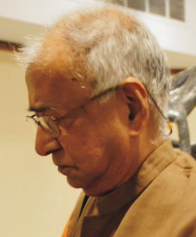
Kalpathi Ganpathi "K.G." Subramanyan was an Indian artist. He was awarded the Padma Vibhushan in 2012.

Somnath Hore was a Bengali sculptor and printmaker. His sketches, sculptures and prints were a reaction to major historical crises and events of 20th century Bengal, such as the Bengal Famine of 1943 and the Tebhaga movement. He was a recipient of the Indian civilian honour of the Padma Bhushan.

The Government College of Art & Craft in Kolkata is one of the oldest Art colleges in India. It was founded on August 16, 1854 at Garanhata, Chitpur, "with the purpose of establishing an institution for teaching the youth of all classes, industrial art based on scientific methods." as the School of Industrial Art. The institute was later renamed as the Government School of Art and in 1951 it became the Government College of Art & Craft.
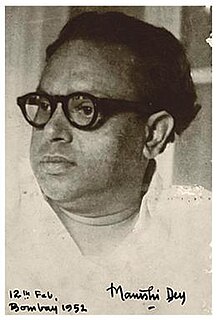
Manishi Dey was an Indian painter of the Bengal School of Art. He was born in Dhaka, Bengal Presidency. Originally named Bijoy Chandra, Manishi was the fifth child, and third son, of Purnashashi Devi and Kula Chandra Dey. He died in Kolkata at the height of his career at 56 years of age. Manishi Dey was the younger brother of Mukul Dey, a pioneering Indian artist and dry point etcher. Their two sisters, Annapura and Rani, were accomplished in arts and crafts as well.

Beohar Rammanohar Sinha was an Indian artist who is very well known for his illustrations in the original final manuscript of Constitution of India, including the complete Preamble-page, which was brought to fruition in 1949 as one of the most beautiful Constitutions in the world in addition to being the most comprehensive one. He is also known as a cultural ambassador of India who disseminated Indian art in the Far East, and brought Oriental Art to India. His works are housed in numerous prestigious public and private collections throughout the world and his murals still adorn the walls and gigantic dome of Jabalpur’s historic Shaheed-Smarak or Martyrs’-Memorial Auditorium even after more than half a century, though now demanding conservation.

Raman Siva Kumar, well known as R. Siva Kumar, is an Indian contemporary art historian, art critic, and curator. R. Siva Kumar's major research has been in the area of early Indian modernism with special focus on the Santiniketan School. He has written several important books, lectured widely on modern Indian art and contributed articles to prestigious international projects such as the Art Journal, Grove Art Online or The Dictionary of Art, Oxford University Press.

Kala Bhavana is the fine arts faculty of Visva-Bharati University, in Shantiniketan, India. It is an institution of education and research in visual arts, founded in 1919, it was established by Nobel laureate Rabindranath Tagore.
The wife or daughter of the Bengali kumar or potter creates all products which do not involve the use of the wheel. They also paint all the products that are painted in the potter's family workshop, the ghata, sara or pot cover, dolls etc. In the weavers household the women do almost all else except work on the loom. However, women have never been part of the artisan tradition of the country. They have never been part of a guild. There were never any female swarnakar(goldsmith), sutradhar(carpenter) or takshak(carver). The economic structure of producer and consumer relationship that is current in the country has always been male-centristic. Yet the first painter that finds mention in Sanskrit literature is Chitralekha, who had run of the inner chambers of the Bana king of Pragjyotishpura. The painting skills of the companions of Radha find repeated mention in Vaishnava literature."The touch of the Bengali woman's dexterous hands is to be found in all of Bengal's folk arts. About the culinary arts, Dineshchandra Sen says that the artistic skills woman shows in making sandesh(a sweetmeat) is such that they achieve the beauty of flowers and fruits. There are hundreds of moulds made of clay by Bengali women, their decoration are a pleasure to behold. The dexterity they show with the coconut kernel cannot be appreciated by any one who has not seen the coconut sweets made by the women of East Bengal.
Santiniketan: The Making of a Contextual Modernism was an exhibition curated by R. Siva Kumar at the National Gallery of Modern Art in 1997, on the occasion of the 50th anniversary of India's Independence.
Surendranath Kar (1892–1970) was an Indian artist and architect, known for amalgamating the Indian architectural style with western and eastern styles of architecture. Born in 1892 in the Indian state of Bihar, Kar did his primary learning of art under renowned Bengali painter, Nandalal Bose and Abanindranath Tagore, the nephew of Nobel Laureate, Rabindranath Tagore. Later, he joined Vichitra Club, founded by the Tagore family, as a teacher of art. In 1917, when Tagore set up Brahmacharyasrama, the precursor of later day Shantiniketan, he joined the institution and worked as an art teacher. Two years later, he moved to Kala Bhavana of Tagore as a faculty member.
Chitranibha Chowdhury was a twentieth-century Indian artist, a member of the Bengal School of Art, and the first female painter in Bangladesh. She created over a thousand artworks, including landscapes, still lifes, decorative art, murals, and portraits.
The following is a list of notable people associated withVisva- Bharati University and/or Santiniketan, a neighbourhood in Bolpur city in West Bengal, India:
References
- 1 2 3 "The man who gave Kala Bhavan a new life". The Times of India, 14 February 2011. Retrieved 23 August 2019.
- ↑ Memoir of an artist. Amitabh Sengupta. Patridge Publishing India. 2014-06-27. ISBN 978-1-4828-2126-0 . Retrieved 23 August 2019.
- ↑ Trends in Modern Indian Art. Sunil Kumar Bhattacharya, Page 8: New Trends. MD Publications Private Limited. 1994. ISBN 9788185880211 . Retrieved 23 August 2019.
- ↑ "Nandan Mela". Santiniketan. Retrieved 23 August 2019.
 | This Indian biographical article is a stub. You can help Wikipedia by expanding it. |