Overview
The djamaat is a centuries-old political unit, traditionally consisting of up to ten tribal or ancestral structures known as tuhums, which are broadly extended families. The government of a djamaat traditionally consisted of the elders from each of the tuhums. The djamaats were, in turn, governed by the adat (common law, prescriptions). The role of the djamaats in Dagestani history has been compared with that of the poleis in Ancient Greece. Although members of the djamaat often spoke the same language, ethnicity was not the primary connecting factor.
In anthropology, a tribe is a human social group. Exact definitions of what constitutes a tribe vary among anthropologists, and the term is itself considered controversial in academic circles in part due to its association with colonialism. In general use, the term may refer to people perceived by a population to be primitive and may have negative connotations. The concept is often contrasted with other social groups concepts, such as nations, states, and forms of kinship.
An extended family is a family that extends beyond the nuclear family, consisting of parents like father, mother, and their children, aunts, uncles, and cousins, all living in the same household.
The family changes from immediate household to extended household.
The term Elder, or its equivalent in another language, is used in several different countries and organizations to indicate a position of authority. This usage is usually derived from the notion that the oldest members of any given group are the wisest, and are thus the most qualified to rule, provide counsel or serve the said group in some other capacity.
The role of the djamaats faded after the new 1994 constitution of Dagestan, which provided other sources of authority in the republic, but the djamaats re-emerged when the national movement weakened. The Dagestani political life began to be dominated by "ethnoparties", whose key positions were often filled by djamaat members. The Dagestani djamaat, with its transcending kinship and ethnic structures, has been seen as a stabilizing factor in the political life of this ethnically and culturally diverse region. [1]

Lezgins are a Northeast Caucasian ethnic group native predominantly to southern Dagestan and northeastern Azerbaijan and who speak the Lezgian language.
The Laks or Laki are a Northeast Caucasian ethnic group native to an inland region known as Lakia within Dagestan in the North Caucasus. They speak the Lak language. Laks historically live in Lakskiy and Kulinskiy District of Dagestan. This ethnocultural area is known as Lakia. There are about 200,000 ethnic Laks.
Rutuls, Rutulians are an ethnic group in Dagestan, a republic in the south of Russia, and some parts of Azerbaijan. According to the 2010 Russian Census, there were 35,240 Rutuls in Russia. In 1989 Soviet Census in Azerbaijan there were 336 Rutuls. The Rutul language is a member of the Northeast Caucasian language family; its speakers often have a good command of Azeri and Russian, as Rutul was not a written language until 1990. The Rutul culture is close to that of the Tsakhur and other peoples who inhabit the basin of the upper reaches of the Samur River. Most of the Rutuls are engaged in cattle breeding, farming, and gardening.

The Tsakhur or Caxur people are an ethnic group of northern Azerbaijan and southern Dagestan (Russia). They number about 30,000 and call themselves yiqy, but are generally known by the name Tsakhur, which derives from the name of a Dagestani village, where they make up the majority.

The War of Dagestan began when the Chechnya-based Islamic International Peacekeeping Brigade (IIPB), an Islamist group, led by warlords Shamil Basayev and Ibn al-Khattab, invaded the neighboring Russian republic of Dagestan, on 7 August 1999, in support of the Shura of Dagestan separatist rebels. The war ended with a major victory for the Russian Federation and Dagestan Republic, and the retreat of the IIPB. The Invasion of Dagestan was the casus belli for the Second Chechen War.
Azerbaijanis in Russia or Russian Azerbaijanis are Azerbaijani people in the Russian Federation, and are Russian citizens or permanent residents of ethnic Azerbaijani background.
Aside from the large Azeri community native to Russia's Dagestan Republic, the majority of Azeris in Russia are fairly recent immigrants. Azeris started settling in Russia around the late nineteenth century, but their migration intensified after World War II, and especially after the collapse of the Soviet Union in 1991. According to the 2010 All-Russian Population Census, there are 603,070 Azeris residing in Russia, however the actual numbers may be much higher due to the arrival of guest workers in the post-Soviet era. The estimated total Azeri population of Russia as of 2002 might have reached as many as 3,000,000 people, with more than one and half million of them living in Moscow, though in the following decade there was a tendency for many Azeris to move back to Azerbaijan. The majority of post-1991 ethnic Azeri migrants have come to Russia from rural Azerbaijan, Georgia and Armenia. Today most provinces of Russia have more or less significant Azeri communities, the biggest ones, according to official numbers, residing in Dagestan, Moscow, Khanty–Mansi, Krasnoyarsk, Rostov-on-the-Don, Saratov, Sverdlovsk, Samara, Stavropol, etc.
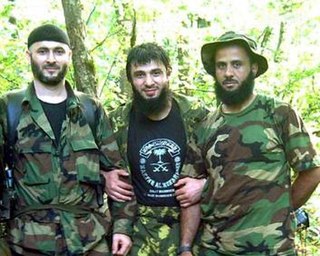
Rappani Khalilov, also known as Rabbani, was the militant leader of the Shariat Jamaat of the Caucasian Front during the Second Chechen War, in the volatile southern Russian republic of Dagestan. He was killed on September 17, 2007 in a fierce shoot-out with the Russian special forces.

Rutul is a language spoken by the Rutuls, an ethnic group living in Dagestan (Russia) and some parts of Azerbaijan. It is spoken by 30,000 people in Dagestan and 17,000 in Azerbaijan. The word Rutul derives from the name of a Dagestani village where speakers of this language make up the majority.
The Borozdinovskaya operation was a zachistka-type operation by Russian forces in Borozdinovskaya, Chechnya, on June 4, 2005, during the Second Chechen War. Members of the Special Battalion Vostok, an ethnic Chechen Spetsnaz unit of the Russian GRU, killed or disappeared 12 people in the ethnic minority Avar village of Borozdinovskaya, near the border with the Dagestan. Representatives of the Russian federal authorities expressed outrage over the incident, and the commander of the unit responsible was convicted.

The Arab Mujahideen in Chechnya was an international unit of the Islamist Mujahideen that fought in Chechnya and other parts of the North Caucasus.
The Islamic Djamaat of Dagestan, known in Russia as the Kadar zone, was an Islamist political entity in the Buynaksky District of Dagestan consisting of the fortified villages of Kadar, Karamakhi and Chabanmakhi. In the late 1990s, the Djamaat, heavily influenced by militant Wahhabism, declared independence and ejected Dagestani officials from the area. After a series of armed conflicts with Dagestani police and local moderate Muslims, the Djamaat broke off from government control. Sharia law was introduced in the villages, the Russian Constitution was declared void and an alliance was signed with Chechen forces with the aim of establishing an Independent Islamic Republic in the Caucasus.
Karim Huseyn oglu Mammadbeyov was a Soviet Dagestani politician, social activist and revolutionary who participated in the Bolshevik movement in Dagestan and served in various government positions from 1921 to 1937.
Magomed Vagabov, also known as Emir Seyfullah or Seyfullah Gubdensky, was the leader of the militant Vilayat Dagestan organisation in the Russian Republic of Dagestan, and the Supreme Qadi of the Caucasus Emirate.
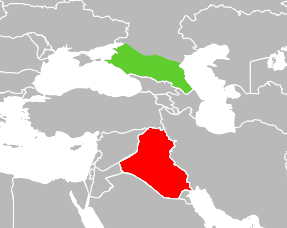
Circassians in Iraq are people of North Caucasian origin in Iraq, including Adyghes, Chechens and Dagestanis.
Said Dzhaparovich Amirov is a Dagestani economist and former politician for United Russia who was mayor of Makhachkala from 1998 to 2013. He was detained in June 2013 on suspicion of having ordered the murder of state investigator Arsen Gadzhibeko in 2011. Amirov was suspended from his position as mayor of Makhachkala on 14 June 2013 by the Basmanny Court of Moscow which also ruled that Amirov could be kept in custody until November 2013. He is currently serving a life sentence on charges of terrorism and commissioning contract killings.
Ruslan Kurbanov is a Russian political expert, a social activist and a columnist, Director of the foundation for the support of humanitarian initiatives “Altair”, a senior fellow at Institute of Oriental Studies of the Russian Academy of Sciences. Born October 26, 1976 in South-Dagestanian village Kurakh, he is an ethnic Lezgian. His research has been presented in numerous publications and broadcast through various news outlets. He has been a guest speaker at national radio and TV programs.

Magomed Aliyevich Suleimanov, also known as Abu Usman Gimrinsky, was a Dagestani Islamist in Russia and the third leader of the Caucasus Emirate militant group.
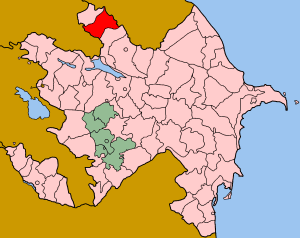
The Djaro-Belokani communities (also Char, Chary, rarely Chartalah were a group of self-governing communities in the Caucasus from the 17th to the 19th centuries. They had significant connections to the Elisu Sultanate to the southeast.

The national emblem of the Dagestan Autonomous Soviet Socialist Republic was adopted in 1937 by the government of the Dagestan Autonomous Soviet Socialist Republic. The emblem is identical to the emblem of the Russian Soviet Federative Socialist Republic.