Dragutin Drago Radimir (August 3, 1889 - December 26, 1983) was a forestry engineer, senior government advisor, forestry expert, associate scientific consultant to Forestry Encyclopedia in Yugoslavia.
He attended Gymnasium in Kotor, at the time under the Austro-Hungarian Monarchy, and later enrolled at University in Prague and Vienna. He graduated in 1912 at the University of Vienna Faculty for Soil Culture in the class of dipl.ing. Radimir Karl.
Between 1920 and 1937 he was a forestry engineer in the directorate of forests for the Drina Banovina.
In 1938 he was transferred to the same position but in Mostar, for the Littoral Banovina. He stayed there until 1939 when he moved to Zagreb.
Between 1939 and 1941 he worked at the Department of Forestry of the Banovina of Croatia as a senior advisor.
During World War II, he worked in Zagreb in the laboratories of the company "La Roche" .
In 1945 he was employed at the Ministry of Forestry Zagreb, SFR Yugoslavia as a senior government adviser. He worked there until his retirement in 1950.
After World War II he wrote and published many papers on the utilization of forestry by-products, especially resins.
As an amateur photographer, he compiled a remarkable collection of photographs of forests and their by-products. He gave the collection to a forestry company "Šipad" in Sarajevo. Unfortunately the whole collection was destroyed during the civil war in the nineties.
Drago Radimir's principal occupation was reforestation in Bosnia and Herzegovina, Croatia, and Serbia. To his merit was the introduction of the Serbian Spruce (Serbian: Pančićeva omorika) in Zagreb's parks and in other parts of former Yugoslavia. Several Sequoia (Redwood) trees on the Croatian and Montenegrin coast were planted by him and his co-workers.
In 1962 Radimir was awarded a gold certificate at the College for soil culture in Vienna at the 50th anniversary of his graduation (1912 to 1962).
He was a member of the Croatian Mountaineering Association before the Second World War, and the mountain society Zagreb since its inception. As a mountaineer he visited many European mountains, some in North America, photographed them and lectured. He was an associate member and a member of the Forestry section of the Društvo inženjera i tehničara (Society of Engineers of Yugoslavia that existed as a single organization between 1945 and 1951; afterwards the Society of Engineers of Croatia).
Radimir's first marriage was with to Angela née. Radoničić, and the pair had daughters Vjera (married Popović) and Nada. Second marriage was with Marija Macolić.
The foreign relations of Croatia is primarily formulated and executed via its government which guides the state's interactions with other nations, their citizens, and foreign organizations. Active in global affairs since the 9th century, modern Croatian diplomacy is considered to have formed following their independence from Yugoslavia in 1991. As an independent state, Croatia established diplomatic relations with most world nations – 189 states in total – during the 1990s, starting with Germany (1991) and ending most recently with Liberia (2024). Croatia has friendly relations with most of its neighboring countries, namely Slovenia, Hungary, and Montenegro. They maintain colder, more tense relations with Serbia as well as Bosnia and Herzegovina due to historic nation-building conflict and differing political ideologies.
Štrigova is a village and municipality in Međimurje County, in northern Croatia.
Vladimir Maček was a politician in the Kingdom of Yugoslavia. As a leader of the Croatian Peasant Party (HSS) following the 1928 assassination of Stjepan Radić, Maček had been a leading Croatian political figure until the Axis invasion of Yugoslavia in 1941. As a leader of the HSS, Maček played a key role in establishment of the Banovina of Croatia, an autonomous banovina in Yugoslavia in 1939.
The Football Association of Yugoslavia (FSJ) was the governing body of football in Yugoslavia, based in Belgrade, with a major administrative branch in Zagreb.
Igor Štiks is a Bosnian and Croatian novelist and political philosopher. As an academic, Štiks works as a research associate at the University of Edinburgh. His novels The Judgment of Richard Richter and A Castle in Romagna have earned him multiple awards; the former has been translated into 15 languages.
The 1923 National Championship held in the Kingdom of Serbs, Croats and Slovenes was the first nationwide domestic football competition. At this point there was no league championship in the modern sense as the competition was held in a single-legged cup format, with participating clubs qualifying via regional playoffs organised by the existing 6 regional football subfederations.
The Kingdom of Croatia-Slavonia was a nominally autonomous kingdom and constitutionally defined separate political nation within the Austro-Hungarian Empire. It was created in 1868 by merging the kingdoms of Croatia and Slavonia following the Croatian–Hungarian Settlement of 1868. It was associated with the Kingdom of Hungary within the dual Austro-Hungarian state, being within the Lands of the Crown of St. Stephen, also known as Transleithania. While Croatia had been granted a wide internal autonomy with "national features", in reality, Croatian control over key issues such as tax and military issues was minimal and hampered by Hungary. It was internally officially referred to as the Triune Kingdom of Croatia, Slavonia and Dalmatia, also simply known as the Triune Kingdom, and had claims on Dalmatia, which was administered separately by the Austrian Cisleithania. The city of Rijeka, following a disputed section in the 1868 Settlement known as the Rijeka Addendum, became a corpus separatum and was legally owned by Hungary, but administered by both Croatia and Hungary.
The Banovina of Croatia or Banate of Croatia was an administrative subdivision (banovina) of the Kingdom of Yugoslavia between 1939 and 1941. It was formed by a merger of Sava and Littoral banovinas into a single autonomous entity, with small parts of the Drina, Zeta, Vrbas and Danube banovinas also included. Its capital was Zagreb and it included most of present-day Croatia along with portions of Bosnia and Herzegovina and Serbia. Its sole Ban during this period was Ivan Šubašić.
Matica hrvatska is the oldest independent, non-profit and non-governmental Croatian national institution. It was founded on February 2, 1842 by the Croatian Count Janko Drašković and other prominent members of the Illyrian movement during the Croatian National Revival (1835–1874). Its main goals are to promote Croatian national and cultural identity in the fields of art, science, spiritual creativity, economy and public life as well as to care for social development of Croatia.
Yugoslavia had various administrative divisions throughout its 74 years of existence.
Mirko pl. Vidaković was a Croatian botanist and dendrologist and the expert for the genetics of the forest trees.
Latinka Perović was a Yugoslav communist leader, historian and politician. During the existence of the Socialist Federal Republic of Yugoslavia, Perović was a secretary general of the League of Communists of Serbia (SKS) in the period between 1968 and 1972. On 21 October 1972, Perović resigned from all her political positions together with Marko Nikezić under the accusation that they were excessively liberal. The resignations were accepted by the SKS Central Committee on 25 October. The dismissal of the Serbian communist reformers in 1972 was preceded by the removal of Croatian nationalists during the Croatian Spring.
Viktor Novak was a Yugoslav Croat historian, professor at the University of Belgrade and full member of the Serbian Academy of Sciences and Arts (SANU), and a corresponding member of the Yugoslav Academy of Sciences and Arts (JAZU).
Gaboš is a village in Vukovar-Syrmia County, Croatia, population 516. The settlement was originally established as a pustara, a Pannonian type of hamlet. Gaboš became a colonist settlement was established during the land reform in interwar Yugoslavia.
Željko Ivanković is a Yugoslavian and Bosnian poet, novelist, short story writer, essayist, translator.
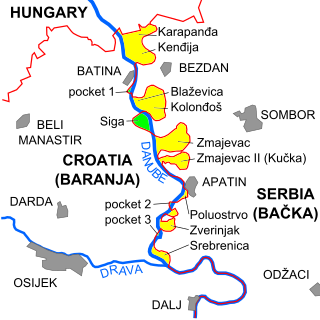
The border between Croatia and Serbia in the area of the Danube is disputed, an important part of their broader diplomatic relations. While Serbia claims that the thalweg of the Danube valley and the centreline of the river represents the international border between the two countries, Croatia disagrees, claiming that the international border lies along the boundaries of the cadastral municipalities located along the river—departing from the course at several points along a 140-kilometre (87 mi) section. The cadastre-based boundary reflects the course of the Danube which existed in the 19th century, before anti-meandering and hydrotechnical engineering works altered its course. The area size of the territory in dispute is reported variously, up to 140 km2.
The 1940 Croatian local elections were held in 625 municipalities of the Banovina of Croatia on 19 May 1940, and in 33 municipalities on 26 May and 2 June. These were the first elections following the Cvetković–Maček Agreement and the establishment of the autonomous Croatian Banate within the Kingdom of Yugoslavia. The elections were not held in cities and some Adriatic counties bordering, or adjacent to, Italy. Only men older than 24 were allowed to vote. Voting was public and conducted by voice.
During World War II in Yugoslavia, when the village of Gornja Rijeka, Croatia was part of the Independent State of Croatia, it was the site of a concentration camp.
Stanoje Mihaldžič was a Yugoslav politician who served as the Minister of the Interior of the Kingdom of Yugoslavia from 26 August 1939 to 8 July 1940 and then as the Ban of Drina Banovina from 10 July 1940 to 17 April 1941.
This page is based on this Wikipedia article Text is available under the CC BY-SA 4.0 license; additional terms may apply. Images, videos and audio are available under their respective licenses.