
Hanoi, also called the Hanoi Capital, is the capital and second-most populous city of Vietnam. It covers an area of 3,359.82 km2 (1,297.2 sq mi), and consists of 12 urban districts, one district-leveled town and 17 rural districts. It is located within the Red River Delta of Northern Vietnam.
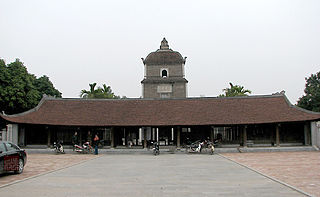
Bắc Ninh is a province of Vietnam, located in the Red River Delta of the northern part of the country. It is the smallest province of Vietnam by area and is situated to the east of the nation's capital, Hanoi, and borders Bắc Giang province, Hưng Yên province, Hải Dương province and Hanoi.

Nam Định is a province in the southern part of the Red River Delta region of northern Vietnam. It borders Ninh Bình province to the southwest, Hà Nam province to the northwest, Thái Bình province to the northeast, and the Gulf of Tonkin to the southeast. As of 2018, it is the 52nd largest province by area and the 12th most populous province of Vietnam.

Phú Thọ is a province in northern Vietnam. Its capital is Việt Trì, which is 80 kilometres (50 mi) from Hanoi and 50 kilometres (31 mi) from Nội Bài International Airport. The province covers an area of 3534.56 square kilometres and, as of 2019, it had a population of 1,463,726.
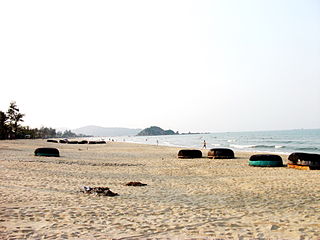
Nghệ An is a coastal province near the northernmost part of the North Central Coast region, the Central of Vietnam. It borders Thanh Hóa to the north, Hà Tĩnh to the south, Xiangkhouang, Bolikhamsai and Houaphan of Laos to the west, and the East Sea to the east.

Việt Trì (越池) is the capital city of Phú Thọ Province in the Northeast region of Vietnam. In 2010, the city had a population of 260,288. The city covers an area of 110 square kilometres (42 sq mi). Việt Trì is also the economic centre of the province and contains many industrial firms and service industries.

The Red River Delta or Hong River Delta is the flat low-lying plain formed by the Red River and its distributaries merging with the Thái Bình River in northern Vietnam. Hồng (紅) is a Sino-Vietnamese word for "red" or "crimson". The delta has the smallest area but highest population and population density of all regions. The region, measuring some 15,000 square kilometres (6,000 sq mi) is well protected by a network of dikes. It is an agriculturally rich and densely populated area. Most of the land is devoted to rice cultivation.

Cầu Giấy is an urban district of Hanoi, the capital city of Vietnam. The district currently has eight wards, covering a total area of 12.32 km2 (4.76 sq mi). It is bordered by Ba Đình district, Đống Đa district, Nam Từ Liêm district, Thanh Xuân district, Tây Hồ district, Bắc Từ Liêm district. As of 2019, there were 292,536 people residing in the district, the population density is 24,000 inhabitants per square kilometer.

Đống Đa is one of the four original urban districts (quận) of Hanoi, the capital city of Vietnam. It is bordered by Ba Đình to the north, Hoàn Kiếm to the northeast, Hai Bà Trưng to the east, Thanh Xuân to the south, and Cầu Giấy to the west. The district currently has 21 wards, covering a total area of 9.95 square kilometers. It is the most populous district in Hanoi. As of 2017, there were 420900 people residing in the district, the population density is 42302 inhabitants per square kilometer, 18 times higher than the overall density of Hanoi. Dong Da district is home to various enterprises and many of Vietnam's most prestigious universities such as Hanoi Medical University, Foreign Trade University, University of Transport and Communications, Thuyloi University.

Hai Bà Trưng is one of the four original urban districts (quận) of Hanoi, the capital city of Vietnam. The district currently has 18 wards, covering a total area of 10.26 square kilometers. It is bordered by Long Biên district, Đống Đa district, Thanh Xuân district, Hoàng Mai district, Hoàn Kiếm district. As of 2019, there were 303,586 people residing in the district, the population density is 30,000 inhabitants per square kilometer.

Hoàng Mai is an urban district (quận) of Hanoi, the capital city of Vietnam. The district currently has 14 wards, covering a total area of 40.32 square kilometers. As of 2019, there were 506,347 people residing in the district, the highest of all districts in Hanoi. The district borders Thanh Trì District, Thanh Xuân District, Gia Lâm District, Long Biên District, Hai Bà Trưng District.

Mekong Capital is a Vietnam-focused private equity firm. Operating in Vietnam since 2001, Mekong Capital is one of the first private equity firms to engage Vietnam, and has completed 42 private equity investments in Vietnam through 5 funds with more than 60 full-time employees. Mekong Capital has offices in Ho Chi Minh City, Hanoi. Focusing on manufacturing companies until 2005, Mekong Capital shifted its focus towards consumer-driven businesses in 2006.

Quán Sứ Pagoda is a Buddhist temple located at 73 Quan Su Street, Hanoi, Vietnam. The temple is the headquarters of the Buddhist Sangha of Vietnam.

The Imperial Citadel of Thăng Long is a complex of historic buildings associated with the history of Vietnam located in the centre of Hanoi, Vietnam. Its construction began in 1010 and was completed in early 1011 under the reign of Emperor Lý Thái Tổ of the Lý dynasty.
The Hanoi Metro is a rapid transit system in Hanoi, the capital city of Vietnam. Owned by Vietnam Railways and operated by Hanoi Metro Company (HMC), it is the first operational rapid transit system in Vietnam. The first line opened to service on 6 November 2021.

Ước Lễ is a Vietnamese village, located in Tân Ước commune, Thanh Oai District, Hanoi, Vietnam. The village is best known for its traditional giò lụa and the ancient village gate. Every year, on 15 January, the village holds a festival, when residents of the village visit ancestral graves, to honor the village's tradition of giò lụa. There are two national historical monuments in the village: the ancient village gate and So temple.
Thirty-eight Vietnamese police officers were taken hostage by villagers in Đồng Tâm commune, Mỹ Đức district, Hanoi on April 15, 2017, after police arrested four villagers without a warrant in a land dispute. The hostages included district People's Committee deputy chief Đặng Văn Triều, Deputy Chief of Public Security Nguyễn Thanh Tùng, district party committee propaganda chief Đặng Văn Cảnh, and two journalists. Two days after the initial hostage-taking, three detainees were released by the police in Hanoi; one was the main representative of the people in the land dispute, Lê Đình Kình, an 82-year-old man who was injured and hospitalized. In response, the villagers released 15 policemen; three more escaped.

Khai Hoan Land Group Joint Stock Company is a Vietnamese real estate developer and agency. Founded in 2009 by Nguyễn Khải Hoàn, it is headquartered in District 7, Ho Chi Minh City. In the south of the country alone, Khai Hoan Land maintains the largest market share by volume, which make it the region's leading property developer and real estate agency.

The Ringway 3 of Greater Hanoi area, signed as CT.37 is a major freeway and urban thoroughfare surrounding the inner part of Hanoi. As the first ringway built in Greater Hanoi area, Ringway 3 connects most of the newly developed area outside the urban core of Hanoi. In addition to that, Ringway 3 is the terminus of most expressway connecting Greater Hanoi to other regions of Vietnam. Due to its importance, Ringway 3 is one of the busiest and most congested highway in Vietnam, carrying from 8 to 10 times its maximum capacity. To deal with congestion, the Government of Vietnam has proposed building additional ringway to help alleviate traffic on Ringway 3.


