Egno von Eppan

Last updated
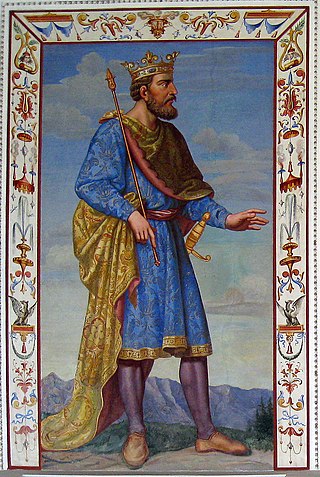
Egno von Eppan, 16th-century fresco in the Buonconsiglio Castle by Marcello Fogolino Castello del Buonconsiglio, sala vescovi - Fogolino - 19 Egnone di Appiano.jpg
Egno von Eppan, 16th-century fresco in the Buonconsiglio Castle by Marcello Fogolino

Egno von Eppan (died 25 May 1273) was the bishop of Brixen from 1240 to 1250, and then bishop of Trent until his death.

Egno belonged to the family of the counts of Eppan. He became a canon of the cathedral of Trent as an acolyte in 1232 and became a subdeacon in 1234. [1] Bishop Henry  [ de ] died on 18 November 1239 and by 8 April 1240 Egno had been elected to succeed him. [2] [3] He was probably chosen by the canons in the hope that his family might help the church resist the counts of Andechs, Gorizia and Tyrol. [1] He received the regalia from King Conrad IV in Nördlingen on 20 May 1240. [2] [3] [4]

At Nördlingen, Conrad IV granted Egno a privilege stating that nobody could cross the duchy of Brixen without the permission of either the emperor, the king or the bishop. At the same time, Egno entered into a business deal with Conrad's important advisor, Conrad of Winterstetten. [4] Thus, during the papal war against the Emperor Frederick II, which began in 1239, Egno supported the Emperor. He allied with Duke Bernard of Carinthia against the counts of Gorizia and Tyrol. [1] He controlled the Brenner Pass, the most important pass between Germany and Italy. A letter written by Albert von Behaim confirms that Egno had closed the passes by September 1240, greatly hampering communication between the Pope and his German allies. [4]

The Mongol threat to the Empire in 1241–1242 provided Egno with a respite from these quarrels. [1] On 20 March 1241, a preliminary agreement was reached between Egno and Counts Meinhard I of Gorizia and Albert IV of Tyrol. On 30 April, in the presence of Patriarch Berthold, a final agreements was signed at Patriasdorf  [ de ]. The timing of these agreements suggests that they may have been made in response to news of the Mongols. [5] A letter addressed to Egno from Bartholomew of Trent provides valuable information on the Mongols' movements. [6] Conrad IV's crusade against the Mongols was preached in the diocese of Brixen, and even the Count Albert IV took the cross. [4]

In April 1245, Egno was in Vienna aiding the negotiations between the Emperor and Duke Frederick II of Austria for the former's marriage to the latter's niece, Gertrude. He joined the Emperor's court in Verona by June 1245. On 4 June 1246, Pope Innocent IV summoned Egno to appear before him and, on 25 July, he was excommunicated by the papal legate Filippo da Pistoia for failing to obey a summons from Henry Raspe, anti-king in Germany. [4] Before the end of the year, he made his submission to the Pope and changed sides. [1] [4] He was then placed under the imperial ban. [1]

On 8 March 1247, Egno was appointed administrator of the diocese of Trent. [1] [4] In 1250, he was transferred there as bishop and succeeded at Brixen by Bruno. [1] [2] He now found himself allied with Count Albert IV and the counts of Gorizia, on whom he bestowed fiefs and offices in his gift. He had to fight the podestà Sodeger de Tito and Ezzelino III da Romano for control of his bishopric. [1] The death of Ezzelino in 1259 brought respite to Egno, but in 1265 he faced a rebellion in Trent and had to flee to Riva del Garda. Count Meinhard I took control of the bishopric. [3]

On 21 April 1263, Egno enfeoffed Louis II, Duke of Bavaria, with the fiefs that had escheated to the bishopric on the death of Count Siboto VI of Falkenstein. [7] He spent most of his later years in Bozen. He died on 25 May 1273 in Padua. [1] [3]

Related Research Articles

<span class="mw-page-title-main">Conrad IV of Germany</span> 13th century King of Germany, Sicily, and Jerusalem

Conrad, a member of the Hohenstaufen dynasty, was the only son of Emperor Frederick II from his second marriage with Queen Isabella II of Jerusalem. He inherited the title of King of Jerusalem upon the death of his mother in childbed. Appointed Duke of Swabia in 1235, his father had him elected King of Germany and crowned King of Italy in 1237. After the emperor was deposed and died in 1250, he ruled as King of Sicily until his death.

<span class="mw-page-title-main">Henry of Bohemia</span> King of Bohemia from 1307 to 1310

Henry of Gorizia, a member of the House of Gorizia, was Duke of Carinthia and Landgrave of Carniola and Count of Tyrol from 1295 until his death, as well as King of Bohemia, Margrave of Moravia and titular King of Poland in 1306 and again from 1307 until 1310. After his death, the Habsburgs took over Carinthia and Carniola and held them almost without interruption until 1918.

<span class="mw-page-title-main">Meinhard, Duke of Carinthia</span>

Meinhard II, a member of the House of Gorizia (Meinhardiner), ruled the County of Gorizia and the County of Tyrol together with his younger brother Albert from 1258. In 1271 they divided their heritage and Meinhard became sole ruler of Tyrol. In 1286 he was enfeoffed with the Duchy of Carinthia and the adjacent March of Carniola.

<span class="mw-page-title-main">Albert I of Gorizia</span>

Albert I, a member of the House of Gorizia, ruled the counties of Gorizia (Görz) and Tyrol from 1258, jointly with his elder brother Meinhard IV. In 1271, the brothers divided their heritage and Albert became sole ruler of the Gorizia estates until his death. His descendants, known collectively as the Albertine line, ruled the County of Gorizia until the extinction of the House in 1500.

<span class="mw-page-title-main">Meinhard I, Count of Gorizia-Tyrol</span>

Meinhard I, a member of the House of Gorizia (Meinhardiner), was Count of Gorizia from 1231 and Count of Tyrol from 1253 until his death.

<span class="mw-page-title-main">Prince-Bishopric of Trent</span> Imperial estate of the Holy Roman Empire in present-day northern Italy (1027-1803)

The Prince-Bishopric of Trent was an ecclesiastical principality roughly corresponding to the present-day Northern Italian autonomous province of Trentino. It was created in 1027 and existed until 1803, when it was secularised and absorbed into the County of Tyrol held by the House of Habsburg. Trent was a Hochstift, an Imperial State under the authority of a prince-bishop at Trento.

<span class="mw-page-title-main">Prince-Bishopric of Brixen</span> Imperial estate of the Holy Roman Empire in present-day northern Italy (1027-1803)

The Prince-Bishopric of Brixen was an ecclesiastical principality of the Holy Roman Empire in the present-day northern Italian province of South Tyrol. It should not be confused with the larger Catholic diocese, over which the prince-bishops exercised only the ecclesiastical authority of an ordinary bishop. The bishopric in the Eisack/Isarco valley was established in the 6th century and gradually received more secular powers. It gained imperial immediacy in 1027 and remained an Imperial Estate until 1803, when it was secularised to Tyrol. The diocese, however, existed until 1964, and is now part of the Diocese of Bolzano-Brixen.

<span class="mw-page-title-main">County of Tyrol</span> Estate of the Holy Roman Empire (1140–1806); county of Austria (1806–1919)

The (Princely) County of Tyrol was an estate of the Holy Roman Empire established about 1140. After 1253, it was ruled by the House of Gorizia and from 1363 by the House of Habsburg. In 1804, the County of Tyrol, unified with the secularised prince-bishoprics of Trent and Brixen, became a crown land of the Austrian Empire. From 1867, it was a Cisleithanian crown land of Austria-Hungary.

<span class="mw-page-title-main">Eppan an der Weinstraße</span> Comune in Trentino-Alto Adige/Südtirol, Italy

Eppan an der Weinstraße, often abbreviated to Eppan or Appiano, is a comune (municipality) in South Tyrol in northern Italy, located about 8 kilometres (5 mi) southwest of the city of Bolzano.

<span class="mw-page-title-main">House of Gorizia</span> Noble family in the Holy Roman Empire

The Counts of Gorizia, also known as the Meinhardiner, House of Meinhardin, were a comital, princely and ducal dynasty in the Holy Roman Empire. Named after Gorizia Castle in Gorizia, they were originally "advocates" (Vogts) in the Patriarchate of Aquileia who ruled the County of Gorizia (Görz) from the early 12th century until the year 1500. Staunch supporters of the Emperors against the papacy, they reached the height of their power in the aftermath of the battle of Marchfeld between the 1280s and 1310s, when they controlled most of contemporary Slovenia, western and south-western Austria and part of northeast Italy mostly as (princely) Counts of Gorizia and Tyrol, Landgraves of Savinja and Dukes of Carinthia and Carniola. After 1335, they began a steady decline until their territories shrunk back to the original County of Gorizia by the mid 1370s. Their remaining lands were inherited by the Habsburg ruler Maximilian I.

<span class="mw-page-title-main">Elisabeth of Bavaria, Queen of Germany</span> 13th-century Queen of Germany, Sicily, and Jerusalem

Elisabeth of Bavaria was Queen of Germany and Jerusalem from 1246 to 1254 by her marriage to King Conrad IV of Germany.

<span class="mw-page-title-main">Roman Catholic Diocese of Bolzano-Brixen</span> Roman Catholic diocese in Italy

The Diocese of Bolzano-Brixen is a Latin diocese of the Catholic Church in northern Italy, with its seat in the city of Bolzano. Its territory corresponds with that of the province of South Tyrol with its predominantly German-speaking population. It is a suffragan of the Archdiocese of Trento.

<span class="mw-page-title-main">County of Kirchberg</span> Swabian aristocratic family

The House of Kirchberg were a Swabian aristocratic family, once wealthy that held the County of Kirchberg, mainly south of Ulm, on the right and left of the Iller. They are difficult to document, but at the end of the early Middle Ages and the beginning of the High Middle Ages they may have had a significance that went beyond regional power. By the end of the 12th century, the family had split into two lines, later into three, becoming impoverished towards the end of the Middle Ages and dying out in 1510 after the sale of their possessions and rights.

<span class="mw-page-title-main">Agnes of the Palatinate</span>

Agnes of the Palatinate (1201–1267) was a daughter of Henry V, Count Palatine of the Rhine, of the House of Welf, by his first wife Agnes of Hohenstaufen, daughter and heiress of Conrad of Hohenstaufen, Count Palatine of the Rhine. She married Otto II Wittelsbach, Duke of Bavaria.

<span class="mw-page-title-main">Otto III, Duke of Carinthia</span> Count of Gorizia and Tyrol and Duke of Carinthia (1265–1310)

Otto III, a member of the House of Gorizia, was Duke of Carinthia and Count of Tyrol from 1295 until his death. He ruled jointly with his younger brothers Louis and Henry VI.

<span class="mw-page-title-main">Albert IV, Count of Tyrol</span> Count of Tyrol

Albert IV was Count of Tyrol from 1202 until his death, the last from the original House of Tirol. He also served as Vogt of the bishoprics of Trent and Brixen.

<span class="mw-page-title-main">Meinhard II, Count of Gorizia</span>

Meinhard II, nicknamed the Elder, a member of the House of Gorizia (Meinhardiner), was ruling Count of Gorizia from 1220 until his death. He also held the title of Vogt (Reeve) of the Patriarchate of Aquileia.

<span class="mw-page-title-main">Mongol incursions in the Holy Roman Empire</span> Part of the first great Mongol invasion of Europe

Mongol incursions in the Holy Roman Empire took place in the spring of 1241 and again in the winter of 1241–42. They were part of the first Mongol invasion of Europe.

References

  1. 1 2 3 4 5 6 7 8 9 10 Franz Huter [in German] (1959), "Egno", Neue Deutsche Biographie (in German), vol. 4, Berlin: Duncker & Humblot, p. 341; ( full text online ).
  2. 1 2 3 Konrad Eubel (1913), Hierarchia catholica, vol. 1 (2nd ed.), Libreria Regensbergiana, pp. 148, 497.
  3. 1 2 3 4 Heinrich von Zeißberg [in German] (1877), "Egno", Allgemeine Deutsche Biographie (in German), vol. 5, Leipzig: Duncker & Humblot, pp. 688–691.
  4. 1 2 3 4 5 6 7 Daniel R. Sodders (1996), Conrad the Fourth as German King, 1237–1250 (PhD dissertation), University of Kansas, pp. 90–91, 98, 180n36, 226, 257n104, 340, 345.
  5. Matthew Coulter (2022), "Patterns of Communication During the 1241 Mongol Invasion of Europe: Insights from the Ottobeuren Letter Collection", Journal of Medieval History, 48 (4): 496–523, doi: 10.1080/03044181.2022.2101020 , S2CID   250971115 .
  6. Peter Jackson (2005), The Mongols and the West, 1221–1410, Routledge, p. 68.
  7. John B. Freed (1984), "The Counts of Falkenstein: Noble Self-Consciousness in Twelfth-Century Germany", Transactions of the American Philosophical Society, 74 (6): 1–70, doi:10.2307/1006394, JSTOR   1006394 , at 55, 58, 60.