Wausau is a city in and the county seat of Marathon County, Wisconsin, United States, along the Wisconsin River. As of the 2020 census, it had a population of 39,994. It is the core city of the Wausau metropolitan area, which includes all of Marathon County and had a population of 138,013 in 2020. The city's suburbs include Schofield, Weston, Mosinee, Maine, Rib Mountain, Kronenwetter, and Rothschild.

The First Unitarian Society of Madison (FUS) is a Unitarian Universalist congregation in Shorewood Hills, Wisconsin. Its meeting house was designed by Frank Lloyd Wright and built by Marshall Erdman in 1949–1951, and has been designated a U.S. National Historic Landmark for its architecture. With over 1,000 members, it is one of the ten largest Unitarian Universalist congregations in the United States.
The American System-Built Homes were modest houses in a series designed by architect Frank Lloyd Wright. They were developed between 1911 and 1917 to fulfill his interest in affordable housing but were sold commercially for just 14 months. The Wright archives include 973 drawings and hundreds of reference materials, the largest collection of any of single Wright project. Wright cancelled the project in July 1917 by successfully suing his partner Arthur Richards for payments due and didn't speak of the program again. The designs were standardized and modular, so customers could choose from one hundred and twenty nine models on seven floorplans and three roof styles. Most materials were prepared and organized at Arthur Richards' lumber yard, so there was less waste and specialized labor needed for construction. Milled and marked materials were delivered to the work site for cutting and assembly by a carpenter. Windows, doors and some cabinetry were built at the yard. Frames, shelves, trim and some fixtures were cut and assembled on site. Most wood parts had a part number and corresponding instructions and drawings for joining, fit and finish. Richards' yard also supplied plaster, concrete, paint and hardware.

The Marathon County Historical Museum is museum located in Wausau, Marathon County, Wisconsin, United States. It is located in the Cyrus Carpenter Yawkey House, a house listed on the National Register of Historic Places in 1974. The house is a significant example of Classical Revival architecture.
Alexander Chadbourne Eschweiler was an American architect with a practice in Milwaukee, Wisconsin. He designed both residences and commercial structures. His eye-catching Japonist pagoda design for filling stations for Wadham's Oil and Grease Company of Milwaukee were repeated over a hundred times, though only a very few survive. His substantial turn-of-the-20th-century residences for the Milwaukee business elite, in conservative Jacobethan or neo-Georgian idioms, have preserved their cachet in the city.

This is a list of the National Register of Historic Places listings in Marathon County, Wisconsin. It is intended to provide a comprehensive listing of entries in the National Register of Historic Places that are located in Marathon County, Wisconsin. The locations of National Register properties for which the latitude and longitude coordinates are included below may be seen in a map.

The Charles L. and Dorothy Manson home is a single-family house located at 1224 Highland Park Boulevard in Wausau, Wisconsin. Designated a National Historic Landmark, it was listed on the National Register of Historic Places on April 5, 2016, reference Number, 16000149.

The Frederick C. Bogk House is a single-family residential project in Milwaukee, Wisconsin designed by Frank Lloyd Wright. Bogk was an alderman and secretary-treasurer of the Ricketson Paint Works. This house embodies Wright's prairie style elements into a solid-looking structure that appears impregnable.

Duey and Julia Wright House is a Frank Lloyd Wright designed Usonian home that was constructed on a bluff above the Wisconsin River in Wausau, Wisconsin in 1958. Viewed from the sky, the house resembles a musical note. The client owned a Wausau music store, and later founded the broadcasting company Midwest Communications through his ownership of WRIG radio. The home also has perforated boards on the clerestories "represent the rhythm of Beethoven's Fifth Symphony Allegro con brio first theme." A photograph showing the perforated panels is in the web page on the National Register application.
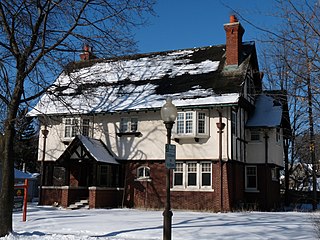
The C. B. Bird House is a Tudor Revival house built in 1922 and located in Wausau, Wisconsin. It was added to the National Register of Historic Places on May 1, 1980.

The C. F. Dunbar House is a Tudor Revival house built in 1926 in Wausau, Wisconsin, United States. It was added to the National Register of Historic Places in 1980.

The First Universalist Church in Wausau was designed by Alexander C. Eschweiler in Tudor Revival style and built in 1914 for the local Universalist congregation. Additions and remodeling were done in 1928, 1956, and 2006. It is still used by the local Unitarian Universalist congregation; in this context, it is called the First Unitarian Universalist Church of Wausau. It was added to the National Register of Historic Places in 1980.
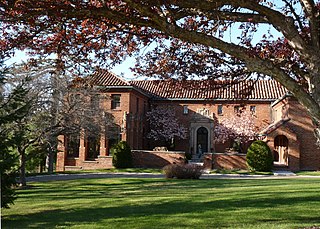
The D.C. Everest House is an English-Spanish Baroque-styled home in Wausau, Wisconsin, United States. It was added to the National Register of Historic Places in 1980.

The Granville D. Jones House in Wausau, Wisconsin, United States was designed by George W. Maher in Prairie Style and built in 1904. It was added to the National Register of Historic Places in 1977.

The Louis Marchetti House is located in Wausau, Wisconsin, United States. It was added to the National Register of Historic Places in 1996.

The E.K. Schuetz House is a historic house located in Wausau, Wisconsin. It was added to the National Register of Historic Places in 1980.

The Hiram C. Stewart House is a historic Prairie School house designed by George W. Maher located at 521 Grant Street in Wausau, Wisconsin. It was added to the National Register of Historic Places on August 30, 1974.

Van Ryn & DeGelleke was an architectural firm in Wisconsin. It was a partnership of Henry J. Van Ryn and Gerrit Jacob DeGelleke, both of whom grew up in Milwaukee.
Patrick James Snyder is an American Republican politician and former radio host from Schofield, Wisconsin. He is a member of the Wisconsin State Assembly, representing Wisconsin's 85th Assembly district since 2017. He also previously served as a member of the Schofield City Council, and worked as a legislative aide to U.S. Representative Sean Duffy.

The C. H. Wegner House is located in Wausau, Wisconsin.