Nutrition is the science that interprets the interaction of nutrients and other substances in food in relation to maintenance, growth, reproduction, health and disease of an organism. It includes food intake, absorption, assimilation, biosynthesis, catabolism, and excretion.

Fructose, or fruit sugar, is a simple ketonic monosaccharide found in many plants, where it is often bonded to glucose to form the disaccharide sucrose. It is one of the three dietary monosaccharides, along with glucose and galactose, that are absorbed directly into blood during digestion. Fructose was discovered by French chemist Augustin-Pierre Dubrunfaut in 1847. The name "fructose" was coined in 1857 by the English chemist William Allen Miller. Pure, dry fructose is a sweet, white, odorless, crystalline solid, and is the most water-soluble of all the sugars. Fructose is found in honey, tree and vine fruits, flowers, berries, and most root vegetables.

In nutrition, diet is the sum of food consumed by a person or other organism. The word diet often implies the use of specific intake of nutrition for health or weight-management reasons. Although humans are omnivores, each culture and each person holds some food preferences or some food taboos. This may be due to personal tastes or ethical reasons. Individual dietary choices may be more or less healthy.
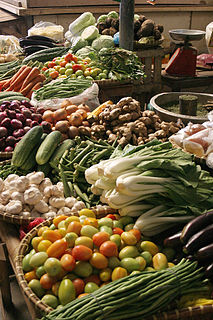
A healthy diet is a diet that helps to maintain or improve overall health. A healthy diet provides the body with essential nutrition: fluid, macronutrients, micronutrients, and adequate calories.

The nutrition facts label is a label required on most packaged food in many countries. Most countries also release overall nutrition guides for general educational purposes. In some cases, the guides are based on different dietary targets for various nutrients than the labels on specific foods.
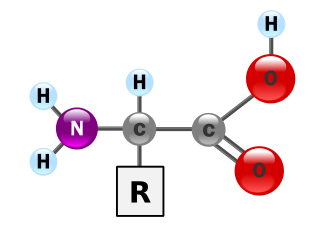
Proteins are essential nutrients for the human body. They are one of the building blocks of body tissue and can also serve as a fuel source. As a fuel, proteins provide as much energy density as carbohydrates: 4 kcal per gram; in contrast, lipids provide 9 kcal per gram. The most important aspect and defining characteristic of protein from a nutritional standpoint is its amino acid composition.

A low-fat diet is one that restricts fat and often saturated fat and cholesterol as well. Low-fat diets are intended to reduce the occurrence of conditions such as heart disease and obesity. For weight loss, they perform similarly to a low-carbohydrate diet, since macronutrient composition does not determine weight loss success. Reducing fat in the diet can make it easier to cut calories. Fat provides nine calories per gram while carbohydrates and protein each provide four calories per gram, so choosing low-fat foods makes it possible to eat a larger volume of food for the same number of calories. This effect is countered by the rapidity of digestion of carbohydrates compared to fats. The Institute of Medicine recommends limiting fat intake to 35% of total calories to help prevent obesity and to help control saturated fat intake. A low-fat diet is not well defined, but a very low fat diet is one that gets less than 15% of daily calories from fat.

The Western pattern diet (WPD) or standard American diet (SAD) is a modern dietary pattern that is generally characterized by high intakes of red meat, processed meat, pre-packaged foods, butter, fried foods, high-fat dairy products, eggs, refined grains, potatoes, corn and high-sugar drinks. The modern standard American diet was brought about by fundamental lifestyle changes following the Neolithic Revolution, and, later, the Industrial Revolution.
The Dietary Guidelines for Americans (DGA) provide nutritional advice for Americans who are more than 2 years old. The Guidelines are published every 5 years by the US Department of Agriculture, together with the US Department of Health and Human Services. The most recent edition is the 2015-2020 Dietary Guidelines for Americans. The nominal purpose of the Dietary Guidelines for Americans is to help health professionals and policymakers to advise Americans about healthy choices for their diet. Although the Dietary Guidelines for Americans are purported to be based on a systematic review of the current body of nutrition science, the Advisory Committee tasked with formulating the plan for retrieval and analysis of the scientific evidence for the current edition of the DGA used a less than rigorous process for assessing the health effects of consumption of saturated fat and salt and for assessing the health effects of a low-fat, high-carbohydrate diet. This less than rigorous review of the nutrition science literature resulted in omission of multiple large, high-quality, clinical trials and also omission of some high-quality prospective observational studies. Some Advisory Committee members also had conflicts-of-interest that in some cases were not fully disclosed. For these reasons, the quality of the Advisory Committee's Scientific Report and the validity of the 2015 - 2020 DGA itself has been challenged by critics as being unduly influenced by commercial interests and as being flawed due to confirmation bias of some members of the Advisory Committee.

Diet plays an important role in the genesis of obesity. Personal choices, food advertising, social customs and cultural influences, as well as food availability and pricing all play a role in determining what and how much an individual eats.

Weight management is the phrase used to describe both the techniques and underlying physiological processes that contribute to a person's ability to attain and maintain a certain weight. Most weight management techniques encompass long-term lifestyle strategies that promote healthy eating and daily physical activity. Moreover, weight management involves developing meaningful ways to track weight over time and to identify ideal body weights for different individuals.
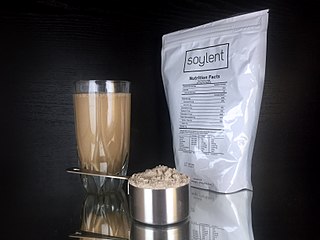
A meal replacement is a drink, bar, soup, etc. intended as a substitute for a solid food meal, usually with controlled quantities of calories and nutrients. Some drinks are in the form of a health shake. Medically prescribed meal replacement drinks include the required vitamins and minerals. Bodybuilders sometimes use meal replacements, not formulated for weight loss, to save food preparation time when they are eating 5 to 6 meals a day.
Snacking does not have a concrete definition. A study taken by Katherine Chaplin and Andrew Smith from the journal Appetite says, “Participants defined snacking as food or drink eaten between main meals”.

Robert H. Lustig is an American pediatric endocrinologist. He is Professor of Pediatrics in the Division of Endocrinology at the University of California, San Francisco (UCSF), where he specializes in neuroendocrinology and childhood obesity. He is also director of UCSF's WATCH program, and president and co-founder of the non-profit Institute for Responsible Nutrition.
Added sugars are sugar carbohydrates added to food and beverages during their production. This type of sugar is chemically indistinguishable from naturally occurring sugars, but the term "added sugar" has become increasingly used in nutrition and medicine to help identify foods characterized by added energy. Added sugars have no nutritional value, only adding "empty calories". Consumption of added sugar is positively correlated with high calorie intake, and through it, with excess weight and obesity. Added sugars are also known as extrinsic, with naturally occurring sugars known as intrinsic.

A sweetened beverage is any beverage with added sugar. It has been described as "liquid candy". Consumption of sweetened beverages has been linked to weight gain, obesity, and associated health risks. According to the CDC, consumption of sweetened beverages is also associated with unhealthy behaviors like smoking, not getting enough sleep and exercise, and eating fast food often and not enough fruits regularly.