
Katanga was one of the four large provinces created in the Belgian Congo in 1914. It was one of the eleven provinces of the Democratic Republic of the Congo between 1966 and 2015, when it was split into the Tanganyika, Haut-Lomami, Lualaba, and Haut-Katanga provinces. Between 1971 and 1997, its official name was Shaba Province.
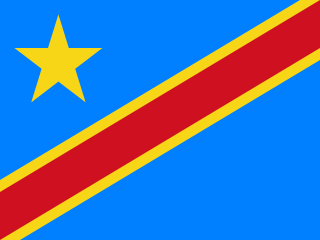
The Democratic Republic of the Congo, informally Congo-Kinshasa, DR Congo, the DRC, the DROC, or the Congo, and formerly and also colloquially Zaire, is a country in Central Africa. The DRC is located in central sub-Saharan Africa, bordered to the northwest by the Republic of the Congo, to the north by the Central African Republic, to the northeast by South Sudan, to the east by Uganda, Rwanda and Burundi, and by Tanzania, to the south and southeast by Zambia, to the southwest by Angola, and to the west by the South Atlantic Ocean and the Cabinda Province exclave of Angola.

The French Congo or Middle Congo was a French colony which at one time comprised the present-day area of the Republic of the Congo and parts of Gabon, and the Central African Republic. In 1910, it was made part of the larger French Equatorial Africa.

African Queen was the name of two boats used in the 1951 movie The African Queen starring Humprey Bogart and Katharine Hepburn. It was filmed in the Belgian Congo on a tributary of the Congo River, and on the Nile in the Murchison Falls National Park in Uganda. Two boats were utilised, one in each location. One of the boats is now located in Key Largo, Florida and on February 18, 1992, was added to the U.S. National Register of Historic Places. The other is located in Jinja, Uganda.
Dercylus is a genus of beetles in the family Carabidae, containing the following species:

Platycorynus compressicornis is a species of beetles belonging to the Chrysomelidae family. This species can be found in tropical Africa.

Purpuricenus laetus is a species of beetle in the family Cerambycidae.
Dicolectes aulicus is a species of leaf beetle of West Africa and the Democratic Republic of the Congo. It was first described from Assinie by Édouard Lefèvre in 1886.
Dicolectes clavareaui is a species of leaf beetle of the Democratic Republic of the Congo, first observed by Kuntzen in 1914.
Dicolectes ornatus is a species of leaf beetle of the Democratic Republic of the Congo, observed by Jacoby in 1894.
Dicolectes rugulosus is a species of leaf beetle. It is distributed in the Democratic Republic of the Congo, Sudan and Ivory Coast. It was described by Édouard Lefèvre in 1886.
Uhehlia nerissidioides is a species of leaf beetle of the Democratic Republic of the Congo, observed by Kuntzen in 1912.
Uhehlia pardalis is a species of leaf beetle of East Africa and the Democratic Republic of the Congo. It was first described from Uhehe, a region now in Tanzania, by Julius Weise in 1906.

Platycorynus dejeani is a species of leaf beetle. It was first described by the Italian entomologist Giuseppe Bertoloni from Inhambane, Mozambique in 1849. It occurs widely in sub-Saharan Africa.
Cheiridea is a genus of leaf beetles in the subfamily Eumolpinae. It contains only one species, Cheiridea chapuisi, found in Sierra Leone. It was first described by Joseph Sugar Baly in 1878.
Dicolectes is a genus of leaf beetles in the subfamily Eumolpinae. It is distributed in Africa.
Ennodius is a genus of leaf beetles in the subfamily Eumolpinae. It is known from Africa.
Nerissus is a genus of leaf beetles in the subfamily Eumolpinae. It is known from Africa.
Uhehlia is a genus of leaf beetles in the subfamily Eumolpinae. It is known from Africa. It was first described by the German entomologist Julius Weise in 1906 from Uhehe, a region now in Tanzania.
