
Delftware or Delft pottery, also known as Delft Blue or as delf, is a general term now used for Dutch tin-glazed earthenware, a form of faience. Most of it is blue and white pottery, and the city of Delft in the Netherlands was the major centre of production, but the term covers wares with other colours, and made elsewhere. It is also used for similar pottery, English delftware.

Émile Gallé was a French artist and designer who worked in glass, and is considered to be one of the major innovators in the French Art Nouveau movement. He was noted for his designs of Art Nouveau glass art and Art Nouveau furniture, and was a founder of the École de Nancy or Nancy School, a movement of design in the city of Nancy, France.

Faience or faïence is the general English language term for fine tin-glazed pottery. The invention of a white pottery glaze suitable for painted decoration, by the addition of an oxide of tin to the slip of a lead glaze, was a major advance in the history of pottery. The invention seems to have been made in Iran or the Middle East before the ninth century. A kiln capable of producing temperatures exceeding 1,000 °C (1,830 °F) was required to achieve this result, the result of millennia of refined pottery-making traditions. The term is now used for a wide variety of pottery from several parts of the world, including many types of European painted wares, often produced as cheaper versions of porcelain styles.

Barro negro pottery is a style of pottery from Oaxaca, Mexico, distinguished by its color, sheen and unique designs. Oaxaca is one of few Mexican states which is characterized by the continuance of its ancestral crafts, which are still used in everyday life. Barro negro is one of several pottery traditions in the state, which also include the glazed green pieces of Santa María Atzompa; however, barro negro is one of the best known and most identified with the state. It is also one of the most popular and appreciated styles of pottery in Mexico. The origins of this pottery style extends as far back as the Monte Albán period and for almost all of this pottery's history, had been available only in a grayish matte finish. In the 1950s, a potter named Doña Rosa devised a way to put a black metallic like sheen onto the pottery by polishing it before firing. This look has made the pottery far more popular. From the 1980s to the present, an artisan named Carlomagno Pedro Martínez has promoted items made this way with barro negro sculptures which have been exhibited in a number of countries.
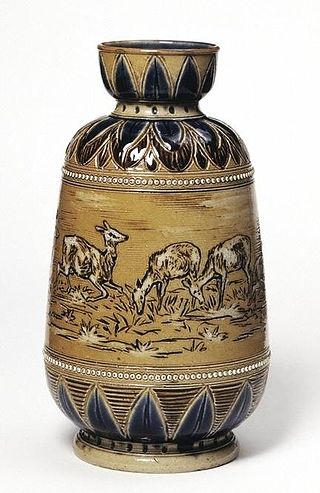
Royal Doulton is an English ceramic and home accessories manufacturer that was founded in 1815. Operating originally in Vauxhall, London, and later moving to Lambeth, in 1882 it opened a factory in Burslem, Stoke-on-Trent, in the centre of English pottery. From the start, the backbone of the business was a wide range of utilitarian wares, mostly stonewares, including storage jars, tankards and the like, and later extending to drain pipes, lavatories, water filters, electrical porcelain and other technical ceramics. From 1853 to 1901, its wares were marked Doulton & Co., then from 1901, when a royal warrant was given, Royal Doulton.

Frederick Hurten Rhead (1880–1942) was a ceramicist and a major figure in the Arts and Crafts movement. A native of England, worked as a potter in the United States for most of his career. In addition to teaching pottery techniques, Rhead was highly influential in both studio and commercial pottery. He worked for the Roseville Pottery, established his own Rhead Pottery (1913–1917), and in 1935 designed the highly successful Fiesta ware for Homer Laughlin China Company.

Mintons was a major company in Staffordshire pottery, "Europe's leading ceramic factory during the Victorian era", an independent business from 1793 to 1968. It was a leader in ceramic design, working in a number of different ceramic bodies, decorative techniques, and "a glorious pot-pourri of styles - Rococo shapes with Oriental motifs, Classical shapes with Medieval designs and Art Nouveau borders were among the many wonderful concoctions". As well as pottery vessels and sculptures, the firm was a leading manufacturer of tiles and other architectural ceramics, producing work for both the Houses of Parliament and United States Capitol.
The Overbeck sisters were American women potters and artists of the Arts and Crafts Movement who established Overbeck Pottery in their Cambridge City, Indiana, home in 1911 with the goal of producing original, high-quality, hand-wrought ceramics as their primary source of income. The sisters are best known for their fanciful figurines, their skill in matte glazes, and their stylized designs of plants and animals in the Art Nouveau and Art Deco styles. The women owned and handled all aspects of their artistic enterprise until 1955, when the last of the sisters died and the pottery closed. As a result of their efforts, the Overbecks managed to become economically independent and earned a modest living from the sales of their art.

Gzhel is a Russian style of blue and white ceramics which takes its name from the village of Gzhel and surrounding area, where it has been produced since 1802.

Art pottery is a term for pottery with artistic aspirations, made in relatively small quantities, mostly between about 1870 and 1930. Typically, sets of the usual tableware items are excluded from the term; instead the objects produced are mostly decorative vessels such as vases, jugs, bowls and the like which are sold singly. The term originated in the later 19th century, and is usually used only for pottery produced from that period onwards. It tends to be used for ceramics produced in factory conditions, but in relatively small quantities, using skilled workers, with at the least close supervision by a designer or some sort of artistic director. Studio pottery is a step up, supposed to be produced in even smaller quantities, with the hands-on participation of an artist-potter, who often performs all or most of the production stages. But the use of both terms can be elastic. Ceramic art is often a much wider term, covering all pottery that comes within the scope of art history, but "ceramic artist" is often used for hands-on artist potters in studio pottery.

The Grueby Faience Company, founded in 1894, was an American ceramics company that produced distinctive American art pottery vases and tiles during America's Arts and Crafts Movement.

Hugh C. Robertson (1845–1908) was the first American studio potter who experimented with new ceramic glazes. Born in England, Robertson apprenticed at the Jersey City Potter in 1860. In 1868, he started work in his father's shop that had opened in 1866 in Chelsea, Massachusetts. In 1872 the factory was incorporated into the Chelsea Keramic Art Works (CKAW). The company became known for their antique Grecian terra cotta and Pompeian bronzes. In 1877, Robertson developed the Chelsea faience, underglazed opaque earthenware, which led the development of other American faience. There in 1884, Robertson worked on discovering the famous Chinese sang de boeuf glaze. In 1888, he finally discovered the recipe for the glaze and produced three hundred pieces of what he dubbed, Sang de Chelsea.

Ceramics in Mexico date back thousands of years before the Pre-Columbian period, when ceramic arts and pottery crafts developed with the first advanced civilizations and cultures of Mesoamerica. With one exception, pre-Hispanic wares were not glazed, but rather burnished and painted with colored fine clay slips. The potter's wheel was unknown as well; pieces were shaped by molding, coiling and other methods,

French porcelain has a history spanning a period from the 17th century to the present. The French were heavily involved in the early European efforts to discover the secrets of making the hard-paste porcelain known from Chinese and Japanese export porcelain. They succeeded in developing soft-paste porcelain, but Meissen porcelain was the first to make true hard-paste, around 1710, and the French took over 50 years to catch up with Meissen and the other German factories.

Edmond Lachenal was a French potter. He was a key figure in the French art pottery movement, and his works are held in many international public collections.

Newcomb Pottery, also called Newcomb College Pottery, was a brand of American Arts & Crafts pottery produced from 1895 to 1940. The company grew out of the pottery program at H. Sophie Newcomb Memorial College, the women's college now associated with Tulane University in New Orleans, Louisiana. The Pottery was a contemporary of Rookwood Pottery, the Saturday Evening Girls, North Dakota pottery, Teco and Grueby.

Rookwood Pottery is an American ceramics company that was founded in 1880 and closed in 1967, before being revived in 2004. It was initially located in the Over-the-Rhine neighborhood in Cincinnati, Ohio, and has now returned there. In its heyday from about 1890 to the 1929 Crash, it was an important manufacturer, mostly of decorative American art pottery made in several fashionable styles and types of pieces.

American art pottery refers to aesthetically distinctive hand-made ceramics in earthenware and stoneware from the period 1870-1950s. Ranging from tall vases to tiles, the work features original designs, simplified shapes, and experimental glazes and painting techniques. Stylistically, most of this work is affiliated with the modernizing Arts and Crafts (1880-1910), Art Nouveau (1890–1910), or Art Deco (1920s) movements, and also European art pottery.

John Bennett (1840-1907) was a British ceramic artist who spent much of his career in America. He is known for decorative glazed earthenware with natural motifs.
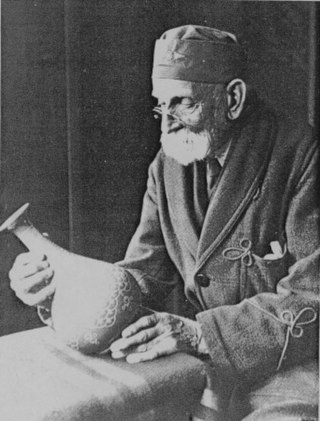
William Ault was an English potter, involved with a number of companies in the Staffordshire potteries and South Derbyshire making art pottery and more utilitarian wares.


