
The Estadio Nemesio Camacho El Campín, commonly known as El Campín, is the main stadium of Bogotá, Colombia. It was inaugurated on 10 August 1938 and has a current capacity of 36,343 spectators. It is the home ground of the Categoría Primera A teams Millonarios F.C and Santa Fe.

The National Stadium of Peru is a multi-purpose stadium located in Lima, Peru. Its current capacity is 40,086 seats as stated by the Peruvian Football Federation without the lodges for some thousands more. The stadium was first inaugurated on 27 October 1952 for the 1953 South American Championship—replacing the Stadium Nacional—and is Peru's principal and national stadium. It has hosted three of the six South American Championship/Copa América football competitions held in Peru. It is referred to as the Coloso de José Díaz because of its proximity to a street of the same name. It is the home ground of the Peru national football team. The IPD —a branch of the Ministry of Education—is the stadium's administrating entity. The stadium has undergone several renovations for tournaments such as the 2004 Copa América. The artificial turf was installed for the 2005 FIFA U-17 World Championship. It will probably be used at the 2021 FIFA U-17 World Cup. The most recent renovation started in 2010 and concluded in 2011. The re-inauguration ceremony of the renovated stadium was held on 24 July 2011 with a match between the Peru national under-20 football team and the Spain national under-20 football team.
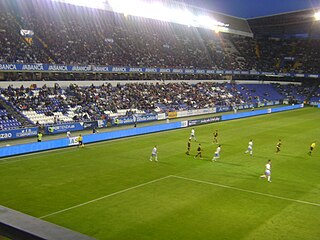
Estadio Municipal de Riazor, also known as Estadio ABANCA-RIAZOR for sponsorship reasons, is an all-seater stadium in A Coruña, Spain. The stadium is the home of Deportivo de La Coruña, and accommodates a total of 32,660 spectators, making it the 13th-largest stadium in Spain and the largest in Galicia.

Estadio La Cartuja, officially known as Estadio La Cartuja de Sevilla, is a multi-purpose stadium situated in the Isla de la Cartuja in Seville, Spain. It is used mostly for football and it is commonly referred to as simply 'la Cartuja'. It was completed in 1999 for the World Championships in Athletics. With a capacity of 57,619 seats, La Cartuja is the 5th-largest stadium in Spain and the 2nd-largest in Andalusia. It was the venue for the 2003 UEFA Cup Final between Celtic and Porto.

Estadio El Sadar is a football stadium in Pamplona, Navarre, Spain. The stadium holds 23,576 people. It was built in 1967 and is the home of CA Osasuna. It is currently used mostly for football matches.

Power Horse Stadium is a multi-purpose stadium in Almería, Spain. It is the home ground of UD Almería, and holds 15,274 people.

The National Stadium of Costa Rica is a multi-purpose stadium in La Sabana Metropolitan Park, San José, Costa Rica. It is the first modern sport and event arena to be built in Central America. The stadium was completed in 2011 and officially opened its doors to the public on March 26 that year, with a capacity of 35,175 seats. The stadium replaced the original National Stadium, and is the home stadium of the Costa Rica national football team.

Estadio de Béisbol Monclova is a stadium in Monclova, Mexico. It is primarily used for baseball and is the home field of the Monclova Steelers. It holds 8,500 people.

Estadio Francisco I. Madero is a stadium in Saltillo, Mexico. It is primarily used for baseball and is the home field of the Saraperos de Saltillo. It holds 12,000 people, and features a video screen measuring 14 meters high by 22 meters wide. The stadium is named after Coahuila native Francisco I. Madero who served as President of Mexico from 1911 to 1913.

The Estadio Akron, formerly known as the Estadio Omnilife and Estadio Chivas (Estadio Chivas, Spanish pronunciation: [esˈtaðjo ˈtʃiβas]), is a multipurpose stadium that is used mostly for football matches. It is the home of Liga MX side C.D. Guadalajara. It is part of the JVC complex, and has a capacity of 48,071. Construction started in February 2004, but due to financial problems and other issues, the stadium's completion was delayed for a number of years.

Estadio La Independencia is a multi-use stadium in the city of Tunja, Colombia. It is currently used mostly for football matches. The stadium has a capacity of 25,000 people, and is 2,800 metres above sea level. Boyacá Chicó and Patriotas play their home games at this stadium.

The Alfredo Di Stéfano Stadium(Spanish: Estadio Alfredo Di Stéfano) is a football stadium in Madrid, Spain. It is named after Real Madrid's legendary former player Alfredo Di Stéfano.

Félix Sánchez Olympic Stadium is a multi-purpose stadium in Santo Domingo, Dominican Republic, built in 1974 for the XII Central American & Caribbean Games.

The Estadio BBVA, nicknamed "El Gigante de Acero", formerly known as the Estadio BBVA Bancomer, is a stadium developed by FEMSA and C.F. Monterrey in Guadalupe, Greater Monterrey. The stadium replaced the Estadio Tecnológico as the home of Monterrey, ending 63 years of residency at that stadium. The project was met with controversy, stemming from multiple accusations of the construction as an apparent impediment to wildlife growth on a local scale by deforesting 24.5 hectares of forest neighboring a natural protected area that houses 106 animal species, including 8 endangered or protected species such as the yellow headed parrot. It was inaugurated on 2 August 2015 with the eighth edition of the Eusébio Cup, where Monterrey defeated Benfica 3–0.
The knockout phase of the 2010–11 UEFA Europa League began on 15 February and concluded on 18 May 2011 with the final at Aviva Stadium in Dublin, Republic of Ireland. The knockout phase involved 32 teams: the 24 teams that finished in the top two in each group in the group stage and the eight teams that finished in third place in the UEFA Champions League group stage.

The Estadio Jesús Martínez "Palillo" is a multi-use stadium located in the Magdalena Mixhuca Sports City in Mexico City. It is currently the home of the Mexicas of the Liga de Fútbol Americano Profesional (LFA) and Guerreros de Xico of the Serie B de México. The stadium has a capacity of 6,000 seated spectators.
Catedráticos Elite Fútbol Club is a football club that plays in the Liga Premier de México – Serie A. It is based in the city of Ameca, Mexico.

