Related Research Articles

Gregory the Illuminator is the patron saint and first official head of the Armenian Apostolic Church. He was a religious leader who is credited with converting Armenia from paganism to Christianity in 301.

The Armenian Apostolic Church is the national church of the Armenian people. Part of Oriental Orthodoxy, it is one of the most ancient Christian institutions. The Kingdom of Armenia was the first state to adopt Christianity as its official religion under the rule of King Tiridates III of the Arsacid dynasty in the early 4th century. According to tradition, the church originated in the missions of Apostles Bartholomew and Thaddeus of Edessa in the 1st century.
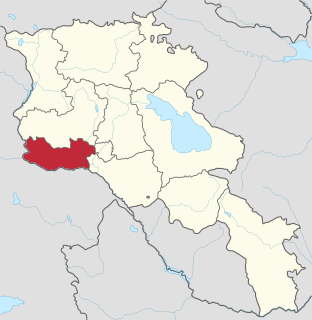
Armavir, is a province (marz) in the western part of Armenia. Located in the Ararat plain dominated by Mount Ararat from the south and Mount Aragats from the north, the province's capital is the town of Armavir while the largest city is Vagharshapat (Etchmiadzin). The province shares a 72 km (45 mi)-long border with Turkey to the south and west.

Soghomon Soghomonian, ordained and commonly known as Komitas, was an Armenian priest, musicologist, composer, arranger, singer, and choirmaster, who is considered the founder of the Armenian national school of music. He is recognized as one of the pioneers of ethnomusicology.
Etchmiadzin Cathedral is the mother church of the Armenian Apostolic Church, located in the city of Vagharshapat (Etchmiadzin), Armenia. According to most scholars it was the first cathedral built in ancient Armenia, and is often considered the oldest cathedral in the world.
Catholicos, plural Catholicoi, is a title used for the head of certain churches in some Eastern Christian traditions. The title implies autocephaly and in some cases it is the title of the head of an autonomous church. The word comes from ancient Greek καθολικός, pl. καθολικοί, derived from καθ' ὅλου from κατά and ὅλος, meaning "concerning the whole, universal, general"; it originally designated a financial or civil office in the Roman Empire. The name of the Catholic Church comes from the same word - however, the title "Catholicos" does not exist in its hierarchy.
Armenian literature begins around AD 400 with the invention of the Armenian alphabet by Mesrop Mashtots.

The Armenian Church of Saint Gregory the Illuminator, referred to locally as the Armenian Church, is the oldest Christian church in Singapore, located at Hill Street in the Museum Planning Area, within the Central Area. The church was completed in 1835 and consecrated the next year. Originally a parish of the Armenian Apostolic Church, an Oriental Orthodox denomination, the last Armenian parish priest left in the late 1930s as Armenian population in Singapore dwindled. It was designated as a national monument in 1973. Armenian and Oriental Orthodox services are now regularly held at the church.
The Armenians in Syria are Syrian citizens of either full or partial Armenian descent.

The following outline is provided as an overview of and topical guide to manufacturing:

The Armenian Catholicosate of the Great House of Cilicia is an autocephalous Oriental Orthodox church. Since 1930, the Catholicosate of the Great House of Cilicia has been headquartered in Antelias, Lebanon. Aram I is the Catholicos of Cilicia of the Armenian Apostolic Church since 1995.

Saint Hripsime Church is a seventh century Armenian Apostolic church in the city of Vagharshapat (Etchmiadzin), Armenia. It is one of the oldest surviving churches in the country. The church was erected by Catholicos Komitas to replace the original mausoleum built by Catholicos Sahak the Great in 395 AD that contained the remains of the martyred Saint Hripsime to whom the church is dedicated. The current structure was completed in 618 AD. It is known for its fine Armenian-style architecture of the classical period, which has influenced many other Armenian churches since. It was listed as a UNESCO World Heritage Site along with other nearby churches, including Etchmiadzin Cathedral, Armenia's mother church, in 2000.

Vagharshapat is the 4th-largest city in Armenia and the most populous municipal community of Armavir Province, located about 18 km (11 mi) west of the capital Yerevan, and 10 km (6 mi) north of the closed Turkish-Armenian border. It is commonly known as Ejmiatsin, which was its official name between 1945 and 1995. It is still commonly used colloquially and in official bureaucracy.

Gevorkian Theological Seminary, also known as Gevorkian Seminary, is a theological university-institute of the Armenian Apostolic Church founded by Catholicos George IV in 1874. It is located in the town of Vagharshapat (Etchmiadzin) within the complex of the Mother See of Holy Etchmiadzin, Armenia.

The Forty Martyrs Armenian Cathedral of Aleppo, Syria, is a 15th-century Armenian Apostolic church located in the old Christian quarter of Jdeydeh. It is significant among the Armenian churches for being one of the oldest active churches in the Armenian diaspora and the city of Aleppo. It is a three-nave basilica church with no dome. Its bell tower of 1912, is considered to be one of the unique samples of the baroque architecture in Aleppo.
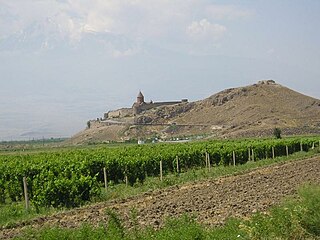
Armenian wine is wine made in Armenia, in the region of South Caucasus. Armenia is one of the oldest wine producing regions of the world. In particular, the oldest known winery was found in Armenia's Areni region, which to this day is still known of its wine production and endemic grapes.

Rafayel "Rafo" Israyelian was an Armenian architect.
Like most communities of the Armenian Diaspora, the Armenian-Cypriot community is predominantly Armenian Apostolic. Some 5% belong either to the Armenian Evangelical Church, the Armenian Catholic Church, the Latin Church, the Greek Orthodox Church, the Anglican Church, the Plymouth Brethren Church, the Seventh-day Adventist Church or they are Jehovah's Witnesses; of this 5%, historically the most significant groups have been Armenian Evangelicals, who in the 1940s and 1950s comprised about 10% of the Armenian-Cypriot community, and Armenian-Catholics, who have been on the island since the time of the Crusades.
Simeon I of Yerevan or Simeon Yerevantsi was the Catholicos of All Armenians from 1763 to 1780. In 1771, he founded a printing press at the Etchmiadzin Cathedral, the first in Armenia. According to Rouben Paul Adalian, the pontificate of Simeon I of Yerevan marked the reemergence of Etchmiadzin as a "truly important center of Armenian national affairs".
References
- ↑ The Memoir of Simeon Catholicos "Simeon Erevantsi's letter to Mr. Kevork of Kars", May 22, 1775, page 403
- ↑ The Memoir of Simeon Catholicos "Simeon Erevantsi's letter to Mr. Kevork of Kars", July 1775, page 464
- ↑ The Memoir of Simeon Catholicos "Simeon Erevantsi's letter to Hovsep vartabed", October 27, 1776, page 512
- ↑ 40 paras make 1 ghroush։