 | Look up exotic in Wiktionary, the free dictionary. |
Exotic may refer to:
| Look up exotic in Wiktionary, the free dictionary. |
Exotic may refer to:


In mathematics, differential topology is the field dealing with the topological properties and smooth properties of smooth manifolds. In this sense differential topology is distinct from the closely related field of differential geometry, which concerns the geometric properties of smooth manifolds, including notions of size, distance, and rigid shape. By comparison differential topology is concerned with coarser properties, such as the number of holes in a manifold, its homotopy type, or the structure of its diffeomorphism group. Because many of these coarser properties may be captured algebraically, differential topology has strong links to algebraic topology.

In mathematics, a diffeomorphism is an isomorphism of smooth manifolds. It is an invertible function that maps one differentiable manifold to another such that both the function and its inverse are differentiable.
In particle physics, a hadron is a composite subatomic particle made of two or more quarks held together by the strong interaction. They are analogous to molecules that are held together by the electric force. Most of the mass of ordinary matter comes from two hadrons: the proton and the neutron, while most of the mass of the protons and neutrons is in turn due to the binding energy of their constituent quarks, due to the strong force.
An exotic atom is an otherwise normal atom in which one or more sub-atomic particles have been replaced by other particles of the same charge. For example, electrons may be replaced by other negatively charged particles such as muons or pions. Because these substitute particles are usually unstable, exotic atoms typically have very short lifetimes and no exotic atom observed so far can persist under normal conditions.
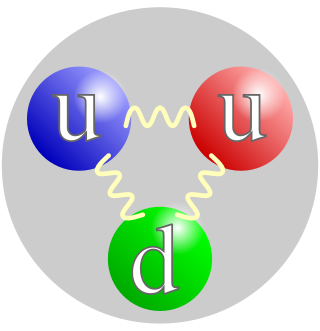
In physical sciences, a subatomic particle is a particle that is smaller than an atom. According to the Standard Model of particle physics, a subatomic particle can be either a composite particle, which is composed of other particles, or an elementary particle, which is not composed of other particles. Particle physics and nuclear physics study these particles and how they interact.
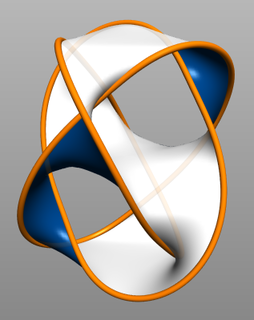
In mathematics, geometric topology is the study of manifolds and maps between them, particularly embeddings of one manifold into another.

In mathematics, low-dimensional topology is the branch of topology that studies manifolds, or more generally topological spaces, of four or fewer dimensions. Representative topics are the structure theory of 3-manifolds and 4-manifolds, knot theory, and braid groups. This can be regarded as a part of geometric topology. It may also be used to refer to the study of topological spaces of dimension 1, though this is more typically considered part of continuum theory.
In mathematics, an n-dimensional differential structure on a set M makes M into an n-dimensional differential manifold, which is a topological manifold with some additional structure that allows for differential calculus on the manifold. If M is already a topological manifold, it is required that the new topology be identical to the existing one.
In an area of mathematics called differential topology, an exotic sphere is a differentiable manifold M that is homeomorphic but not diffeomorphic to the standard Euclidean n-sphere. That is, M is a sphere from the point of view of all its topological properties, but carrying a smooth structure that is not the familiar one.
In mathematics, a 4-manifold is a 4-dimensional topological manifold. A smooth 4-manifold is a 4-manifold with a smooth structure. In dimension four, in marked contrast with lower dimensions, topological and smooth manifolds are quite different. There exist some topological 4-manifolds which admit no smooth structure, and even if there exists a smooth structure, it need not be unique.
In mathematics, more specifically differential topology, a local diffeomorphism is intuitively a map between Smooth manifolds that preserves the local differentiable structure. The formal definition of a local diffeomorphism is given below.

In mathematics, a manifold is a topological space that locally resembles Euclidean space near each point. More precisely, an n-dimensional manifold, or n-manifold for short, is a topological space with the property that each point has a neighborhood that is homeomorphic to an open subset of n-dimensional Euclidean space.
In mathematics, an exotic is a differentiable manifold that is homeomorphic but not diffeomorphic to the Euclidean space The first examples were found in 1982 by Michael Freedman and others, by using the contrast between Freedman's theorems about topological 4-manifolds, and Simon Donaldson's theorems about smooth 4-manifolds. There is a continuum of non-diffeomorphic differentiable structures of as was shown first by Clifford Taubes.
In mathematics, a Hilbert manifold is a manifold modeled on Hilbert spaces. Thus it is a separable Hausdorff space in which each point has a neighbourhood homeomorphic to an infinite dimensional Hilbert space. The concept of a Hilbert manifold provides a possibility of extending the theory of manifolds to infinite-dimensional setting. Analogously to the finite-dimensional situation, one can define a differentiable Hilbert manifold by considering a maximal atlas in which the transition maps are differentiable.
In Riemannian geometry, the sphere theorem, also known as the quarter-pinched sphere theorem, strongly restricts the topology of manifolds admitting metrics with a particular curvature bound. The precise statement of the theorem is as follows. If M is a complete, simply-connected, n-dimensional Riemannian manifold with sectional curvature taking values in the interval then M is homeomorphic to the n-sphere. Another way of stating the result is that if M is not homeomorphic to the sphere, then it is impossible to put a metric on M with quarter-pinched curvature.
In mathematics, specifically differential and algebraic topology, during the mid 1950's John Milnorpg 14 was trying to understand the structure of -connected manifolds of dimension and found an example of a space which is homotopy equivalent to a sphere, but was not explicitly diffeomorphic. He did this through looking at real vector bundles over a sphere and studied the properties of the associated disk bundle. It turns out, the boundary of this bundle is homotopically equivalent to a sphere , but in certain cases it is not diffeomorphic. This lack of diffeomorphism comes from studying a hypothetical cobordism between this boundary and a sphere, and showing this hypothetical cobordism invalidates certain properties of the Hirzebruch signature theorem.
In the mathematical area of topology, the generalized Poincaré conjecture is a statement that a manifold which is a homotopy sphere is a sphere. More precisely, one fixes a category of manifolds: topological (Top), piecewise linear (PL), or differentiable (Diff). Then the statement is
In differential topology, a branch of mathematics, a Mazur manifold is a contractible, compact, smooth four-dimensional manifold which is not diffeomorphic to the standard 4-ball. The boundary of a Mazur manifold is necessarily a homology 3-sphere.
In mathematics, the surgery structure set is the basic object in the study of manifolds which are homotopy equivalent to a closed manifold X. It is a concept which helps to answer the question whether two homotopy equivalent manifolds are diffeomorphic. There are different versions of the structure set depending on the category and whether Whitehead torsion is taken into account or not.