Exportation (logic)

Last updated
Exportation
Type Rule of replacement
Field Propositional calculus
Symbolic statement

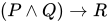
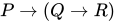
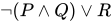
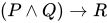
Exportation [1] [2] [3] [4] is a valid rule of replacement in propositional logic. The rule allows conditional statements having conjunctive antecedents to be replaced by statements having conditional consequents and vice versa in logical proofs. It is the rule that:

Contents

Where "" is a metalogical symbol representing "can be replaced in a proof with." In strict terminology, is the law of exportation, for it "exports" a proposition from the antecedent of to its consequent. Its converse, the law of importation, , "imports" a proposition from the consequent of to its antecedent.


Formal notation

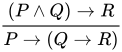
The exportation rule may be written in sequent notation:

where is a metalogical symbol meaning that is a syntactic equivalent of in some logical system;

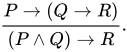
or in rule form:

,

where the rule is that wherever an instance of "" appears on a line of a proof, it can be replaced with "", and vice versa.

Import-export is a name given to the statement as a theorem or truth-functional tautology of propositional logic:

where , , and are propositions expressed in some logical system.

Natural language

Example

It rains and the sun shines implies that there is a rainbow.
Thus, if it rains, then the sun shines implies that there is a rainbow.

If my car is on, when I switch the gear to D the car starts going. If my car is on and I have switched the gear to D, then the car must start going.

Proof

The following proof uses a classically valid chain of equivalences. Rules used are material implication, De Morgan's law, and the associative property of conjunction.

PropositionDerivation
Given
material implication
associativity
De Morgan's law
material implication

Due to the use of De Morgan's law, this is not an intuitionistically valid proof.

Relation to functions

Exportation is associated with currying via the Curry–Howard correspondence.[ citation needed ]

References

  1. Hurley, Patrick (1991). A Concise Introduction to Logic 4th edition . Wadsworth Publishing. pp. 364–5. ISBN   9780534145156.
  2. Copi, Irving M.; Cohen, Carl (2005). Introduction to Logic. Prentice Hall. p. 371.
  3. Moore and Parker
  4. "Rules of Replacement".