
The ionosphere is the ionized part of the upper atmosphere of Earth, from about 48 km (30 mi) to 965 km (600 mi) above sea level, a region that includes the thermosphere and parts of the mesosphere and exosphere. The ionosphere is ionized by solar radiation. It plays an important role in atmospheric electricity and forms the inner edge of the magnetosphere. It has practical importance because, among other functions, it influences radio propagation to distant places on Earth.

In astronomy and planetary science, a magnetosphere is a region of space surrounding an astronomical object in which charged particles are affected by that object's magnetic field. It is created by a celestial body with an active interior dynamo.
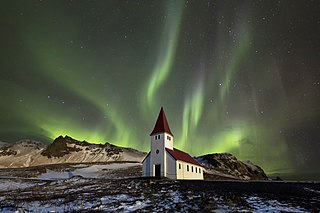
An aurora , also commonly known as the polar lights, is a natural light display in Earth's sky, predominantly seen in high-latitude regions. Auroras display dynamic patterns of brilliant lights that appear as curtains, rays, spirals, or dynamic flickers covering the entire sky.

A solar flare is an intense localized eruption of electromagnetic radiation in the Sun's atmosphere. Flares occur in active regions and are often, but not always, accompanied by coronal mass ejections, solar particle events, and other solar phenomena. The occurrence of solar flares varies with the 11-year solar cycle.

Space weather is a branch of space physics and aeronomy, or heliophysics, concerned with the time varying conditions within the Solar System, including the solar wind, emphasizing the space surrounding the Earth, including conditions in the magnetosphere, ionosphere, thermosphere, and exosphere. Space weather is distinct from, but conceptually related to, the terrestrial weather of the atmosphere of Earth. The term "space weather" was first used in the 1950s and came into common usage in the 1990s. Later, it was generalized to a "space climate" research discipline, which focuses on general behaviors of longer and larger-scale variabilities and effects.

Earth's magnetic field, also known as the geomagnetic field, is the magnetic field that extends from Earth's interior out into space, where it interacts with the solar wind, a stream of charged particles emanating from the Sun. The magnetic field is generated by electric currents due to the motion of convection currents of a mixture of molten iron and nickel in Earth's outer core: these convection currents are caused by heat escaping from the core, a natural process called a geodynamo.

A geomagnetic storm, also known as a magnetic storm, is a temporary disturbance of the Earth's magnetosphere caused by a solar wind shock wave and/or cloud of magnetic field that interacts with the Earth's magnetic field.
The Faraday effect or Faraday rotation, sometimes referred to as the magneto-optic Faraday effect (MOFE), is a physical magneto-optical phenomenon. The Faraday effect causes a polarization rotation which is proportional to the projection of the magnetic field along the direction of the light propagation. Formally, it is a special case of gyroelectromagnetism obtained when the dielectric permittivity tensor is diagonal. This effect occurs in most optically transparent dielectric materials under the influence of magnetic fields.

A Birkeland current is a set of electrical currents that flow along geomagnetic field lines connecting the Earth's magnetosphere to the Earth's high latitude ionosphere. In the Earth's magnetosphere, the currents are driven by the solar wind and interplanetary magnetic field and by bulk motions of plasma through the magnetosphere. The strength of the Birkeland currents changes with activity in the magnetosphere. Small scale variations in the upward current sheets accelerate magnetospheric electrons which, when they reach the upper atmosphere, create the Auroras Borealis and Australis. In the high latitude ionosphere, the Birkeland currents close through the region of the auroral electrojet, which flows perpendicular to the local magnetic field in the ionosphere. The Birkeland currents occur in two pairs of field-aligned current sheets. One pair extends from noon through the dusk sector to the midnight sector. The other pair extends from noon through the dawn sector to the midnight sector. The sheet on the high latitude side of the auroral zone is referred to as the Region 1 current sheet and the sheet on the low latitude side is referred to as the Region 2 current sheet.

The Super Dual Auroral Radar Network (SuperDARN) is an international scientific radar network consisting of 35 high frequency (HF) radars located in both the Northern and Southern Hemispheres. SuperDARN radars are primarily used to map high-latitude plasma convection in the F region of the ionosphere, but the radars are also used to study a wider range of geospace phenomena including field aligned currents, magnetic reconnection, geomagnetic storms and substorms, magnetospheric MHD waves, mesospheric winds via meteor ionization trails, and interhemispheric plasma convection asymmetries. The SuperDARN collaboration is composed of radars operated by JHU/APL, Virginia Tech, Dartmouth College, the Geophysical Institute at the University of Alaska Fairbanks, the Institute of Space and Atmospheric Studies at the University of Saskatchewan, the University of Leicester, Lancaster University, La Trobe University, the Solar-Terrestrial Environment Laboratory at Nagoya University, and the Institute for Space Astrophysics and Planetology.

The equatorial electrojet (EEJ) is a narrow ribbon of current flowing eastward in the day time equatorial region of the Earth's ionosphere. The abnormally large amplitude of variations in the horizontal components measured at equatorial geomagnetic observatories, as a result of EEJ, was noticed as early as 1920 from Huancayo geomagnetic observatory. Observations by radar, rockets, satellites, and geomagnetic observatories are used to study EEJ.
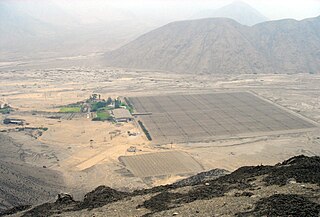
The Jicamarca Radio Observatory (JRO) is the equatorial anchor of the Western Hemisphere chain of Incoherent Scatter Radar (ISR) observatories extending from Lima, Peru to Søndre Strømfjord, Greenland. JRO is the premier scientific facility in the world for studying the equatorial ionosphere. The observatory is about half an hour drive inland (east) from Lima and 10 km from the Central Highway. The magnetic dip angle is about 1°, and varies slightly with altitude and year. The radar can accurately determine the direction of the Earth's magnetic field (B) and can be pointed perpendicular to B at altitudes throughout the ionosphere. The study of the equatorial ionosphere is rapidly becoming a mature field due, in large part, to the contributions made by JRO in radio science.
Satya Prakash is an Indian plasma physicist and a former senior professor at the Physical Research Laboratory. He is known for his studies on Langmuir probes and other contributions in space and plasma sciences. A protégé of Vikram Sarabhai, Satya Prakash is an elected fellow of all the three major Indian science academies such as Indian Academy of Sciences, Indian National Science Academy and National Academy of Sciences, India as well as the Gujarat Science Academy and is a recipient of the Hari Om Ashram Prerit Senior Scientist Award. The Government of India honored him with Padma Shri, the fourth highest Indian civilian award for his contributions to the discipline of Physics, in 1982.

Radio Aurora Explorer (RAX) is the first National Science Foundation sponsored CubeSat mission. The RAX mission is a joint effort between SRI International in Menlo Park, California and the University of Michigan in Ann Arbor, Michigan. The chief scientist at SRI International, Dr. Hasan Bahcivan, led his team at SRI to develop the payload while the chief engineer, Dr. James Cutler, led a team of students to develop the satellite bus in the Michigan Exploration Laboratory. There are currently two satellites in the RAX mission.
The impact of the solar wind onto the magnetosphere generates an electric field within the inner magnetosphere - the convection field-. Its general direction is from dawn to dusk. The co-rotating thermal plasma within the inner magnetosphere drifts orthogonal to that field and to the geomagnetic field Bo. The generation process is not yet completely understood. One possibility is viscous interaction between solar wind and the boundary layer of the magnetosphere (magnetopause). Another process may be magnetic reconnection. Finally, a hydromagnetic dynamo process in the polar regions of the inner magnetosphere may be possible. Direct measurements via satellites have given a fairly good picture of the structure of that field. A number of models of that field exists.

RAX-2 is a CubeSat satellite built as a collaboration between SRI International and students at the University of Michigan College of Engineering. It is the second spacecraft in the RAX mission. The RAX-1 mission ended after approximately two months of operation due to a gradual degradation of the solar panels that ultimately resulted in a loss of power. RAX team members applied the lessons learned from RAX-1 to the design of a second flight unit, RAX-2, which performs the same mission concept of RAX-1 with improved bus performance and additional operational modes. Science measurements are enhanced through interactive experiments with high power ionospheric heaters where FAI will be generated on demand.

In solar physics, a solar particle event (SPE), also known as a solar energetic particle (SEP) event or solar radiation storm, is a solar phenomenon which occurs when particles emitted by the Sun, mostly protons, become accelerated either in the Sun's atmosphere during a solar flare or in interplanetary space by a coronal mass ejection shock. Other nuclei such as helium and HZE ions may also be accelerated during the event. These particles can penetrate the Earth's magnetic field and cause partial ionization of the ionosphere. Energetic protons are a significant radiation hazard to spacecraft and astronauts.

A space hurricane is a huge, funnel-like, spiral geomagnetic storm that occurs above the polar Ionosphere of Earth, during extremely quiet conditions. They are related to the aurora borealis phenomenon, as the electron precipitation from the storm's funnel produces gigantic, cyclone-shaped auroras. Scientists believe that they occur in the polar regions of planets with magnetic fields.

Dynamics Explorer 1 was a NASA high-altitude mission, launched on 3 August 1981, and terminated on 28 February 1991. It consisted of two satellites, DE-1 and DE-2, whose purpose was to investigate the interactions between plasmas in the magnetosphere and those in the ionosphere. The two satellites were launched together into polar coplanar orbits, which allowed them to simultaneously observe the upper and lower parts of the atmosphere.
Dynamics Explorer 2 was a NASA low-altitude mission, launched on 3 August 1981. It consisted of two satellites, DE-1 and DE-2, whose purpose was to investigate the interactions between plasmas in the magnetosphere and those in the ionosphere. The two satellites were launched together into polar coplanar orbits, which allowed them to simultaneously observe the upper and lower parts of the atmosphere.


