
The coat of arms of the United Kingdom are the arms of dominion of the British monarch. They are both the personal arms of the monarch, currently King Charles III, and the arms of the state. In addition to the monarch, the arms are used by state institutions including the Government of the United Kingdom, the Parliament of the United Kingdom, and the British judiciary. Differenced versions of the arms are used by members of the British royal family. The monarch's official flag, the Royal Standard, is the coat of arms in flag form.

The coat of arms of Albania is an adaptation of the flag of Albania and is based on the symbols of Gjergj Kastrioti Skanderbeg. It features the black double-headed eagle, documented in official use since 1458, as evidenced from a sealed document uncovered in the Vatican Secret Archive, addressed to Pope Pius II and co-sealed by notary Johannes Borcius de Grillis. The stylized gold helmet is partially based on the model of crown-like rank that once belonged to Skanderbeg, currently on display at the Kunsthistorisches Museum in Vienna, first mentioned in 1593 in the Ambras armory inventory and depicted in 1601/03 in the "Armamentarium Heroicum" of Jakob Schrenck von Notzing. The ruler of Austria, Ferdinand II, acquired the helmet from the Duke of Urbino, so mentioned in a letter sent to him from the duke, dated 15 October 1578.

The coat of arms of Romania was adopted in the Romanian Parliament on 10 September 1992 as a representative coat of arms for Romania. The current coat of arms is based on the lesser coat of arms of interwar Kingdom of Romania, which was designed in 1921 by the Transylvanian Hungarian heraldist József Sebestyén from Cluj, at the request of King Ferdinand I of Romania, it was redesigned by Victor Dima. As a central element, it shows a golden aquila holding a cross in its beak, and a mace and a sword in its claws. It also consists of the three colors which represent the colors of the national flag. The coat of arms was augmented on 11 July 2016 to add a representation of the Steel Crown of Romania.
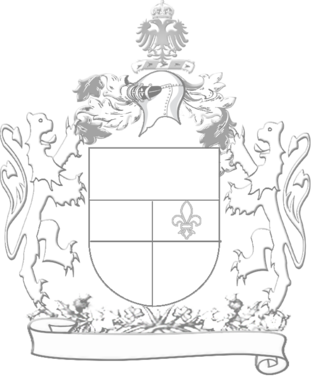
In heraldry, a charge is any emblem or device occupying the field of an escutcheon (shield). That may be a geometric design or a symbolic representation of a person, animal, plant, object, building, or other device. In French blazon, the ordinaries are called pièces, and other charges are called meubles.
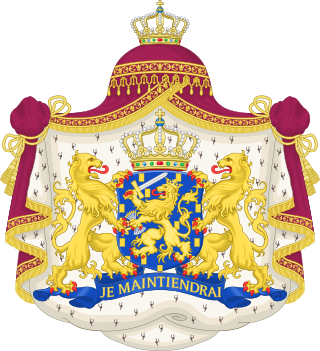
The coat of arms of the Kingdom of the Netherlands was originally adopted in 1815 and later modified in 1907. The arms are a composite of the arms of the former Dutch Republic and the arms of the House of Nassau, it features a checkered shield with a lion grasping a sword in one hand and a bundle of arrows in the other and is the heraldic symbol of the monarch and the country. The monarch uses a version of the arms with a mantle while the government of the Netherlands uses a smaller version without the mantle (cloak) or the pavilion, sometimes only the shield and crown are used. The components of the coats of arms were regulated by Queen Wilhelmina in a royal decree of 10 July 1907, affirmed by Queen Juliana in a royal decree of 23 April 1980.

Canting arms are heraldic bearings that represent the bearer's name in a visual pun or rebus.

The coat of arms of the Czech Republic is divided into two principal variants. Greater coat of arms displays the three historical regions—the Czech lands—which make up the nation. Lesser coat of arms displays lone silver double-tailed lion in red shield. The current coats of arms, which was adopted in 1992, was designed by Czech heraldist Jiří Louda.

The coat of arms of Denmark has a lesser and a greater version.

The coat of arms of Portugal is the main heraldic insignia of Portugal. The present model was officially adopted on 30 June 1911, along with the present model of the Flag of Portugal. It is based on the coat of arms used by the Kingdom of Portugal since the Middle Ages. The coat of arms of Portugal is popularly referred as the Quinas.

Portuguese heraldry encompasses the modern and historic traditions of heraldry in Portugal and the Portuguese Empire. Portuguese heraldry is part of the larger Iberian tradition of heraldry, one of the major schools of heraldic tradition, and grants coats of arms to individuals, cities, Portuguese colonies, and other institutions. Heraldry has been practiced in Portugal at least since the 12th century, however it only became standardized and popularized in the 16th century, during the reign of King Manuel I of Portugal, who created the first heraldic ordinances in the country. Like in other Iberian heraldic traditions, the use of quartering and augmentations of honor is highly representative of Portuguese heraldry, but unlike in any other Iberian traditions, the use of heraldic crests is highly popular.

Lajatico is a comune (municipality) in the Province of Pisa in the Italian region Tuscany, located about 50 kilometers (31 mi) southwest of Florence and about 40 kilometers (25 mi) southeast of Pisa. Lajatico sits in mainly hilly terrain at variable elevations from 100 to 650 meters above sea level) and dominates both the end of the Valdera valley and the opening of the valley known as Val di Cecina.

The coat of arms of Wigan Metropolitan Borough Council was granted by the College of Arms in 1974.
Dajt is a former municipality in the Tirana County, central Albania. At the 2015 local government reform it became a subdivision of the municipality Tirana. The population at the 2011 census was 20,139. The municipal unit took its name from the Mount Dajt.
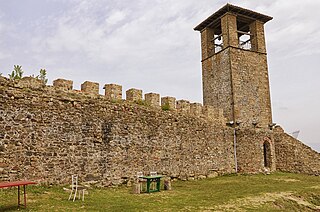
The Prezë Castle is a medieval castle in Prezë, Albania.
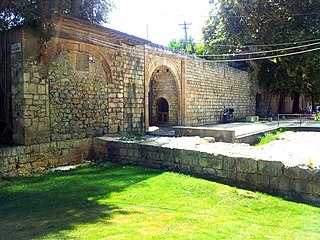
Fortress of Justinian or simply known as Tirana Castle is a castle in Tirana, Albania. Its history dates back before 1300 and is a remnant from the Byzantine-era. The fortress is the place where the main east–west and north–south roads crossed, and formed the heart of Tirana. The current fortification has three known towers and it is undergoing a process of restoration, for touristic purposes. Inside the fortified walls of the former fortress, there are many buildings that can be visited, including restaurants, hotels, and cultural institutions.

The Clock Tower of Tirana, was built in 1822 in Tirana, Albania by Et'hem bey Mollaj, a Bejtexhinj poet who also finished the Et'hem Bey Mosque next to the clock tower. Watchmaster Ismail Tufina was the first to assemble the Tirana clock mechanism in 1822. It is a monument of culture of first category, approved on 24 May 1948.
The Tirana coat of arms, also known as the Shield of Tirana, is the coat of arms of Tirana, features a shield with a clock tower and lion beneath a castle. The coat of arms was approved by the city council on November 14, 2000. Based on the principles of the blazoning it features Per pale Gules and Azure, dexter a Clock Tower Argent, sinister a lion rampant Argent, in chief a fleur-de-lis Or. Above the shield, a representation of Tirana Castle proper.
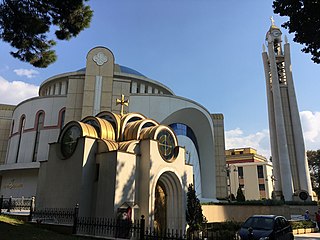
There are many landmarks in Tirana, Albania some of which are of considerable historical or artistic interest. Many monuments and landmarks situated in Tirana, date back to the Illyrian, Roman, Greek and Ottoman periods.
The Skura were a medieval Albanian feudal family centred around the historical and ethnographic region of Benda in the highlands north-east of modern Tirana, central Albania. They were among the Albanian families that rose to prominence in the Theme of Dyrrhachium and reached high military-administrative ranks within the Byzantine state apparatus. On top of their relations with the Byzantine Empire and other members of the local Albanian nobility, the Skura were also closely involved with other prominent powers in the region, such as the Angevin Kingdom of Albania and the Ottoman Empire.

The coat of arms of Castile was the heraldic emblem of its monarchs. Historian Michel Pastoureau says that the original purpose of heraldic emblems and seals was to facilitate the exercise of power and the identification of the ruler, due to what they offered for achieving these aims. These symbols were associated with the kingdom, and eventually also represented the intangible nature of the national sentiment or sense of belonging to a territory.


