You can help expand this article with text translated from the corresponding article in German. (November 2007)Click [show] for important translation instructions.
View a machine-translated version of the German article.
Machine translation, like DeepL or Google Translate, is a useful starting point for translations, but translators must revise errors as necessary and confirm that the translation is accurate, rather than simply copy-pasting machine-translated text into the English Wikipedia.
Do not translate text that appears unreliable or low-quality. If possible, verify the text with references provided in the foreign-language article.
You must provide copyright attribution in the edit summary accompanying your translation by providing an interlanguage link to the source of your translation. A model attribution edit summary is Content in this edit is translated from the existing German Wikipedia article at [[:de:Floh de Cologne]]; see its history for attribution.
You may also add the template {{Translated|de|Floh de Cologne}} to the talk page.
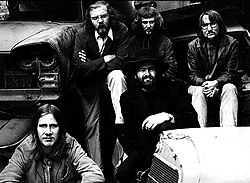
Floh de Cologne (wordplay on Eau de Cologne) were a German band, active from 1966 to 1983, regarded as a pioneer of krautrock and Political Satire Music. After some success at the beginning of the 70s, the band separated finally in 1983.[1]
Markus Schmid (Bass Guitar, Guitar, Vocals, Keyboards) until 1974
Gerd Wollschon (Vocals, Keyboards) until 1976
Other Members
Hans-Jörg “Hansi” Frank (Drums, Keyboards, Vocals) since 1966
Dieter Klemm (Percussion, Speaker, Management) since 1967
Dick Städtler (Bass Guitar, Guitar, Vocals) since 1969
Theo König (Saxophone, Clarinet, Harmonica, Vocals) since 1972
Vridolin Enxing (Keyboards, Bass Guitar, Guitar, Cello, Vocals) since 1973
History
The group was formed in 1966 by a group of radical theatre students from the University of Cologne.[2] The band originated from the Cologne APO (Extra-Parliamentary Opposition) around the SDS (Socialist German Student Union), and their political orientation shifted over the years towards a dialectical-Marxist position. Independently of one another, the band members joined the DKP (German Communist Party) between 1970 and 1973. Their first album, Vietnam, released in 1968, is a fierce criticism of the war in Vietnam.[2] the profits made from said album was donated to a Vietnamese charity. They satirised consumer society and sought to take their message to young workers and apprentices.[3][2] Impressed by their music and especially their lyrics, Rolf-Ulrich Kaiser decided to produce their next two albums: Rockoper Profitgeier (1971) and Lucky Streik (1972).
On September 6, 1970, the group performed at the Fehmarn Festival, following Jimi Hendrix. In 1973, Floh de Cologne performed as part of a West German delegation at the 10th World Festival of Youth and Students in East Berlin.[4] After Gerd Wollschon's departure (1976), the group increasingly collaborated with the lyricist Peter Maiwald, who contributed important songs for their stage shows and LPs. From 1980 onwards, members of the band (Vridolin Enxing as chairman) were active in Rock gegen Rechts; in the same year, the group received the German Cabaret Prize together with Gerhard Polt. After more than 3,000 concerts in Germany and Europe, Floh de Cologne disbanded in May 1983 following a farewell tour. The farewell concert at the Cologne Sports Hall had 6,000 spectators and lasted 14 hours, featuring numerous musicians such as Hannes Wader, Dieter Süverkrüp, Franz-Josef Degenhardt, Hanns-Dieter Hüsch, Die 3 Tornados, Wolfgang Niedecken (BAP), and Ina Deter.[5][6] In 2023, the band received the Holger Czukay Honorary Award from the City of Cologne for their lifetime artistic achievements.[7][8]
Their musical style is considered to be krautrock.
After the originally conventional cabaret group Floh de Cologne experienced underground bands like the Mothers of Invention, the Fugs, and the Edgar Broughton Band at the Essen Song Days in 1968 – where the group itself performed two special programs – they stylistically reoriented themselves with their 7. Programm, combining agitational texts with beat music and a stage show to create so-called "agitation revues"[9] and developing into one of the leading political rock bands. In 1970, Floh de Cologne signed an exclusive record deal with the label Ohr/Metronome for the production Fließbandbabys-Beatshow and other releases. Metronome producer Rolf-Ulrich Kaiser was instrumental in the development of the so-called Krautrock scene of those years. In 1971, Floh de Cologne created Profitgeier, the first German-language rock opera. In the three-movement Geyer Symphony of 1973, the band incorporated original excerpts from political speeches given at the funeral of the German industrialist Friedrich Flick into their music. With the cantata for rock band Mumien"(Mummies), the band responded to the 1973 coup in Chile, including a musical setting of the last speech by the ousted president Salvador Allende. That same year, the group collaborated with Hans Werner Henze on alternative settings of the Chilean anthem (Dieser chilenische Sommer war süß; 1974), with lyrics by Rudi Bergmann (born 1950). The premiere took place on May 31, 1974, in Essen (Grugahalle: memorial concert for Víctor Jara, also a solidarity event for the resistance in Chile). Their collaboration with Mauricio Kagel at the "Cologne Courses for Political Music" (1975) also transcended national borders. In the rock opera Koslowsky, for which the band had researched on location for a year, Floh de Cologne traced the fate of a worker from the Ruhr area who comes to Bavaria to work at the Maxhütte steelworks in 1980.
This page is based on this Wikipedia article Text is available under the CC BY-SA 4.0 license; additional terms may apply. Images, videos and audio are available under their respective licenses.