The Dutch public broadcasting system is a group of organizations that are responsible for public service television and radio broadcasting in the Netherlands. It is composed of the Nederlandse Publieke Omroep (NPO) foundation, which acts as its governing body, and a number of public broadcasters. The Dutch Media Act 2008 regulates how air time is divided and puts the administration of the public broadcasting system in the hands of the NPO Board of Directors.

Catharina-Amalia, Princess of Orange is the heir apparent to the throne of the Kingdom of the Netherlands, which consists of the constituent countries of Aruba, Curaçao, the Netherlands, and Sint Maarten.

George Wilhelm Kettmann or George Kettmann Jr. was a Dutch poet, writer, journalist, and publisher who promoted Nazism in the Netherlands. With his wife, he founded the best known Dutch Nazi publishing house, De Amsterdamsche Keurkamer. Until 1941 he was editor in chief of Volk en Vaderland, the weekly journal of the National Socialist Movement in the Netherlands (NSB), the movement of Anton Mussert.
The Diamond Film is a film award recognising domestic box office achievements in the Netherlands. The Diamond Film is awarded to films from the Netherlands once they have sold 1,000,000 cinema tickets or more during the original circulation. The award is initiated by the Netherlands Film Festival and the Netherlands Film Fund in addition to the Golden Film for 100,000 visitors, the Platinum Film for 400,000 visitors, and the Crystal Film for 10,000 visitors of a documentary film.
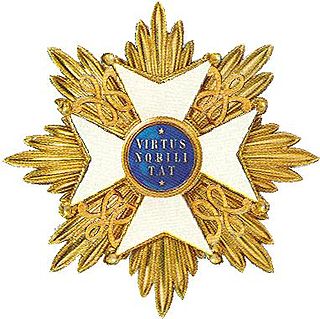
In the Dutch honours system, most orders are the responsibility of ministers of the Netherlands Government. The house orders, however, are awarded at the discretion of the Dutch monarch alone.
Buddhism is a small minority religion in the Netherlands, but it has shown rapid growth in recent years. As of the 2006 estimate, 170,000 Dutch people identified their religion as Buddhist.
The Netherlands was represented at the Eurovision Song Contest 1993 with the song "Vrede", composed by Eric van Tijn and Jochem Fluitsma, with lyrics by Henk Westbroek, and performed by Ruth Jacott. The Dutch participating broadcaster, Nederlandse Omroep Stichting (NOS), selected its entry for the contest through a national final, after having previously selected the performer internally.
The Netherlands was represented at the Eurovision Song Contest 1994 with the song "Waar is de zon" composed by Edwin Schimscheimer, with lyrics by Coot van Doesburgh, and performed by Willeke Alberti. The Dutch participating broadcaster, Nederlandse Omroep Stichting (NOS), selected its entry for the contest through a national final, after having previously selected the performer internally.

The Indies Monument is a memorial in The Hague in memory of all Dutch citizens and soldiers killed during World War II as a result of the Japanese occupation (1942–1945) of the former Dutch East Indies. It is dedicated to all who died in battle, in prison camps or during forced labor. As stated in the mission statement of the 15 August 1945 Commemoration Foundation, it is also:
A place where you can pass on to your children the part of your childhood spent in the Dutch East Indies

Stichting The Rijnlands Lyceum Foundation is an educational foundation in the Netherlands encompassing nine different schools; three offering primary education and six offering secondary education. The Foundation, established in 1936, is based in Wassenaar, a suburb of The Hague.

Albert Vogel was a Dutch officer, teacher and performer.

Emile Linus Alfred Wijntuin was a Surinamese politician who served as Chairman of the National Assembly of Suriname from 1975 until the aftermath of the 1980 Surinamese coup d'état. Wijntuin was a member of the Progressive Surinamese People's Party (PSV).

As of 2018, Wolters Kluwer ranks as the Dutch biggest publisher of books in terms of revenue. Other notable Dutch houses include Brill and Elsevier.

The Rengat massacre was committed by the Royal Netherlands East Indies Army on 5 January 1949 in Rengat, Riau during Operation Kraai. Following the capture of the town, paratroopers of the Korps Speciale Troepen under lieutenant Rudy de Mey subjected confirmed and suspected TNI militants, civil servants, and ordinary townspeople to looting, rape, and summary execution. Bodies were disposed of in the Indragiri River.
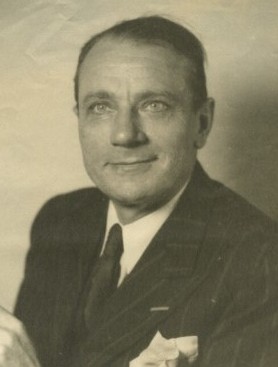
George Antoon Philip Weijer (1891-1979) was a business representative in colonial Indonesia, an economics professor at the University of Utrecht, and a government advisor and company director in the Netherlands.

Belang van Nederland is a political party in the Netherlands, led by Wybren van Haga. Between 2021 and 2023, it was active in the House of Representatives as the independent Van Haga Group. Its three MPs split from Forum for Democracy in August 2021.

The Nationaal Comité Handhaving Rijkseenheid, fully the Nationaal Comité tot Handhaving der Rijkseenheid, commonly shortened to Comité Rijkseenheid was an extra-parliamentary action group in the Netherlands that unsuccessfully appealed the 1946 Linggadjati Agreement between the Dutch government and the Republic of Indonesia regarding the exercise of authority over the Dutch East Indies. Enjoying wide support, in 1947 there were more than 250 local Committee meetings throughout the Netherlands, and by July 1947 it was able to collect 236,000 signatures for a petition.
The National Remembrance 15 August 1945 is an annual event at the Indies Monument in The Hague, the Netherlands, to commemorate the end of the Japanese occupation of the Dutch East Indies and the end of World War II. Taking place every 15 August since 1988, it is also known as the National Indies Remembrance.
The Dutch Honorary Debts Committee Foundation is an independent interest group in the Netherlands and Indonesia for victims of Dutch colonialism in the former Dutch East Indies (1603–1949), in particular within the context of the Indonesian National Revolution of 1945–1949.


