Related Research Articles

The 2nd Cavalry Regiment,also known as the Second Dragoons,is an active Stryker infantry and cavalry regiment of the United States Army. The Second Cavalry Regiment is a unit of the United States Army Europe and Africa,with its garrison at the Rose Barracks in Vilseck,Germany. It can trace its lineage back to the early part of the 19th century.

Victorio was a warrior and chief of the Warm Springs band of the Tchihendeh division of the central Apaches in what is now the American states of Texas,New Mexico,Arizona,and the Mexican states of Sonora and Chihuahua.

Jicarilla Apache,one of several loosely organized autonomous bands of the Eastern Apache,refers to the members of the Jicarilla Apache Nation currently living in New Mexico and speaking a Southern Athabaskan language. The term jicarilla comes from Mexican Spanish meaning "little basket",referring to the small sealed baskets they used as drinking vessels. To neighboring Apache bands,such as the Mescalero and Lipan,they were known as Kinya-Inde.
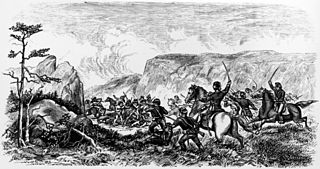
The Battle of Ash Hollow,also known as the Battle of Blue Water Creek or the Harney Massacre,was an engagement of the First Sioux War,fought on September 2 and 3,1855,between United States Army soldiers under Brig. Gen. William S. Harney and a band of the BruléLakota along the Platte River in present-day Garden County,Nebraska. In the 20th century,the town of Lewellen,Nebraska,was developed here as a railroad stop.

The Apache Wars were a series of armed conflicts between the United States Army and various Apache tribal confederations fought in the southwest between 1849 and 1886,though minor hostilities continued until as late as 1924. After the Mexican–American War in 1846,the United States annexed conflicted territory from Mexico which was the home of both settlers and Apache tribes. Conflicts continued as American settlers came into traditional Apache lands to raise livestock and crops and to mine minerals.

The First Battle of Adobe Walls took place between the United States Army and Native Americans. The Kiowa,Comanche and Plains Apache tribes drove from the battlefield a United States Expeditionary Force that was reacting to attacks on white settlers moving into the Southwest. The battle on November 25,1864,resulted in light casualties on both sides but was one of the largest engagements fought on the Great Plains.

The Battle of Apache Pass was fought in 1862 at Apache Pass,Arizona,in the United States,between Apache warriors and the Union volunteers of the California Column as it marched from California to capture Confederate Arizona and to reinforce New Mexico's Union army. It was one of the largest battles between the Americans and the Chiricahua during the Apache Wars.

The 1st Cavalry Regiment is a United States Army regiment that has its antecedents in the early 19th century in the formation of the United States Regiment of Dragoons. To this day,the unit's special designation is "First Regiment of Dragoons". While they were the First Regiment of Dragoons,another unit designated the 1st Cavalry Regiment was formed in 1855 and in 1861 was re-designated the 4th Cavalry Regiment. The First Dragoons became the 1st Cavalry Regiment,since they were the oldest mounted regiment.

The Apache Scouts were part of the United States Army Indian Scouts. Most of their service was during the Apache Wars,between 1849 and 1886,though the last scout retired in 1947. The Apache scouts were the eyes and ears of the United States military and sometimes the cultural translators for the various Apache bands and the Americans. Apache scouts also served in the Navajo War,the Yavapai War,the Mexican Border War and they saw stateside duty during World War II. There has been a great deal written about Apache scouts,both as part of United States Army reports from the field and more colorful accounts written after the events by non-Apaches in newspapers and books. Men such as Al Sieber and Tom Horn were sometimes the commanding officers of small groups of Apache Scouts. As was the custom in the United States military,scouts were generally enlisted with Anglo nicknames or single names. Many Apache Scouts received citations for bravery.

The Battle of Cieneguilla was an engagement of the Jicarilla War involving a group of Jicarilla Apaches,possibly their Ute allies,and the American 1st Cavalry Regiment on March 30,1854 near what is now Pilar,New Mexico. The Santa Fe Weekly Gazette reported that the action "was one of the severest battles that ever took place between American troops and Red Indians." It was one of the first significant battles between American and Apache forces and was also part of the Ute Wars,in which Ute warriors attempted to resist Westward expansion in the Four Corners region.

Dohäsan,Dohosan,Tauhawsin,Tohausen,or Touhason was a prominent Native American. He was War Chief of the Kata or Arikara band of the Kiowa Indians,and then Principal Chief of the entire Kiowa Tribe,a position he held for an extraordinary 33 years. He is best remembered as the last undisputed Principal Chief of the Kiowa people before the Reservation Era,and the battlefield leader of the Plains Tribes in the largest battle ever fought between the Plains tribes and the United States.

The First Battle of Dragoon Springs was a minor skirmish between a small troop of Confederate dragoons of Governor John R. Baylor's Arizona Rangers,and a band of Apache warriors during the American Civil War. It was fought on May 5,1862,near the present-day town of Benson,Arizona,in Confederate Arizona.
The Battle of the Florida Mountains was an action of the Apache Wars. Forces involved were Chiricahua Apache warriors and mounted Confederate States militia. The battle occurred in a pass of the Florida Mountains within Confederate Arizona,now southwestern New Mexico. The engagement occurred sometime around the middle of August 1861.
The Battle of Pinos Altos was a military action of the Apache Wars. It was fought on September 27,1861,between settlers of Pinos Altos mining town,the Confederate Arizona Guards,and Apache warriors. The town is located about seven miles north of the present day Silver City,New Mexico.
The Battle of Ojo Caliente Canyon,or simply the Battle of Ojo Caliente was an engagement of the Jicarilla War on April 8,1854. Combatants were Jicarilla Apache warriors,and their Ute allies,against the United States Army. The skirmish was fought as result of the pursuit of the Jicarilla after the Battle of Cieneguilla just over a week earlier.
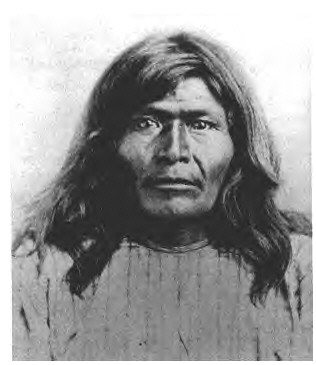
Victorio's War,or the Victorio Campaign,was an armed conflict between the Apache followers of Chief Victorio,the United States,and Mexico beginning in September 1879. Faced with arrest and forcible relocation from his homeland in New Mexico to San Carlos Indian Reservation in southeastern Arizona,Victorio led a guerrilla war across southern New Mexico,west Texas and northern Mexico. Victorio fought many battles and skirmishes with the United States Army and raided several settlements until the Mexican Army killed him and most of his warriors in October 1880 in the Battle of Tres Castillos. After Victorio's death,his lieutenant Nana led a raid in 1881.
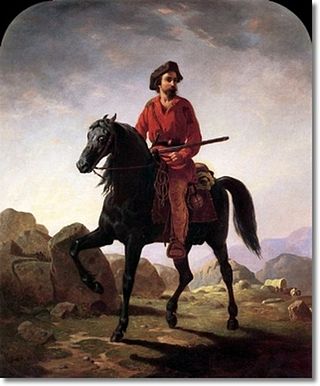
The Jicarilla War began in 1849 and was fought between the Jicarilla Apaches and the United States Army in the New Mexico Territory. Ute warriors also played a significant role in the conflict as they were allied with the Jicarillas. The war started when the Apaches and Utes began raiding against settlers on the Santa Fe Trail. Eventually,in 1853,the U.S. Army retaliated which resulted in a series of battles and campaigns that ended in 1854 when a large military expedition managed to quell most of the violence. However,some minor skirmishing continued into 1855.

Dragoon Springs is an historic site in what is now Cochise County,Arizona,at an elevation of 4,925 feet (1,501 m). The name comes from a nearby natural spring,Dragoon Spring,to the south in the Dragoon Mountains at 5,148 feet (1,569 m). The name originates from the 3rd U.S. Cavalry Dragoons who battled the Chiricahua,including Cochise,during the Apache Wars. The Dragoons established posts around 1856 after the Gadsden Purchase made the area a U.S. territory.
Flechas Rayadas or Striped Arrows was a Jicarilla Apache chief of the band that,together with Francisco Chacon's warriors,defeated Lieutenant Davidson's detachment of 60 men from the First Regiment of Dragoons in the Battle of Cieneguilla,in the Embudo Mountains,on April 4,1854,killing 22 and wounding 36. On April 7,as Lieutenant Colonel Cooke was pursuing the Jicarillas,General Garland sent word to Cooke that Flechas Rayadas had offered to return all the horses and arms captured in that fight if peace could be made;the chief's proposal was rejected.
Lobo Blanco or White Wolf was a Jicarilla Apache chief of the band that,with 30 warriors,raided the horse herd of the Second Regiment of Dragoons at Fort Union,and,reached up near the Canadian River,was defeated by Lieutenant Bell's Dragoon detachment in the Battle of Canadian River on April 4,1854,before the Battle of Cieneguilla;repeatedly wounded,the chief was finally killed crushing him under a boulder.
References
 | This biographical article related to the American Old West is a stub. You can help Wikipedia by expanding it. |
 | This biographical article about an Indigenous person of North America is a stub. You can help Wikipedia by expanding it. |