Fruela Díaz

Last updated

Fruela (or Froila) Díaz (died 1119), known in contemporary sources as Froila Didaci or Didaz, was a nobleman in the Kingdom of León, the dominant figure in the centre of the realm during the late reign of Alfonso VI and the early reign of Urraca. A man of great private wealth who expanded his landholdings through numerous purchases, he was able to marry royalty and maintain good terms with his sovereigns of León as well as the rulers of Galicia and Portugal, whose territories lay immediately to the west of his area of influence. He also founded a hospital, a traveller's inn and a settlement that grew into a town. His lands raised some of the most valuable horses in Spain, he was buried in the royal pantheon of the kings of León, and his high rank—highest in the kingdom after the king and the rulers of Galicia and Portugal—is remembered in the most famous of cantares de gesta .

Kingdom of León Former country, from 910-1230 CE

The Kingdom of León was an independent kingdom situated in the northwest region of the Iberian Peninsula. It was founded in AD 910 when the Christian princes of Asturias along the northern coast of the peninsula shifted their capital from Oviedo to the city of León. The County of Castile separated in 931, the County of Portugal separated to become the independent Kingdom of Portugal in 1139 and the eastern, inland part of León was joined to the Kingdom of Castile in 1230.

Alfonso VI of León and Castile 1040-1109, King of Leon, King of Castile, King of Galicia

Alfonso VI, nicknamed the Brave or the Valiant, was the son of King Ferdinand I of León and Queen Sancha, daughter of Alfonso V and sister of Bermudo III. He became king of León (1065–72) and of Galicia, and then king of the reunited Castile and León.

Kingdom of Galicia kingdom in Iberia

The Kingdom of Galicia was a political entity located in southwestern Europe, which at its territorial zenith occupied the entire northwest of the Iberian Peninsula. Founded by Suebic king Hermeric in 409, the Galician capital was established in Braga, being the first kingdom which adopted Catholicism officially and minted its own currency. It was part of the Kingdom of the Spanish Visigothic monarchs from 585 to 711. In the 8th century Galicia became a part of the newly founded Christian kingdoms of the Northwest of the peninsula, Asturias and León, while occasionally achieving independence under the authority of its own kings. Compostela became capital of Galicia in the 11th century, while the independence of Portugal (1128) determined its southern boundary. The accession of Castilian King Ferdinand III to the Leonese kingdom in 1230 brought Galicia under the control of the Crown of Castile, the kingdom of Galicia becoming a political division within the larger realm.

Contents

Origins and service to Raymond of Galicia

Fruela Diaz's family tree. Flaginez family, Fruela Diaz branch.png
Fruela Díaz's family tree.

Fruela's origins lay in the Asturias, although his parentage is nowhere explicitly stated in surviving sources. [1] Ramón Menéndez Pidal believed that Fruela was the brother of Jimena Díaz, wife of Rodrigo Díaz de Vivar, but this is unlikely. [2] In fact Fruela's wife was the sister of Ramiro Sánchez, husband of Rodrigo's daughter Christina. It has been suggested that Fruela was a son of Diego Ansúrez and thus a nephew of Pedro Ansúrez, but this hypothesis has little to recommend it besides the patronymic Díaz ("son of Diego"). Fruela's father was probably Diego Pérez, a son of Pedro Flaínez and Bronilde. [3] His mother was Mayor (María) Fróilaz, daughter of Froila Múñoz. [3] A charter of the Cathedral of Oviedo, dated 5 April 1078, reads in part: "I, Mayor Fróilaz, known as María, at the same time with my sons named Fruela Díaz and Antonio Díaz, who are sons of Diego Pérez and grandsons of Count Pedro Flaínez ..." [4]

Asturias Autonomous community and province of Spain

Asturias, officially the Principality of Asturias, is an autonomous community in north-west Spain. It is coextensive with the province of Asturias, and contains some of the territory that was part of the larger Kingdom of Asturias in the Middle Ages. Divided into eight comarcas (counties), the autonomous community of Asturias is bordered by Cantabria to the east, by Castile and León to the south, by Galicia to the west, and by the Bay of Biscay to the north.

Ramón Menéndez Pidal Spanish historian

Ramón Menéndez Pidal was a Spanish philologist and historian. He worked extensively on the history of the Spanish language and Spanish folklore and folk poetry. One of his main topics was the history and legend of El Cid. He was nominated for a Nobel Prize 23 times, the most nominated person, three times more than the second most nominated person, André Malraux.

Jimena Díaz politician

Doña Jimena Díaz was the wife of El Cid, whom she married between July 1074 and 12 May 1076, and her husband's successor as ruler of Valencia from 1099 to 1102.

The earliest surviving record of Fruela dates to 1069. [3] His elder brother, Antonio, died young and Fruela, as the only surviving male child, inherited his father's estates. [5] The archives of Fruela's branch of the Flagínez family were preserved in the monastery of Santa María de Oteros de las Dueñas, the only such case of a noble family's records being preserved from the Spanish high Middle Ages. [6] On top of this is conserved in the tumbo of the Cathedral of Santa María in León (doc. 11, fol. 83) a brief genealogy of Antonio and Fruela, then children, as part of a diploma whereby their mother donated the monastery of San Pedro de Valdoré to the cathedral in December 1073. [7]

Cartulary type of medieval manuscript

A cartulary or chartulary, also called pancarta or codex diplomaticus, is a medieval manuscript volume or roll (rotulus) containing transcriptions of original documents relating to the foundation, privileges, and legal rights of ecclesiastical establishments, municipal corporations, industrial associations, institutions of learning, or families. The term is sometimes also applied to collections of original documents bound in one volume or attached to one another so as to form a roll, as well as to custodians of such collections.

León Cathedral Church in Spain

Santa María de León Cathedral, also called The House of Light or the Pulchra Leonina is situated in the city of León in north-western Spain. It was built on the site of previous Roman baths of the 2nd century which, 800 years later, king Ordoño II converted into a palace.

Fruela served Count Raymond of Galicia as majordomo, the highest court official, from 1094 to 1096 at least, and perhaps as late as 1106. [8] He may have held the post throughout Raymond's countship (1090–1107), but insufficient surviving documentation does not allow the case to be proven. [9] An analysis of the charters he confirmed for Count Raymond shows that he "was a regular member ... of the entourage that gathered around [Raymond] during the latter's circuit of Galicia in the late springs and early summers", but not a fixture at Raymond's court. [10] In the count's disputes with the king, Fruela openly took Raymond's side. [11] Fruela was prominent enough at the royal court, however, confirming a third of all royal charters given during the latter part of Alfonso's reign. [1]

A majordomo is a person who speaks, makes arrangements, or takes charge for another. Typically, this is the highest (major) person of a household staff, a head servant who acts on behalf of the owner of a large or significant residence. Synonyms include castellan, concierge, chamberlain, seneschal, mayor of the palace, curopalate, maître d'hôtel, head butler, and steward.

Fiefs of the crown

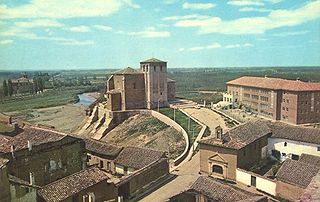
The fortified monastery of San Vicente del Pino sits on a hill overlooking Monforte de Lemos. Archaeological excavations in 2007 indicate that the Castro Dactonio likely stood on the same hill when Fruela founded the town at its foot in 1116. Monforte vista san vicente.JPG
The fortified monastery of San Vicente del Pino sits on a hill overlooking Monforte de Lemos. Archaeological excavations in 2007 indicate that the Castro Dactonio likely stood on the same hill when Fruela founded the town at its foot in 1116.

Both of Fruela's grandfathers were counts and by 14 May 1087 he also held that rank. [12] Not long thereafter, in 1091, he was granted the fief (tenencia) of Valdeorras in Galicia, which he held until 1104. [13] Such tenencias were held ad imperandum, to be governed and could be revoked by the monarch at any time. They were distinct from the count's private holdings, lands ad possidendum, which he owned and which the monarch could not alienate. The only other fiefs he held for more than a year or two were Sarria (1098–1103), Larín (1102–06), and the important episcopal city of Astorga (1107–17). [3] The rule of Astorga probably carried limited rights in the city itself but extensive powers in the surrounding region. [14] It is with Astorga that Fruela is most commonly associated after 1107. [14] On 10 April 1104, according to a royal charter now lost, Fruela and his wife founded a settlement at the foot of the castle called castro Dactonio in the fiefdom of Sarria on land owned by the monastery of San Vicente del Pino. [9] This settlement became the town of Monforte de Lemos, which Fruela held as a tenencia until 1111, when it passed to Rodrigo Vélaz. [9]

Count (Male), or Countess (Female), is a historical title of nobility in certain European countries, varying in relative status, generally of middling rank in the hierarchy of nobility. The etymologically related English term, "county" denoted the land owned by a count. Equivalents of the rank of count exist or have existed in the nobility structures of some non-European countries, such as hakushaku during the Japanese Imperial era.

Fief System of economic governance during the Middle Ages in Europe.

A fief was the central element of feudalism. It consisted of heritable property or rights granted by an overlord to a vassal who held it in fealty in return for a form of feudal allegiance and service, usually given by the personal ceremonies of homage and fealty. The fees were often lands or revenue-producing real property held in feudal land tenure: these are typically known as fiefs or fiefdoms. However, not only land but anything of value could be held in fee, including governmental office, rights of exploitation such as hunting or fishing, monopolies in trade, and tax farms.

Valdeorras Comarca in Galicia, Spain

Valdeorras is a comarca in the Galician Province of Ourense. The overall population of this local region is 28,984 (2005).

Late in his life Fruela briefly acquired the fiefs of Aguilar [15] (1111–12), Riba de Esla (1113), and Cifuentes de Rueda (1117–19). [3] He also governed the Bierzo for a time, probably in 1115. [3] In 1116 he made a donation of land at Puerto de Pajares to the Augustinian canons of the collegiate church of Santa María at Arbas del Puerto. [16] This land, in the mountains of the Asturias, was intended for the construction of a hostel for travellers, which operated until as late as 1835. The full text of the diploma has now been lost, and it is suspected that it may have included a fuller will and testament, since Fruela was then in his old age. [17]

Augustinians general term for various religious orders

The term Augustinians, named after Augustine of Hippo (354–430), applies to two distinct types of Catholic religious orders, dating back to the first millennium but formally created in the 13th century, and some Anglican religious orders, created in the 19th century, though technically there is no "Order of St. Augustine" in Anglicanism. Within Anglicanism the Rule of St. Augustine is followed only by women, who form several different communities of Augustinian nuns in the Anglican Communion.

Marriage and private dealings

Fruela married Estefanía Sánchez, daughter of Sancho Garcés, an illegitimate son of García Sánchez III of Navarre, and his wife Constance. She possessed lands in the Rioja, near Calahorra, but may have sold these in order to purchase land more near to her husband's estates. [5] They were married towards 1085, and on 11 September 1087 Fruela gave his wife arras . [18] Her royal pedigree was mentioned in a grant of land in Astorga they received from Henry of Portugal on 1 March 1112, which included the Torre Cornellera and ten sections of the city wall. [9] [19] She outlived her husband by at least ten years: on 18 April 1129 she granted a fuero to Villarmildo. [3] The couple's children were Constance, Diego, María, and Ramiro. [3]

Fruela's patrimonial lands contained some of Spain's premier horse pastures, and he was able to give the queen a horse worth 5,000 solidi in 1116. The famous warhorse Bavieca was said, albeit wrongly, to have hailed from Fruela's lands. The above illustration is from c.1086. B Osma 85v.jpg
Fruela's patrimonial lands contained some of Spain's premier horse pastures, and he was able to give the queen a horse worth 5,000 solidi in 1116. The famous warhorse Bavieca was said, albeit wrongly, to have hailed from Fruela's lands. The above illustration is from c.1086.

Fruela and Estefanía were most active in acquiring property (gananciales) through private transactions between 1088 and 1113. [20] With twenty-three such exchanges having left records, their case is one of the best preserved of its kind: private land transactions, especially aristocratic purchases from peasants, increased dramatically in Spain between the late tenth and early twelfth century. [21] Some of the couple's early, eleventh-century property gains were of the form of loan repayments, though this type of transaction disappears from the record altogether in the twelfth century. [22]

In 1118 a certain Martín Eitaz, convicted of murdering one of Fruela's servants, was forced to become his servant for life or until released by a payment. [3]

Service to Queen Urraca

Fruela was one of the magnates who witnessed the first recorded act of Queen Urraca, on 22 July 1109, and implicitly acknowledged her claim to have been granted "the whole kingdom" (regnum totum) by her father, Alfonso VI, shortly before his death. [23] This important document Fruela signs as legionensium comes (count of León), a high-sounding title that was probably honorific and had long been associated with the Flagínez. [9] [14] On 17 November 1110 he signed a document as comes in terra de legione et in gralare (count in the land of León and in Grajal), perhaps a special authority associated with the breakdown of relations between Urraca and the King of Aragon, Alfonso the Battler, who was also her husband. [14] In 1112 Fruela received a royal "gift" of estates at Ulvayo from the queen "for loyal service", and he repaid her generosity with the gift of a horse worth a magnificent 5,000 solidi , equivalent at the time to 5,000 sheep. [24] A horse worth so much could only be destined for the royal stables and royal rider, the queen herself, and it illustrates Fruela's enormous personal wealth. [25] In 1115, when Urraca and Alfonso were fighting for control of the important monastic site of Sahagún, Fruela was acting as count in Ceia (Ceón) just to the north. [14] On 9 December 1117 Fruela witnessed the second charter issued by Urraca's son Alfonso Raimúndez, whom the Galicians had made co-ruler against her will in 1111. Although the language and the name of the notary may suggest that it has been interpolated, the document, made at Sahagún, refers to Alfonso with the title imperator (emperor). [26]

Death, burial and reputation

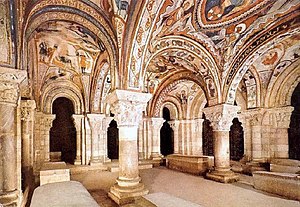
The Panteon wherein Fruela is reportedly interred has been called the "Sistine Chapel of Spanish Romanesque" for its well-preserved, high-quality ceiling frescoes. PanteonSanIsidoroLeon.jpg
The Panteón wherein Fruela is reportedly interred has been called the "Sistine Chapel of Spanish Romanesque" for its well-preserved, high-quality ceiling frescoes.

When Fruela died in the summer of 1119 [27] he passed Cifuentes on to his eldest son, Diego, who became alférez of Alfonso VII in 1137 and died prematurely in 1040, leaving a daughter, Estefanía Díaz, who was disinherited by her uncle, Ramiro, when she married without his will. [28] Ramiro then received Cifuentes. In 1198 Cifuentes received a fuero from Ramiro's son, Froila Ramírez, and it remained with their family into the thirteenth century. [28] Fruela's elder daughter Constance died in the flower of youth, while the younger, María, married twice: first to a Galician magante, Melendo Núñez, and second to the count Pedro Alfonso.

Fruela and Estefanía may have been buried in the Panteón de los Reyes in the church of San Isidoro de León amongst their relatives of the Flagínez clan. Prudencio de Sandoval claimed to find the sepulchres of "the countess Estefanía who endowed this church, and the count Don Fruela, a great knight in arms" among ten of their family in the third row of burials in either the main chapel or the Panteón (it is unclear which). The identifying inscriptions, however, were already illegible in the time of Manuel Risco, and today Sandoval's conclusions cannot be verified. [29]

Fruela's posthumous reputation can be gauged from lines 3000–3006 of the Poema del Cid (c.1140), where he is placed in the second tier of nobility, immediately beneath Alfonso VI, Henry of Portugal, and Raymond of Galicia, all of whom he served in his long career. This is the beginning of the "Cortes de Carrión" passage: [30]

Llegaba el plazo, querien ir a la Cort,
en los primeros va el buen rey don Alfonso,
el conde don Anric y el conde don Remond:
aqueste fue el padre del buen enperador:
el conde don Fruella y el conde don Beltrán. [31]
Fueron y de su reino otros muchos Sabidores,
de toda Castiella todos los meiores.
The time arrived, they wished to go to Court,
among the first went the good king Alfonso,
the count don Henry and the don Raymond:
that one was the father of the good emperor:
the count don Fruela and the count don Bertrand.
They went and from the realm many other Wise Men,
from all Castile all the greatest.

Notes

  1. 1 2 Reilly (1988), 227.
  2. For Fruela's genealogy, cf. Canal Sánchez-Pagín, 29–30.
  3. 1 2 3 4 5 6 7 8 9 Barton (1997), 245–46.
  4. Ego, Maior Froilaz cognomento Maria simul cum filiis meis nominatis Froila Didaz et Antonito Didaz qui sunt filios de Dedagus Petriz et neptos comité Petro Flainiz, quoted in Margarita Cecilia Torres Sevilla-Quiñones de León (1999), Linajes nobiliarios de León y Castilla: diglos IX–XIII (Salamanca: Junta de Castilla y León, Consejería de educación y cultura, ISBN   84-7846-781-5).
  5. 1 2 Canal Sánchez-Pagín, 30.
  6. They are now in the Archivo Histórico Diocesano de León, though some documents have been misplaced or lost, cf. Canal Sánchez-Pagín, 30, who also provides an appendix of original documents and notices on pp. 35–40 and a facsimile reproduction of one on pp. 41–42.
  7. Canal Sánchez-Pagín, 29 n23. The brothers are named Froila Didaci [et] Antonino [Antolino] Didaci.
  8. A charter of 1 May 1106 appears to have been originally drawn up a decade earlier, cf. Barton (1997), 245 n6.
  9. 1 2 3 4 5 Canal Sánchez-Pagín, 32.
  10. Reilly (1988), 278.
  11. Reilly (1988), 258.
  12. He may have already been a count at the time of his first appearance at the royal court, on 18 December 1086, cf. Reilly (1988), 191 n13 and 227.
  13. Fruela is recorded as comite imperante in lorres (the count ruling in lorres). The identification of lorres with Valdeorras was made by Augusto Quintana Prieto, cf. Reilly (1982), 292 n63.
  14. 1 2 3 4 5 Reilly (1982), 292–93.
  15. Aquilare, a place probably northwest of the Bierzo.
  16. As Canal Sánchez-Pagín, 33, shows, Fruela and his family did not found the monastery, as sometimes stated, but rather endowed a pre-existing establishment, then under an abbot named Sancho.
  17. Speculation of Canal Sánchez-Pagín, 33.
  18. The charter is an original, but its location is nowadays unknown. The grant was confirmed by Fernando Díaz, cf. Canal Sánchez-Pagín, 24.
  19. She was the eldest daughter of the eldest son of the eldest son of Sancho III of Navarre and Henry's grant refers to her as ex regali sanguine et prosapie horta ("of royal blood and family raised"), quoted in Barton (1997), 245 n4.
  20. The charters and the dates of transaction are listed in Barton (1997), 246 n19, who appears to list twenty-four, and the locations of the properties are found in Canal Sánchez-Pagín, 30–31, who lists twenty-two transactions concerning twenty-one places.
  21. Cf. Barton (1997), 72–73.
  22. Barton (1997), 76.
  23. Urraca signed the document totius Yspanie regina (queen of all Spain), and she first put forward her claim about Alfonso's wishes in 1110; cf. Fletcher (1984), 127, who believes the surviving document to be the original. Among the other important persons who witnessed are to be found Bernard de Sedirac, Álvar Fáñez, Pedro Ansúrez, Gómez González, and Pedro Fróilaz de Traba.
  24. Barton (1997), 82. Canal Sánchez-Pagín, 31, quotes the original source: uno kavallo obtimo valente V mille solidos ("one optimal horse worth five thousand solidi").
  25. Canal Sánchez-Pagín, 31 and n24. The belief that Rodrigo Díaz's horse Bavieca came from Fruela's lands is false.
  26. Reilly (1982), 126.
  27. He last confirmed a document on 30 June, cf. Barton, 245.
  28. 1 2 Barton (1997), 108. Canal Sánchez-Pagín, 34, considers Diego the younger brother.
  29. Canal Sánchez-Pagín, 33 and n34.
  30. Quoted in Canal Sánchez-Pagín, 23. Available at Wikisource.
  31. Also rendered el comde don Froila y el comde don Birbón.

Related Research Articles

The Battle of Viadangos or Fontedangos was fought in the autumn of 1111 between the forces of Alfonso I of Aragon and the Galician allies of his estranged wife, Urraca of León and Castile, at Villadangos north of Luna, some twenty kilometres from León. Alfonso was victorious in a rout, but Urraca's son and co-ruler, Alfonso Raimúndez, escaped.
Fernando Díaz Count of Asturias

Fernando Díaz was a Spanish nobleman and military leader in the Kingdom of León, the most powerful Asturian magnate of the period. He held the highest rank in the kingdom, that of count, from at least 24 September 1089. He was the last Count of Asturias de Oviedo and was succeeded by a castellan, a novus homo, perhaps in an ecclesiastical–royal effort to curtail the power of the Asturian aristocracy.

Fernando Fernández de Carrión Spanish count

Fernando Fernández or Fernán Fernándiz de Carrión was a count in the Kingdom of León during the reign of Queen Urraca.

Froila Ramírez Leonese noble

Froila Ramírez, also spelled Fruela or Froilán, was a Leonese nobleman and a member of the Flagínez family. His power and influence lay chiefly in the heart of the province of León and its west, but it extended also into Galicia and the Asturias. He was most active after the death of his father (1169/70) and more especially that of his brother (1185) until his own death, probably in 1203.

Gómez González Caatilian noble

Gómez González, called de Lara or de Candespina, was a Castilian nobleman and military leader who had some claim to being Count of Castile. He was the eldest son and successor of Gonzalo Salvadórez and his wife Sancha, and thus kinsman of the Lara family. Like his father, he perished in battle.

Diego López I de Haro was the third Lord of Biscay, and also the ruler of Álava, Buradón, Grañón, Nájera, Haro, and perhaps Guipúzcoa: the most powerful Castilian magnate in the Basque Country and the Rioja during the first quarter of the twelfth century. He was a loyal supporter of Queen Urraca and he fought the invading armies of her estranged husband Alfonso the Battler on two, or perhaps three, occasions.

Lope Díaz I de Haro Lord of Biscay

Lope Díaz I de Haro was the fourth Lord of Biscay. He was an important magnate in Castile during the reign of the Emperor Alfonso VII and in the kingdom of his son and grandson. Between 1147 and 1168 he is recorded as governing Old Castile on behalf of the crown.

Pedro Fróilaz de Traba Count of Traba

Pedro Fróilaz de Traba was the most powerful secular magnate in the Kingdom of Galicia during the first quarter of the twelfth century. According to the Historia compostelana, he was "spirited ... warlike ... of great power ... a man who feared God and hated iniquity," for Diego Gelmírez himself had "fed him, like a spiritual son, with the nutriment of holy teaching." Brought up at the court of the Emperor Alfonso VI, Pedro raised the future Emperor Alfonso VII in his household. Around the latter he and Diego formed a "Galician party" that dominated that region during the turbulent reign of Urraca (1109–26). In September 1111 they even had the child Alfonso crowned king at Santiago de Compostela, but it was Pedro who was imperator in orbe Galletiae.

Pedro Alfonso or Alfónsez was an Asturian magnate, dominating the region from 1139 until his death. He had vast landholdings in the Asturias, the region of León, and "kingdom" of Toledo, including in the cities of León and Toledo themselves, the most important cities of the realm. His commercial dealings were extensive, a sign of his economic power, and he loyally served Alfonso VII and his son Ferdinand II as a military commander and diplomat from 1128 until his death.

Rodrigo González de Lara ruled that half of Asturias

Rodrigo González de Lara was a Castilian nobleman of the House of Lara. Early in his career he ruled that half of Asturias allocated to Castile. He was faithful to the crown throughout the reign of Queen Urraca (1109–26), during which time he was married to the queen's half-sister and ruled a large part of the old County of Castile. He and his elder brother, Pedro González, led the opposition to Alfonso VII early in his reign (1126–57). He led a revolt in 1130 and was exiled in 1137. He was a leader in the Reconquista—about which the contemporary Chronica Adefonsi imperatoris has much to say—and also took part in the military activities of the Crusader states on two occasions. He travelled widely throughout Spain, but ended his days in Palestine.
Rodrigo Muñoz (Asturian count) Asturian noble

Rodrigo Muñoz, son of Count Munio González and Mayor Muñoz, was a Castilian magnate in the kingdoms of León and Castile. His tenancies were mostly in Cantabria, in the northern Castilian lands bordering the Basque country.

Rodrigo Vélaz Galician noble

Rodrigo Vélaz was the "count of Galicia, who held Sarria" according to the near-contemporary Chronica Adefonsi imperatoris. During his long public career he was the dominant figure in mountainous eastern Galicia while the House of Traba dominated its western seaboard. He served under three monarchs—Alfonso VI, Urraca, and Alfonso VII—and was loyal to all of them, never figuring in any rebellion. The contemporary Historia compostellana is a valuable source for his life, since there are no aristocratic archives surviving in Spain from this period. Rodrigo's career must be pieced together from the few references in the chronicles and the charters preserved in various ecclesiastical archives.

Rodrigo Martínez Leonese noble

Rodrigo Martínez was a Leonese nobleman, landowner, courtier, military leader, governor, and diplomat, "the most powerful lay figure in the region of the western Tierra de Campos," who "emerges as far and away the most regular visitor to the court of Alfonso VII between 1127 and 1138." He was a member of the Flagínez family, rose to the highest rank in the kingdom and met his end on the battlefield.
Beltrán de Risnel Aragonese statesman and general

Beltránde Risnel, also called Bertrand de Laon, was a French-born Aragonese political and military leader during the reign of Alfonso the Battler, who was his cousin. Beltrán was mainly active in the kingdoms of León and Castile, which Alfonso co-ruled for a time with his wife, Queen Urraca. He received Leonese titles and governed territories in León and Castile on behalf of the crown. He only sporadically attended the court of either King Alfonso or Queen Urraca, but he sometimes acted as a go-between. He became progressively more involved to Leonese court politics, eventually serving Alfonso VII as a count and having a marriage arranged to the king's half-sister. In 1130, he joined his father-in-law in revolt and ended up much reduced in status. He eventually rejoined Alfonso the Battler and died in battle alongside him.

Ramiro Fróilaz Noble, governor and military commander

Ramiro Fróilaz was a Leonese magnate, statesman, and military leader. He was a dominant figure in the kingdom during the reigns of Alfonso VII and Ferdinand II. He was primarily a territorial governor, but also a court figure, connected to royalty both by blood and by marriage. The military exploits of his sovereigns involved him against both the neighbouring kingdoms of Navarre and Portugal and in the Reconquista of the lands of al-Andalus.

Suero Vermúdez Asturian noble

Suero Vermúdez was an Asturian nobleman, extensive landowner, patron of churches, territorial governor, and military leader. He was an important man in León and Castile during the reigns of three monarchs—Alfonso VI, Urraca, and Alfonso VII—all of whom he served with notable loyalty, never taking part in any revolt, but aiding his sovereigns in wars against rebels, against rivals, and against the Moors. The primary sources for the life of Suero are the contemporary narratives the Historia compostellana and the Chronica Adefonsi imperatoris and some 150 surviving charters which make mention of, were drawn up by, or confirmed by Suero. Suero held extensive interests in ecclesiastical properties. Out of his enormous wealth he was a generous patron of monasteries, and appears to have favoured the Benedictines and the Cluniac reform. The Chronica describes Suero, one of the few noblemen it praises, as "a man strong in counsel and a seeker of truth" and "a lover of peace and truth and a faithful friend of the king".

FroilaMuñoz was a Leonese count. The sixty-seven surviving charters recording his property exchanges between 1007 and 1045 provide "compelling evidence of the active part that was being played by members of the aristocracy in the land markets of eleventh-century León" and that no "ecclesiastical monopoly on land investment and speculation existed." It is also partial evidence of a "spectacular increase in the mobility of land" in Christian Spain in the eleventh century "as both aristocratic families and ecclesiastical institutions sought to expand their domains at the expense of individual peasant proprietors". In the eleventh and twelfth centuries in Spain, serious crimes such as murder, rape, arson, robbery, and cattle rustling were generally punished by the local lord with the imposition of a calumnia, or compensatory fine. These were more often paid in land than in monies, and this contributed heavily to Froila's increase in landed wealth, as several of his charters demonstrate. A record of all these transactions is kept in the archives of the convent of Santa María de Otero de las Dueñas, to which its foundress, María Núñez, granted all her Leonese properties inherited from her ancestors, with their titles deeds, in 1240.

Fernando García de Hita was a Castilian nobleman, traditionally considered the founder of the noble House of Castro. He governed the lordships of Hita and Guadalajara, and frequently attended the royal court under King Alfonso VI and Queen Urraca.

Froila Arias was a Galician count who governed the fortress of Traba and the region of Trastámara during a tumultuous period.

Aldonza Martínez de Silva Portuguese noblewoman, mistress of King Alfonso IX of León

Aldonza Martínez de Silva a Portuguese noblewoman, daughter of Martim Gomes da Silva and his wife Urraca Rodríguez, was one of the mistresses of King Alfonso IX of León and afterward, the wife of Diego Froilaz.
References

External links