
The unification of Italy, also known as the Risorgimento, was the 19th-century political and social movement that resulted in the consolidation of different states of the Italian Peninsula into a single state in 1861, the Kingdom of Italy. Inspired by the rebellions in the 1820s and 1830s against the outcome of the Congress of Vienna, the unification process was precipitated by the Revolutions of 1848, and reached completion in 1871 after the Capture of Rome and its designation as the capital of the Kingdom of Italy.

Victor Emmanuel II was King of Sardinia from 1849 until 17 March 1861, when he assumed the title of King of Italy and became the first king of an independent, united Italy since the 6th century, a title he held until his death in 1878. Borrowing from the old Latin title Pater Patriae of the Roman emperors, the Italians gave him the epithet of Father of the Fatherland.
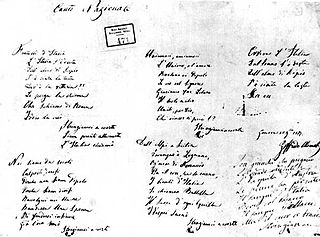
"Il Canto degli Italiani" is a canto written by Goffredo Mameli set to music by Michele Novaro in 1847, and is the current national anthem of Italy. It is best known among Italians as the "Inno di Mameli", after the author of the lyrics, or "Fratelli d'Italia", from its opening line. The piece, in a time signature of 4/4 and the key of B-flat major, consists of six strophes, and a refrain sung at the end of each strophe. The sixth group of verses, which is almost never performed, recalls the text of the first strophe.
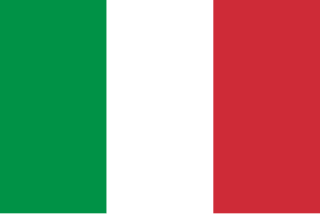
The national flag of Italy, often referred to in Italian as il Tricolore is a tricolour featuring three equally sized vertical pales of green, white and red, national colours of Italy, with the green at the hoist side, as defined by article 12 of the Constitution of the Italian Republic. The Italian law regulates its use and display, protecting its defense and providing for the crime of insulting it; it also prescribes its teaching in Italian schools together with other national symbols of Italy.

The Redshirts, also called the Red coats, are volunteers who followed the Italian patriot Giuseppe Garibaldi during his campaigns. The name derived from the color of their shirts or loose fitting blouses that the volunteers, usually called Garibaldini, which were worn in lieu of a uniform.
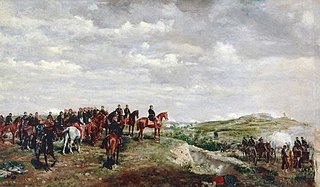
The Second Italian War of Independence, also called the Franco-Austrian War, the Austro-Sardinian War or Italian War of 1859, was fought by the Second French Empire and the Savoyard Kingdom of Sardinia against the Austrian Empire in 1859 and played a crucial part in the process of Italian Unification.

The Expedition of the Thousand was an event of the Italian Risorgimento that took place in 1860. A corps of volunteers led by Giuseppe Garibaldi sailed from Quarto, near Genoa and landed in Marsala, Sicily, in order to conquer the Kingdom of the Two Sicilies, ruled by the House of Bourbon-Two Sicilies.

The Battle of Varese was fought on 26 May 1859 at Varese (Lombardy). It was an engagement of the Second Italian War of Independence, fought between the Italian volunteers formation of the Hunters of the Alps, led by Giuseppe Garibaldi, against Austrian troops. The Austrian defeat allowed the movement of the Hunters towards Como, and obliged the Austrians to keep troops on the northern part of the front.
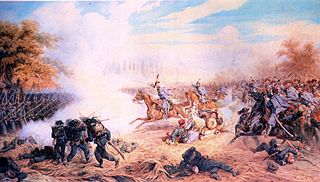
The Third Italian War of Independence was a war between the Kingdom of Italy and the Austrian Empire fought between June and August 1866. The conflict paralleled the Austro-Prussian War and resulted in Austria conceding the region of Venetia to France, which were later annexed by Italy after a plebiscite. Italy's acquisition of this wealthy and populous territory represented a major step in the Unification of Italy.
The 1866 Treaty of Vienna was an agreement signed on the 3rd of October and later ratified on the 12th by the Kingdom of Italy and the Austrian Empire that concluded the hostilities of the Third War of Italian Independence, a theatre of concurrent Austro-Prussian War.

The Battle of Mentana was fought on November 3, 1867 near the village of Mentana, located north-east of Rome, between French-Papal troops and the Italian volunteers led by Giuseppe Garibaldi, who were attempting to capture Rome, then the main centre of the peninsula still outside of the newly unified Kingdom of Italy. The battle ended in a victory by the French-Papal troops.
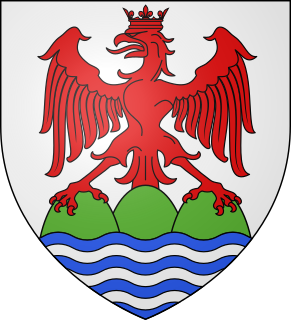
Italian irredentism in Nice was the political movement supporting the annexation of the County of Nice to the Kingdom of Italy.

Giuseppe Maria Garibaldi was an Italian general, patriot, revolutionary and republican. He contributed to Italian unification and the creation of the Kingdom of Italy. He is considered one of the greatest generals of modern times and one of Italy's "fathers of the fatherland", along with Camillo Benso, Count of Cavour, Victor Emmanuel II of Italy and Giuseppe Mazzini. Garibaldi is also known as the "Hero of the Two Worlds" because of his military enterprises in South America and Europe.
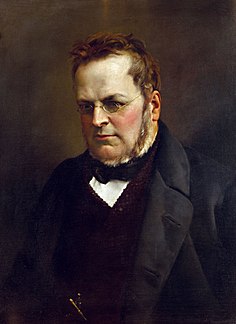
Camillo Paolo Filippo Giulio Benso, Count of Cavour, Isolabella and Leri, generally known as Cavour, was an Italian politician, businessman, economist and noble, and a leading figure in the movement towards Italian unification. He was one of the leaders of the Historical Right and prime minister of the Kingdom of Piedmont–Sardinia, a position he maintained throughout the Second Italian War of Independence and Giuseppe Garibaldi's campaigns to unite Italy. After the declaration of a united Kingdom of Italy, Cavour took office as the first prime minister of Italy; he died after only three months in office and did not live to see the Roman Question solved through the complete unification of the country after the Capture of Rome in 1870.
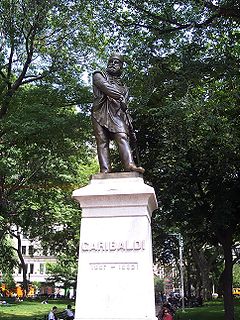
An outdoor bronze sculpture of Giuseppe Garibaldi, one of the leaders of Italian unification, is installed in Washington Square Park in Manhattan, New York.

The Battle of San Fermo, which took place the 27 May 1859 at a pass near Como in the northern part of Lombardy, was an engagement of the Second Italian War of Independence in which the Italian volunteers of Giuseppe Garibaldi's Hunters of the Alps defeated an Austrian force, forcing the Austrians to abandon Como.

Achille Cantoni was an Italian war volunteer who fought in the Second and Third Italian Wars of Independence. He is credited with saving the life of Giuseppe Garibaldi, an Italian general and central figure of the Risorgimento, during a battle in the town of Velletri in 1849. He died at the Battle of Mentana on November 3, 1867. After his death, Giuseppe Garibaldi wrote a novel entitled Cantoni il volontario in his honor.

Pietro Domenico Frattini was a supporter of Italian unification and one of the Belfiore martyrs.

Domenico Menotti Garibaldi was an Italian soldier and politician who was the eldest son of Giuseppe Garibaldi and Anita Garibaldi. He fought in the Second and Third wars of Italian Unification, and organized the Garibaldi Legion, a unit of Italian volunteers who fought for Polish independence in the January Uprising of 1863. He also served in the Chamber of Deputies.

The Operations in Valtellina was a battle of the Third Italian War of Independence and consisted in the penetration of Austrian units of the 8th Division of General Franz Kuhn von Kuhnenfeld operating in Trentino against the Italian Volunteer Corps of Giuseppe Garibaldi and in the subsequent Italian counterattack of the Mobile National Guard commanded by Colonel Enrico Guicciardi.

