Como (Italian:[ˈkɔːmo]ⓘ,[3][4]locally[ˈkoːmo]ⓘ;[3]Comasco: Còmm[ˈkɔm],[5]Cómm[ˈkom] or Cùmm[ˈkum];[6]Latin: Novum Comum) is a city and comune (municipality) in Lombardy, Italy. It is the administrative capital of the Province of Como. Nestled at the southwestern branch of the picturesque Lake Como, the city is a renowned tourist destination, celebrated for its stunning landscapes, artistic heritage, and cultural significance.[7]
Its prime location on the shores of Lake Como and its proximity to the majestic Alps has made Como a popular destination for tourists. The city boasts a rich collection of art, religious sites, verdant gardens, museums, theatres, public parks, and opulent palaces, including the iconic Duomo, seat of the Diocese of Como; the Basilica of Sant'Abbondio; Villa Olmo; the public gardens with the Tempio Voltiano; the Teatro Sociale; the Broletto, the city's medieval town hall; and the 20th-century Casa del Fascio, a landmark of modernist architecture.[8]
Como has been the birthplace of numerous notable historical figures, including the Roman poet Caecilius, mentioned by Catullus in the 1st century BC,[9][10] the celebrated writers Pliny the Elder and Pliny the Younger, the physician and historian Paolo Giovio, Pope Innocent XI, the pioneering scientist Alessandro Volta, inventor of the electric battery,[11]Cosima Liszt, daughter of Franz Liszt and wife of Richard Wagner, and Antonio Sant'Elia, a futurist architect and key figure in the modern architectural movement.
The area around present-day Como has been settled since the Iron Age, when it was first occupied by the CelticOrobii tribe. These people, according to Pliny the Elder and contemporary scholars, had connections with the Ancient Ligurians,[12][13] a group culturally similar to the Celts. Settlement remains can still be found on the wooded hills southwest of the city, particularly in the Rebbio district. The Breccia and Prestino areas, along with neighboring San Fermo della Battaglia and Cavallasca, also show evidence of the Golasecca culture,[13] dating back to the Iron Age. Later, a second Celtic migration brought Gaulish tribes, notably the Insubres, to the Como region.[14]
Around the 1st century BC, the Romans asserted their dominance over the territory. Although the original settlement was located in the hills, Julius Caesar ordered the town moved to its present lakeside location. He directed the draining of the marsh near the lake's southern tip and implemented a typical Roman grid plan for the walled city, with streets intersecting at right angles. The newly established town, named Novum Comum, was granted the status of municipium, a self-governing Roman city. In a significant archaeological find in September 2018, hundreds of gold coins dating to 474 AD were discovered in the basement of the former Cressoni Theater. These coins, minted during the reigns of Roman Emperors Honorius and others, were contained in a two-handled soapstoneamphora, providing valuable insights into the late Roman era in the region.[15]
Medieval Era: From Lombard Rule to the Rise of the Commune
Following the fall of the Western Roman Empire, Como's history mirrored that of Lombardy, experiencing periods of control by the Goths, Byzantines, and later the Langobards. The Langobards, a Germanic people originating from Scandinavia, profoundly impacted the region after their arrival in the Po Valley in 568 AD under King Alboin. They established the Lombard Kingdom, initially encompassing Northern Italy and later expanding to include Tuscany and parts of Southern Italy. Under Lombard rule, Como prospered, largely due to the reconstruction of Queen Theudelind's road, a crucial trade route connecting Germany and the Italian Peninsula, enhancing Como's strategic and commercial importance.[16]
In 774, Como surrendered to the invading Franks led by Charlemagne, becoming a significant center for trade.[17][18] The Commune of Como emerged in the 11th century, evolving from an association of prominent families bound by treaty and oath. This communal structure, initially exclusive to noble families, broadened over time to include all free male citizens, strengthening Como's political independence and the authority of its bishop. The bishop became the de facto leader, while a citizen assembly convened in the "Broletto" (Town Hall), initially composed of nobles and later including representatives from guilds. The Commune established its own laws governing various aspects of urban life, from commerce and agriculture to law enforcement and taxation.[19]
The Commune's territory encompassed the entire Diocese of Como, extending beyond the city itself to include a vast area including much of the modern Province of Como, Canton Ticino, and parts of Valtellina.[20][21] Strategically positioned on Lake Como and benefiting from the Road of Queen Theudelind, Como rapidly grew into a wealthy and influential town.[22]
This prosperity, however, led to rivalry with Milan. Milan's expansionist ambitions culminated in the Decennial War between Como and Milan (1118-1127). Despite initial Comaschi successes, Milan ultimately triumphed, devastating Como in 1127, sparing only churches.[23] Despite this setback, Como's fortunes were revived by Frederick Barbarossa, who restored its independence and supported the rebuilding of its defenses, including town walls and the Baradello castle.[24] Como remained aligned with the Ghibellines, even as other Lombard communes formed the pro-papal Lombard League. Emperor Frederick I formally recognized the Commune of Como in 1175, granting it significant autonomy.[25]
The Rusca Lordship and Subsequent Periods
The Ghibelline Rusca family rose to prominence in Como during the 13th and 14th centuries, vying for power with the Vitani family. They briefly established a lordship over Como and its territories, but ultimately, in 1335, Milan, under Azzone Visconti, reasserted control, annexing Como to the Duchy of Milan. Brief periods of independence followed, including the establishment of the "Republic of Saint Abundius" in 1447, but by 1450, Como was definitively incorporated into the Duchy of Milan under Francesco Sforza.[17]
Subsequently, Como's history was intertwined with the Duchy of Milan, experiencing French invasion, Spanish rule, and Austrian control until the Napoleonic era. Napoleon's rule lasted until 1815, after which Austrian dominion was reinstated following the Congress of Vienna. By 1848, Como's population reached 16,000.[26] In 1859, with Giuseppe Garibaldi's arrival, Como became part of the newly unified Kingdom of Italy.
In the 20th century, Como witnessed a significant historical event at the end of World War II. Benito Mussolini, attempting to escape to Switzerland, was captured and executed by partisans in Giulino di Mezzegra, near Lake Como. In the 21st century, Como remains a vital city in Lombardy, economically linked to Milan and increasingly reliant on tourism.
Geography
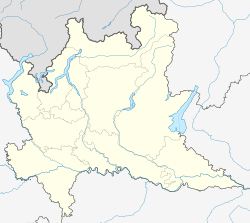
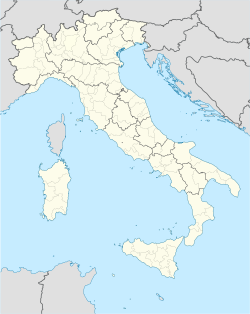
Como is strategically located at the southern end of the southwestern arm of Lake Como, approximately 40 kilometres (25mi) north of Milan. The city shares borders with Switzerland, specifically the Swiss communes of Chiasso and Vacallo, and the Italian comune of Blevio, Brunate, and several others. Major nearby cities include Varese, Lecco, and Lugano.
The lakefront of ComoComo Main Town buildings decorated with a light show in December 2017
According to the Köppen climate classification, Como experiences a humid subtropical climate (Cfa). Historically, winters were colder with average daily temperatures often below freezing.[27] While occasional frosts from the Siberian Anticyclone still occur, global warming has led to a gradual increase in average winter temperatures since the start of the 21st century, with a record high of 21 degrees Celsius (70°F) recorded on January 27, 2024.[28][29] Spring and autumn are generally mild and pleasant, while summers can be hot and humid. Strong winds are rare, though sudden foehn winds can occur. Air pollution can be a concern in winter due to cold air trapping pollutants. Rainfall is more frequent in spring, while summers are prone to thunderstorms and occasional violent hailstorms.[30]
The legislative body of Como is the City Council (Consiglio Comunale), composed of 32 councillors elected every five years through a proportional system, coinciding with the mayoral elections. The executive branch is the City Committee (Giunta Comunale), comprising 9 assessori (city ministers), each overseeing a specific department. The assessori are nominated and presided over by the directly elected Mayor (Sindaco). Since June 27, 2022, Alessandro Rapinese, an independent candidate leading the "Rapinese Sindaco" alliance, has served as the Mayor of Como.
The facade of Como's Duomo (Cathedral) Villa Olmo's park with the Cathedral in the distanceThe apse of San Fedele Church, showcasing Romanesque architectureThe English gardens of Villa Olmo, designed in Neoclassical styleVilla Geno and fountain from ferry on the lakeThe Tempio Voltiano (Volta Temple) is a museum dedicated to the memory of Alessandro Volta
Como Cathedral (Duomo): A masterpiece of Gothic and Renaissance architecture, the Duomo's construction spanned centuries, resulting in a blend of styles. Its notable features include the 15th-century façade, the Rococo dome by Filippo Juvarra, and an interior adorned with 16th-century tapestries and paintings by renowned artists.[33]
Basilica di San Fedele: A significant example of Romanesque architecture, San Fedele Basilica is known for its medieval carvings, particularly on the Door of St. Fedele, and its historical importance as one of Como's oldest churches.[34]
Sant'Agostino: Originally built in the 14th century by Cistercian monks, Sant'Agostino church showcases a blend of architectural styles, with a predominantly Baroque interior and a cloister adorned with 15th-17th-century frescoes.[35]
Basilica of Sant'Abbondio: A Romanesque basilica of significant historical and artistic value, Sant'Abbondio features a spacious interior with a nave and four aisles, housing 11th-century paintings and 14th-century frescoes.[36]
San Carpoforo: Believed to be built upon the site of a Roman temple dedicated to Mercury, San Carpoforo is an 11th-century church with a 12th-century apse and crypt, traditionally considered the burial place of Saint Carpophorus and other local martyrs.[37]
Cathedral illuminated at night during Como's light festival in December 2017
Secular Monuments and Buildings
The Broletto: Como's ancient town hall, a historic civic building reflecting the city's medieval past.
Casa del Fascio: A renowned building designed by architect Giuseppe Terragni, considered a seminal example of modern European architecture.[38]
Monumento ai caduti: A war memorial designed by Giuseppe Terragni, commemorating Como's fallen soldiers.
Teatro Sociale: A historic theatre built in 1813 by Giuseppe Cusi, still active as a venue for opera and theatrical performances.[39]
Villa Olmo: A Neoclassical villa built in the late 18th century, Villa Olmo has hosted numerous historical figures and now serves as a prominent exhibition center and event space.[40]
Monumental Fountain (Volta's Fountain): A modern monument dedicated to Alessandro Volta's invention, designed by Carlo Cattaneo and Mario Radice, located in Camerlata Square.
Medieval City Walls: The remnants of Como's ancient defensive walls, offering a glimpse into the city's fortified past.
Tempio Voltiano: A museum dedicated to Alessandro Volta, showcasing his life, inventions, and contributions to the field of electricity.[41]
Life Electric: A contemporary sculpture by Daniel Libeskind, situated on the lakefront.
Castello Baradello: A medieval castle perched on a hill overlooking Como, offering panoramic views and representing the remains of Frederick Barbarossa's 12th-century fortifications.[42]
Economy
Historically, Como's economy was heavily reliant on industry, particularly its world-renowned silk production. In the early 1970s, Como's silk output surpassed that of China and Japan, establishing it as a global silk manufacturing hub.[43][44] However, increased competition from Asian producers since the mid-1990s significantly reduced profit margins, leading to the closure of many small and medium-sized silk firms. As a result, manufacturing is no longer the dominant economic force. Como has become increasingly integrated into the Milan metropolitan area, with a significant portion of its workforce employed in the service industry. Many residents also commute to Swiss towns like Lugano and Mendrisio for employment in industry, healthcare, and hospitality, attracted by higher wages in Switzerland despite the daily commute.[45]
Since the late 1990s, tourism has become increasingly vital to Como's economy. Local businesses have shifted towards catering to tourists, with a proliferation of bars, restaurants, and hotels. In 2023, Como welcomed approximately 400,000 overnight visitors, establishing itself as a leading tourist destination in Lombardy.[46] The city and Lake Como's popularity as filming locations for feature films, along with celebrity residents, has further boosted international tourism, making Como a sought-after destination since the early 2000s.[47]
Como's population grew steadily, reaching a peak of nearly 100,000 in the 1970s, coinciding with the peak of its manufacturing sector, particularly silk production. However, with the decline of manufacturing, the population decreased by approximately 20,000 until the early 21st century. Since then, the city's population has grown again, adding over six thousand residents, largely due to increased immigration from Asia, Eastern Europe, and North Africa. As of January 2023, the population was 83,700, with 12,000 (14%) being resident aliens. The population distribution by origin is as follows:[48]
Como is home to a diverse range of museums and cultural institutions, offering insights into its history, art, and industry:
Museo Archeologico "P. Giovio": Dedicated to local archaeology, the museum showcases artifacts from prehistoric times to the Roman era, providing an overview of Como's ancient past.[49]
Garibaldi Museum (Como): This museum commemorates the life and achievements of Giuseppe Garibaldi, a key figure in the Italian Risorgimento, with exhibits detailing his campaigns and legacy.[50]
Tempio Voltiano: A neoclassical temple-like structure housing a museum dedicated to Alessandro Volta, displaying original instruments and exhibits related to his groundbreaking work in electricity.[41]
Villa Olmo: Beyond its architectural significance, Villa Olmo serves as a cultural hub, hosting temporary art exhibitions, concerts, and other cultural events throughout the year.[51]
Museo Didattico Della Seta: The Educational Silk Museum offers a journey through the history of Como's silk industry, showcasing the techniques, tools, and artistry involved in silk production.[52]
Museo Liceo classico "A. Volta": Located within the historic Liceo Classico "A. Volta" high school, this science museum features a collection of scientific instruments and exhibits primarily focused on physics and natural sciences, used for educational purposes and public viewing.[53]
Pinacoteca Civica: Como's Civic Art Gallery, housed in the Palazzo Volpi, features a diverse collection of paintings and artworks spanning from the Carolingian period to contemporary art, representing various artistic movements and styles.[54]
Cuisine
Como's cuisine reflects Lombard traditions, with Polenta being a prominent dish, particularly during the colder months. This dish, made from corn and buckwheat flour, is typically served with hearty accompaniments like meat, game, cheese, or local fish. A regional specialty is Polenta e Misultin, featuring grilled Alosa agone (a local lake fish) served alongside polenta.[55]
Another local culinary highlight is Risotto con Filetti di Pesce Persico or Risotto al Pesce Persico, a delicate risotto featuring fillets of perch, a fish native to Lake Como. This dish is typically prepared with white wine, onions, and butter, creating a flavorful and representative local specialty.[56]
Palio del Baradello: Reliving Medieval Como
The annual Palio del Baradello medieval festival is a significant cultural event in Como. Held annually, the Palio commemorates the events of 1159 when Como allied with Holy Roman Emperor Frederick Barbarossa.[57] The festival recreates the historical context of Frederick Barbarossa's alliance with Como against Milan and other Lombard communes in the 12th century.
Actors portray key historical figures such as Frederick Barbarossa, Henry the Lion, and Beatrice of Burgundy, while citizens don medieval costumes and participate in historical reenactments. The city is divided into its historical "Borghi" (wards), which compete in various medieval-themed games and contests throughout the festival.[58]
The Palio culminates in a parade through Como, with participants in medieval attire, accompanied by animals, wagons, and siege engine replicas, creating a vibrant spectacle that attracts both locals and tourists.
Participants dressed in medieval clothing for the Palio di Como festivalThe final day parade of the Palio di Como Medieval Festival
City symbols
Coat of Arms
Como's heraldic achievement features a white cross on a red field, a symbol historically associated with the Ghibelline faction, representing the city's political allegiances in the medieval era. The earliest documented use of this emblem dates back to the 12th-century War between Como and Milan. The motto "LIBERTAS" (Freedom) was later added, believed to commemorate Como's periods of independence, particularly during the reign of Frederick Barbarossa. The crown atop the coat of arms, featuring five points and gemstones, was officially incorporated in 1819, when Como was designated a "Royal Town" by Emperor Francis I of Austria.[59]
Flag
Como's historical flag features the Cross of Saint John – a white cross on a red field – reflecting its ancient civic symbolism. A later iteration of the flag incorporated the motto "LIBERTAS" in the lower right corner, mirroring the heraldic achievement. This flag, a symbol of Como's historical identity and aspirations for freedom, is still displayed at the town hall (Palazzo Cernezzi).
Flag of Como featuring the motto "LIBERTAS"'
Transport
Rail Network
Como is well-connected by rail, with the Servizio Ferroviario Regionale (Regional Railway Service) providing frequent train services to other major cities in Lombardy, operated by Trenord. The city is served by two main railway stations: Como San Giovanni, which also serves as a stop for international trains connecting Milan to Zurich and Basel, and Como Nord Lago. Five additional urban stations provide local rail access within the city.
The lakeside funicular railway offers a link between Como's city center and the mountain village of Brunate, providing panoramic views of Lake Como.
An antique steamship on Lake Como, part of the Navigazione Laghi fleetThe historic Como-Brunate funicular railway
Bus and Taxi Services
Como's public transportation network includes an extensive bus system operated by ASF Autolinee, comprising 11 urban lines within the city and numerous extra-urban lines connecting Como to towns throughout the province. Ferrovie Nord Milano also operates bus services connecting Como to Varese. Taxi services are readily available throughout the city, licensed and regulated by the Municipality of Como.
Lake Ferry Services
Navigazione Laghi operates a comprehensive ferry service on Lake Como, with boats and hydrofoils connecting Como to most towns and villages along the lake's shores, providing both passenger and car ferry services.
Como is home to the world's oldest seaplane operation, the Aero Club Como (ICAO code LILY).[61] The Aero Club operates a fleet of seaplanes for flight training, scenic tours, and maintains a collection of historic seaplanes, including a restored 1935 Caproni Ca.100, offering aviation experiences on Lake Como.[62][63]
The meticulously restored Caproni Ca.100 seaplane, a highlight of Aero Club Como's historic fleet
Education, Healthcare, and Sports
Como hosts numerous high schools, the "Giuseppe Verdi" Conservatory of Music, the "Aldo Galli" Design School, the University of Insubria, and a campus of the Politecnico di Milano.
Como's sporting scene includes clubs such as the ASDG Comense 1872 women's basketball team, a two-time EuroLeague Women champion, and Como 1907 football club. Lake Como offers numerous recreational activities, including sailing, windsurfing, and the annual Città di Como Challenger tennis tournament, attracting international tennis talent. The Unione Sportiva Tavernola, a local amateur sports club, promotes community sports participation in Como's Tavernola neighborhood.
12Migliorini, Bruno; Tagliavini, Carlo; Fiorelli, Piero; Borri, Tommaso Francesco, eds. (2010) [1969]. "Como". Dizionario d'Ortografia e di Pronunzia della lingua italiana (in Italian). Rome: Rai Eri. ISBN978-88-397-1478-7.
↑Carlo Bassi, Grammatica essenziale del "dialètt de Còmm", Como, Edizioni della Famiglia Comasca, 2014
↑Libero Locatelli, Piccola grammatica del dialetto comasco, Como, Famiglia Comasca, 1970, p. 6.
↑McElroy, Nan (2007). Italy, Instructions for Use: The Practical, On-Site Assistant for the Enthusiastic (Even Experienced) Traveler. Illustrata Press. ISBN1885436300.
↑"Alessandro Volta". Corrosion-doctors.org. Archived from the original on 25 January 2021. Retrieved 21 June 2011.
↑Peron, Ettore Maria (July 2017). Storia di Como[History of Como] (Firsted.). Pordenone: Edizioni Biblioteca dell'immagine (published 2017). p.4. ISBN9788863912685.
12Luraschi, Giorgio (1999). Storia di Como Antica[Ancient History of Como] (Seconded.). Como: Edizioni New Press. p.5. ISBN8895383834.
↑Peron, Ettore Maria (July 2017). Storia di Como[History of Como] (Firsted.). Pordenone: Edizioni Biblioteca dell'Immagine (published 2017). p.7. ISBN9788863912685.
↑Zanella, Antonio (16 October 1991). Paolo Diacono, La storia dei longobardi[Paul the Deacon, the History of the Langobards]. Rizzoli. ISBN978-8817168243.
↑Bergamaschi, Mario (January 2013). Il Cumano Cronaca della guerra decennale tra Como e Millano 1118-1127[The Cumano, Chronicles of the 10-Years War between Como and Milan 1118-1127] (in Italian). Alessandro Dominioni Editore. pp.29–36. ISBN9788887867459.
↑Almini, Saverio (19 January 2005). "Lombardia Beni Culturali: Diocesi di Como"[Lombardy cultural heritage: the Diocese of Como]. Lombardia Beni Culturali (History page of a Regional Government's Heritage department) (in Italian).
↑Bergamaschi, Mario (January 2013). Il Cumano Cronaca della guerra decennale tra Como e Millano 1118-1127[The Cumano, Cronicles of the 10-Years War between Como and Milan 1118-1127] (in Italian). Alessandro Dominioni Editore. pp.29–36. ISBN9788887867459.
↑Bergamaschi, Mario (January 2013). Il Cumano Cronaca della Guerra Decennale tra Como e Milano 1118-1127[The Cumano, cronicle of the 10-Years War between Como and Milan 1118-1127]. Gorgonzola: Alessandro Dominioni Editore. pp.15–19. ISBN9788887867459.
↑Bergamaschi, Mario (January 2013). Il Cumano Cronaca della guerra decennale tra Como e Milano 1118-1127[The Cumano, Cronicle of the 10-Years War between Como and Milan 1118-1127] (in Italian). Alessandro Dominioni Editore. pp.63–152. ISBN9788887867459.
↑Bergamaschi, Mario (2013). Il Cumano. Cronaca della guerra decennale tra Como e Milano 1118-1127[The Cumano. Chronicles of the Ten-Year War Between Como and Milan (1118-1127)]. Como: Alessandro Dominioni Editore. ISBN9788887867459.
This page is based on this Wikipedia article Text is available under the CC BY-SA 4.0 license; additional terms may apply. Images, videos and audio are available under their respective licenses.