| Garudinodes albiceps | |
|---|---|
| Scientific classification | |
| Kingdom: | Animalia |
| Clade: | Euarthropoda |
| Class: | Insecta |
| Order: | Lepidoptera |
| Superfamily: | Noctuoidea |
| Family: | Erebidae |
| Genus: | Garudinodes |
| Species: | G. albiceps |
| Binomial name | |
| Garudinodes albiceps (Rothschild, 1912) | |
| Synonyms | |
| |
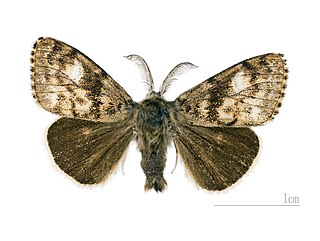
Garudinodes albiceps is a moth of the family Erebidae. It was described by Rothschild in 1912. It is found in New Guinea. [1]
Moths comprise a group of insects related to butterflies, belonging to the order Lepidoptera. Most lepidopterans are moths, and there are thought to be approximately 160,000 species of moth, many of which have yet to be described. Most species of moth are nocturnal, but there are also crepuscular and diurnal species.
The Erebidae are a family of moths in the superfamily Noctuoidea. The family is among the largest families of moths by species count and contains a wide variety of well-known macromoth groups. The family includes the underwings (Catocala); litter moths (Herminiinae); tiger, lichen, and wasp moths (Arctiinae); tussock moths (Lymantriinae), including the arctic woolly bear moth ; piercing moths ; micronoctuoid moths (Micronoctuini); snout moths (Hypeninae); and zales, though many of these common names can also refer to moths outside the Erebidae. Some of the erebid moths are called owlets.
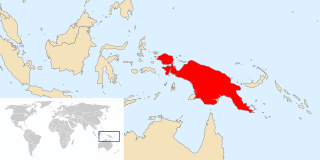
New Guinea is a large island separated by a shallow sea from the rest of the Australian continent. It is the world's second-largest island, after Greenland, covering a land area of 785,753 km2 (303,381 sq mi), and the largest wholly or partly within the Southern Hemisphere and Oceania.
The Arctiini are a tribe of tiger moths in the family Erebidae.
Urodidae or "false burnet moths" is a family of insects in the lepidopteran order, representing its own superfamily, Urodoidea, with three genera, one of which, Wockia, occurs in Europe.
Agathiphaga is a genus of moths in the family Agathiphagidae, known as kauri moths. This caddis fly-like lineage of primitive moths was first reported by Lionel Jack Dumbleton in 1952, as a new genus of Micropterigidae.
Ctenosia is a genus of moths in the subfamily Arctiinae.
Garudinodes is a genus of moths in the family Erebidae.
The Thyatirinae are a subfamily of the moth family Drepanidae with about 200 species described. Until recently, most classifications treated this group as a separate family called Thyatiridae.
Ischnocampa is a genus of arctiine tussock moths in the family Erebidae.
Leptarctia is a genus of tiger moths in the family Erebidae. The moths in the genus are found in North America.
Lepypiranga is a genus of arctiine tussock moths in the family Erebidae.
Pachydota is a genus of arctiine tussock moths in the family Erebidae.
Syngamia is a genus of moths of the family Crambidae.
Rhosus is a genus of moths of the family Noctuidae.
Eucyclodes is a genus of moth in the family Geometridae. According to Catalogue of Life recent revision, only E. buprestaria is included to the genus. Other species are categorized into Chloromachia.
Brachypelma albiceps is a species of spider in the family Theraphosidae (tarantulas). It is known as the Mexican golden red rump tarantula or the Amula red rump tarantula. The carapace is a light golden color and the abdomen dark, covered with long red hairs. Females typically live for about 15 years. Males usually live about 5 years or up to 12 months after the last molt.
Eupithecia albiceps is a moth in the family Geometridae. It is found in Peru.
Ctenosia albiceps is a moth of the subfamily Arctiinae. It was described by George Hampson in 1901. It is found on the Bacan Islands in Indonesia.
Ischnocampa albiceps is a moth of the family Erebidae. It was described by Paul Dognin in 1911. It is found in Colombia.
Lepypiranga albiceps is a moth of the subfamily Arctiinae. It was described by Rothschild in 1933. It is found in Brazil.
Ocinara albiceps is a moth in the Bombycidae family. It was described by Francis Walker in 1862. It is found in Sundaland. The habitat consists of lowland areas, especially alluvial forests, as well as the lower montane zone.
| This Nudariina-related article is a stub. You can help Wikipedia by expanding it. |