Gomalia is a monotypic genus of hesperiid butterfly.Gomalia elma, the marbled skipper or African marbled skipper, is found in Africa and parts of Asia.

Nepticulidae is a family of very small moths with a worldwide distribution. They are characterised by eyecaps over the eyes. These pigmy moths or midget moths, as they are commonly known, include the smallest of all living moths, with a wingspan that can be as little as 3 mm in the case of the European pigmy sorrel moth, but more usually 3.5–10 mm. The wings of adult moths are narrow and lanceolate, sometimes with metallic markings, and with the venation very simplified compared to most other moths.

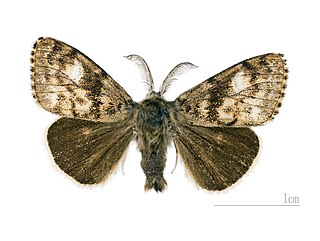
Eupterotidae is a family of insects in the order Lepidoptera with more than 300 described species.
Urodidae or "false burnet moths" is a family of insects in the lepidopteran order, representing its own superfamily, Urodoidea, with three genera, one of which, Wockia, occurs in Europe.
Copromorphoidea, the "fruitworm moths" is a superfamily of insects in the lepidopteran order. These moths are small to medium-sized and are broad-winged bearing some resemblance to the superfamilies Tortricoidea and Immoidea. The antennae are often "pectinate" especially in males, and many species of these well camouflaged moths bear raised tufts of scales on the wings and a specialised fringe of scales at the base of the hindwing sometimes in females only; there are a number of other structural characteristics. The position of this superfamily is not certain, but it has been placed in the natural group of "Apoditrysia" "Obtectomera", rather than with the superfamilies Alucitoidea or Epermenioidea within which it has sometimes previously been placed, on the grounds that shared larval and pupal characteristics of these groups have probably evolved independently. It has been suggested that the division into two families should be abandoned.
Agathiphaga is a genus of moths in the family Agathiphagidae, known as kauri moths. This caddis fly-like lineage of primitive moths was first reported by Lionel Jack Dumbleton in 1952, as a new genus of Micropterigidae.
Garudinodes is a genus of moths in the family Erebidae.

The Thyatirinae are a subfamily of the moth family Drepanidae with about 200 species described. Until recently, most classifications treated this group as a separate family called Thyatiridae.
Mevania is a genus of moths in the subfamily Arctiinae.

Neuroxena is a genus of tiger moths in the family Erebidae.
Ordishia is a genus of arctiine tussock moths in the family Erebidae.
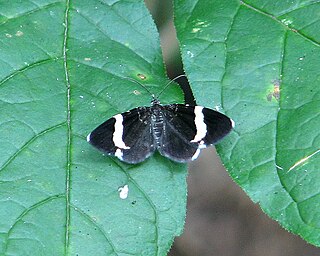
Trichodezia is a genus of moths in the family Geometridae.
Trichodezia albofasciata is a moth in the family Geometridae. It is found in the United States.
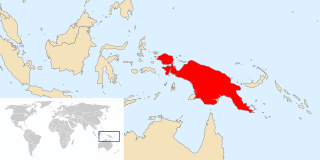
Garudinodes albiceps is a moth of the family Erebidae. It was described by Rothschild in 1912. It is found in New Guinea.
Mevania albofasciata is a moth of the subfamily Arctiinae. It was described by Rothschild in 1912. It is found in Peru.
Neuroxena albofasciata is a moth of the subfamily Arctiinae. It is found in Cameroon.
Epicopiopsis is a genus of moths in the family Epicopeiidae described by Karl Grünberg in 1908. The Global Lepidoptera Names Index has this genus as a synonym of Epicopeia.
Saturnia albofasciata, the white-streaked saturnia moth, is a species of silkmoth in the family Saturniidae. It is found in Central America and North America.