Geological Museum of the Dolomites

Last updated
Geological Museum of the Dolomites
Museo Geologico delle Dolomiti
Museo geologico delle Dolomiti (logo blu).jpg
Museo geologico delle Dolomiti 02.jpg
Italy Trentino-South Tyrol location map.svg
Red pog.svg
Location within Trentino-Alto Adige/Südtirol
Established1899 (1899)
LocationPiazza Santi Filippo e Giacomo 1, Predazzo, Trentino, Italy
Coordinates 46°18′46″N11°36′10″E / 46.312904°N 11.602725°E / 46.312904; 11.602725
TypeGeological museum
Website www.muse.it/en/visita/Muse-sul-Territorio/Pages/Museo-geologico-delle-Dolomiti-di-Predazzo.aspx

The Geological Museum of the Dolomites (in Italian Museo Geologico delle Dolomiti) is located in Predazzo, Fiemme Valley, in the Trentino province of Italy. It is managed by the Comune of Predazzo and the Science Museum (MUSE) of Trento since 2012.

Contents

History

Interest in the geology of the Dolomites started in the 18th century, in the form of explorers and naturalists from all over the world. [1] By the 19th century, geologists and scientists made the hotel "Nave D'Oro" (Golden Ship) in Predazzo the base for their explorations: [2] [3] Alexander von Humboldt, Jean Baptiste Elie de Beaumont, Charles Lyell, Roderick Murchison, Amelia Edwards and many more.

The museum was founded in 1899 [4] in order publicize the geological and natural heritage of the Dolomites through exhibits of minerals, fossils, rocks, etc. The collection, after a few moves in the 20th century, is now housed in the former "house of tourism and handicraft" in the main square of Predazzo. [5]

In 2009, as part of the representation for the Dolomites themselves, the museum was inserted in the World Heritage List by UNESCO. [6]

In 2012 it became part of the MUSE (Science Museum of Trento).The refurbishment of summer 2015 enhanced the collection and the museum itself. [7]

Exposition

Bjuvia fossil from Triassic (240 million years ago), coming from Agnello Mountain, Predazzo Bjuvia sp. - MUSE.jpg
Bjuvia fossil from Triassic (240 million years ago), coming from Agnello Mountain, Predazzo

The museum owns more than 12,000 items, both geologic and fossil, and the largest collection of invertebrate fossils of the Middle Triassic epoch in all Italy. It manages also an external educational itinerary, called "Dos Capèl geological path" (from Italian: Sentiero Geologico del Dos Capèl), that can be visited during summer.

After the refurbishment of 2015, the hall replicates a room of the hotel "Nave d'Oro" (Golden Ship), with testimonials of the flourishing scientific and geological studies of the 18th century. The ground floor hosts an exposition about the history of the Dolomites and their scientific discovery. In the basement it is possible to explore the different mountain chains of the Fiemme Valley and Fassa Valley: Lagorai, Latemar, Catinaccio, Marmolada-Monzoni and Sella.

The museum hosts also a scientific library with over 4,000 volumes regarding geology, mineralogy and paleontology, with a specific section dedicated to history and antiques.

Dos Capèl geological path

Kink band in sedimentary sequence (Livinallongo Formation, Ladinico Inferiore, Dos Capel geological path, Predazzo) Kink band sul Dos Capel (Predazzo).jpg
Kink band in sedimentary sequence (Livinallongo Formation, Ladinico Inferiore, Dos Capèl geological path, Predazzo)

The "Dos Capèl geological path" (in Italian: sentiero geologico del Dos Capèl) is an educational and hiking itinerary. It is 9.7 km (6.0 mi) long and the level of difficulty is not high. [8] Created in 1970, it was restored around 2000 [9] and connected to the Museum of Predazzo as its open-air extension. The starting point is located in Pampeago (1860 m a.s.l.) and consists of a circular itinerary around the mountain Dos Capèl (2200 m a.s.l.) with 32 steps having informative panels, pictures and descriptions, [10] in order to learn and observe in person. [11] It is possible to reach this itinerary also from Passo Feudo, by the cable car of Ski Center Latemar. [12]

See also

Related Research Articles

<span class="mw-page-title-main">Dolomites</span> Mountain range in the Italian Alps

The Dolomites, also known as the Dolomite Mountains, Dolomite Alps or Dolomitic Alps, are a mountain range in northeastern Italy. They form part of the Southern Limestone Alps and extend from the River Adige in the west to the Piave Valley in the east. The northern and southern borders are defined by the Puster Valley and the Sugana Valley. The Dolomites are in the regions of Veneto, Trentino-Alto Adige/Südtirol and Friuli-Venezia Giulia, covering an area shared between the provinces of Belluno, Vicenza, Verona, Trentino, South Tyrol, Udine and Pordenone.

<span class="mw-page-title-main">Cortina d'Ampezzo</span> Town and comune in Veneto, Italy

Cortina d'Ampezzo sometimes abbreviated to simply Cortina, is a town and comune in the heart of the southern (Dolomitic) Alps in the province of Belluno, in the Veneto region of Northern Italy. Situated on the Boite river, in an alpine valley, it is an upscale summer and winter sport resort known for its skiing trails, scenery, accommodation, shops and après-ski scene, and for its jet set and Italian aristocratic crowd.
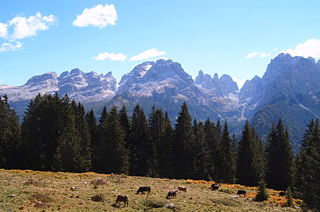
<span class="mw-page-title-main">Brenta group</span> Alpine mountain range in northeastern Italy

The Brenta Group or Brenta Dolomites is a mountain range, and a subrange of the Rhaetian Alps in the Southern Limestone Alps mountain group. They are located in the Province of Trentino, in northeastern Italy. It is the only dolomitic group west of the Adige River. Therefore, geographically, they have not always been considered a part of the Dolomites mountain ranges. Geologically, however, they definitely are - and therefore sometimes called the "Western Dolomites". As part of the Dolomites, the Brenta Group has been officially recognized as UNESCO World Heritage Site under the World Heritage Convention.

<span class="mw-page-title-main">Rovereto</span> City in Trentino-Alto Adige

Rovereto is a city and comune in Trentino in northern Italy, located in the Vallagarina valley of the Adige River.

<span class="mw-page-title-main">Trentino</span> Autonomous province of Italy

Trentino is an autonomous province of Italy in the country's far north. Trentino and South Tyrol constitute the region of Trentino-Alto Adige/Südtirol, an autonomous region under the constitution. The province is composed of 166 comuni. Its capital is the city of Trento (Trent). The province covers an area of more than 6,000 km2 (2,300 sq mi), with a total population of 541,098 in 2019. Trentino is renowned for its mountains, such as the Dolomites, which are part of the Alps.

<span class="mw-page-title-main">Calalzo di Cadore</span> Comune in Veneto, Italy

Calalzo di Cadore is a municipality of 2,400 inhabitants of the province of Belluno, in the Italian region of Veneto. The name Calalzo derives from the Latin altus callis, meaning "high place." The geographical name "di Cadore" was added by Presidential Decree on 30 June 1959.

<span class="mw-page-title-main">Predazzo</span> Comune in Trentino-Alto Adige/Südtirol, Italy

Predazzo is a village and comune in the province of Trento, northern Italy. Predazzo is located about 58 kilometres northeast of Trento in Val di Fiemme.

<span class="mw-page-title-main">Monte Cetona</span> Mountain in Italy

The Monte Cetona is a mountain located in the southern Tuscany region of Italy.

<span class="mw-page-title-main">Cinque Torri</span> Mountain in Italy

Cinque Torri comprise a small rock formation belonging to Nuvolao group in the Dolomiti Ampezzane north-west of San Vito di Cadore and south-west of Cortina d'Ampezzo.

<span class="mw-page-title-main">Ohannés Gurekian</span>

Ohannés Gurekian was an Armenian architect, engineer, and alpinist.

<span class="mw-page-title-main">"Giuseppe Dal Ben" Ski Jumping Arena</span> Sports venue

The "Giuseppe Dal Ben" Ski Jumping Arena is a ski jumping venue in Predazzo, Val di Fiemme, Trentino, in northern Italy. It is a venue in the FIS Ski jumping World Cup.

<span class="mw-page-title-main">Forte Tre Sassi</span> Historic Austro-Hungarian fortress

Tre Sassi fort is a fortress and museum on the road to the Passo di Valparola, within the comune of Cortina d'Ampezzo in the southern (Dolomitic) Alps of the Veneto region of Northern Italy. Hidden between the Ampezzo valley and the high Val Badia, it was built by Austrians between 1897 and 1901 as a fortification against attack from the Italians on the Falzàrego and Valparo. During World War I it was a favorite target for the Italians, and the fort was destroyed as there was inadequate artillery to defend it.

<span class="mw-page-title-main">Cascata del Serpente</span> Waterfall in Liguria, Italy

Cascata del Serpente is a waterfall located in the Ligurian Apennine (Italy). In the past it was also named Cascata delle Cheucie. With other secondary drops it forms the cascate del Serpente complex.

The following is a timeline of the history of the city of Trento in the Trentino-South Tyrol region of Italy.

<span class="mw-page-title-main">Reale Museo di Fisica e Storia Naturale</span> Scientific museum in Florence, Italy

The Reale Museo di Fisica e Storia Naturale was an Italian museum founded on 22 February 1775 in Florence that survived until 1878, when its collections were split up in various Florentine museums.

<span class="mw-page-title-main">Museo leonardiano di Vinci</span> Museum dedicated to Leonardo da Vinci in Italy

The Museo Leonardiano di Vinci, or Leonardian Museum of Vinci, is a museum dedicated to Leonardo da Vinci, located in Vinci, Leonardo's birthplace, in the province of Florence, Italy.
<span class="mw-page-title-main">Monte Alpe</span> Mountain in Italy

The Monte Alpe is a mountain of the Ligurian Prealps, the eastern section of the Ligurian Alps.

<span class="mw-page-title-main">Alta Via 2</span> High altitude footpath, Dolomites

Alta via 2 is a high route located in the Italian Dolomites between Brixen (Bressanone) in the north and Croce d'Aune near Feltre in the south.

References

  1. Italiano, Club Alpino (1871). Bollettino del Club alpino italiano (in French). Vol. 5 (17-18 ed.). Turin. p. 87.{{cite book}}: CS1 maint: location missing publisher (link)
  2. Murray, John (1873). A handbook for travellers in southern Germany. London. p. 353.{{cite book}}: CS1 maint: location missing publisher (link)
  3. Italiano, Club Alpino (1874). Bollettino del Club Alpino Italiano (in Italian) (VIII ed.). Turin. p. 312.{{cite book}}: CS1 maint: location missing publisher (link)
  4. Benedetti, Amedeo; Benedetti, Bruno (2003). Gli archivi della scienza: musei e biblioteche della scienza e della tecnologia in Italia (in Italian). Erga. ISBN   978-88-8163-153-7.
  5. "Regolamento del museo geologico, Delibera di Giunta Comunale n. 58". www.comune.predazzo.tn.it (in Italian). Retrieved 2020-12-23.
  6. UNESCO (2009). "World Heritage 33 COM - Report of decisions" (PDF). Seville, Spain.
  7. "Inaugurato il nuovo percorso espositivo al Museo geologico delle Dolomiti di Predazzo". Fondazione Dolomiti Unesco (in Italian). 2015.
  8. "Sentiero del Dos Capel". Wikiloc | Percorsi nel mondo (in Italian). Retrieved 2020-12-24.
  9. "Mirko Demozzi - Geologo e accompagnatore di territorio". Mirko Demozzi (in Italian). Retrieved 2020-12-24.
  10. "Predazzo, il Sentiero Geologico del Doss Capel, un libro di 200 milioni di anni". PredazzoBlog (in Italian). 2010-05-19. Retrieved 2020-12-24.
  11. Enrico (2008-08-08). "Emozioni Dietro L'Obiettivo: Il sentiero geologico del Dos Càpel". Emozioni Dietro L'Obiettivo. Retrieved 2020-12-24.
  12. "Sentiero Geologico Doss Capel | Dolomiti SuperSummer". 2016-09-19. Archived from the original on 2016-09-19. Retrieved 2020-12-24.