Related Research Articles

The 1820s was a decade of the Gregorian calendar that began on January 1, 1820, and ended on December 31, 1829.

Sir Charles BarryFRS RA was a British architect, best known for his role in the rebuilding of the Palace of Westminster in London during the mid-19th century, but also responsible for numerous other buildings and gardens. He is known for his major contribution to the use of Italianate architecture in Britain, especially the use of the Palazzo as basis for the design of country houses, city mansions and public buildings. He also developed the Italian Renaissance garden style for the many gardens he designed around country houses.
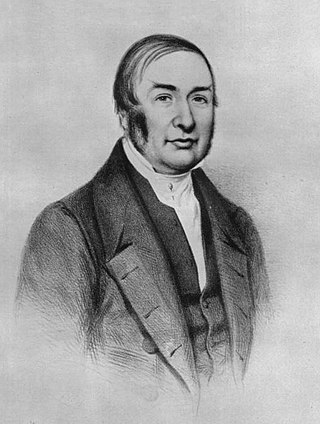
James Braid was a Scottish surgeon, natural philosopher, and "gentleman scientist".

Major General Sir Thomas Makdougall Brisbane, 1st Baronet,, was a British Army officer, administrator, and astronomer. Upon the recommendation of the Duke of Wellington, with whom he had served, he was appointed governor of New South Wales from 1821 to 1825.

John Keate was an English schoolmaster, and Head Master of Eton College.

Sir George Murray was a British soldier and politician from Scotland.

Nathaniel P. Tallmadge was an American lawyer, politician, and Wisconsin pioneer. He served two terms as United States senator from New York and was the 3rd governor of the Wisconsin Territory (1844–1845). Originally active in politics as a Jacksonian Democrat, he fell out with the party during the presidency of Martin Van Buren and eventually became a Whig.

The Venerable Francis Wrangham was the Archdeacon of the East Riding. He was a noted author, translator, book collector and abolitionist.
Charles Calvert (1785–1852) was a British landscape painter. His brothers were artist Michael Pease Calvert, actor Frederick Baltimore Calvert, and surgeon George Calvert.
Frederick Baltimore Calvert was an English actor and academic.

William Edward Armytage Axon was an English librarian, antiquary and journalist for the Manchester Guardian. He contributed to the Dictionary of National Biography under his initials W. E. A. A. He was also a notable vegetarianism activist.

Sir William Thorburn KBE, CB, CMG, FRCS DL was an English surgeon and pioneer in modern spinal surgery. At the time of his death he was Emeritus Professor of Clinical Surgery at the Victoria University of Manchester.

Latham of Bradwall is a family whose seat was at Bradwall Hall, in the township of Bradwall, near Sandbach, England, with several notable members. The line is "a junior branch of the ancient Cheshire house of Lathom, of Lathom and Knowsley, which terminated in the heiress, Isabella Latham, who married Sir John Stanley, Knt., ancestor of the Earls of Derby".

Samuel Cooper FRS was an English surgeon and medical writer. He published a Surgical Dictionary which went through many editions.
Barcarolle was a British Thoroughbred racehorse and broodmare who won the classic 1000 Guineas at Newmarket Racecourse in 1838. In a racing career which lasted from April 1838 until September 1839, the filly ran seven times and won twice. Unraced as a two-year-old Barcarolle won the Guineas on her second appearance of 1838 but contracted an illness and raced only once more that season. After winning one minor race from four starts in 1839, she was retired from racing and exported to Russia in the following year.

Lieutenant-Colonel Ayscoghe Boucherett was a British landowner, businessman and politician who served as Member of Parliament (MP) for Great Grimsby from 1796 to 1803.

Thomas Turner, FRCS, FLS, was an English surgeon known primarily for his involvement in developing medical education outside its then traditional base of London. He established a medical school in Manchester and was both a Fellow of the Royal College of Surgeons of England and the Linnean Society of London.

Charles Hawkes Todd was a medical doctor and the president of the Royal College of Surgeons in Ireland (RCSI) in 1821.

Percy Furnivall FRCS was a British colorectal surgeon who was a champion cyclist in the 1880s and wrote an early book on athletic performance, Physical Training for High Speed Competitions, that was published in 1888.

Thomas Letherbrow (1825–1899) was a British artist, poet, and antiquarian.
References
- ↑ Letherbrow, Thomas (20 July 1878). "The Calverts". The Manchester City News - Notes & Queries. p. 181.
- 1 2 3 Remains, Historical and Literary, Connected with the Palatine Counties of Lancaster and Chester. Chetham Society. 1868. p. 237.
- 1 2 "The Jacksonian Prize. A Retrospect". The British Medical Journal. 1 (1996): 818–820. 1899. ISSN 0007-1447. JSTOR 20260107.
- ↑ Axon, William Edward Armytage (1886). The Annals of Manchester: A Chronological Record from the Earliest Times to the End of 1885. J. Heywood, Deansgate and Ridgefield.
| International | |
|---|---|
| National | |
