Related Research Articles

The Iberian Anarchist Federation is a Spanish organization of anarchist militants active within affinity groups in the Confederación Nacional del Trabajo (CNT) anarcho-syndicalist union. It is often abbreviated as CNT-FAI because of the close relationship between the two organizations. The FAI publishes the periodical Tierra y Libertad.
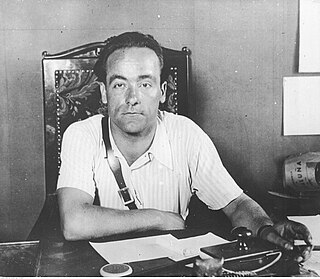
Joan Garcia i Oliver (1901–1980) was a Catalan anarcho-syndicalist revolutionary and Minister of Justice of the Second Spanish Republic. He was a leading figure of anarchism in Spain.

Sinesio Baudillo García Fernández, commonly known by his pseudonym Diego Abad de Santillán, was a Spanish Argentine anarcho-syndicalist economist. Born in León, his family moved to Argentina while he was young. He returned to Spain for his higher education and became involved in the Spanish anarchist movement. After his studies, he went back to Argentina and became involved with the Argentine Regional Workers' Federation (FORA), co-founding the International Workers' Association (IWA). Following the 1930 Argentine coup d'état and the establishment of the Second Spanish Republic, he again went to Spain, becoming involved in the Iberian Anarchist Federation (FAI). During the Spanish Civil War, he served in the Catalan government as Minister of Economy. After the war, he returned to Argentina and largely ceased political activities, going back to Spain only after the Spanish transition to democracy.
Anarchism in Spain has historically gained some support and influence, especially before Francisco Franco's victory in the Spanish Civil War of 1936–1939, when it played an active political role and is considered the end of the golden age of classical anarchism.
The Argentine Libertarian Federation is a libertarian communist federation which operates in Argentina, out of the City of Buenos Aires, San Pedro, La Pampa Province, and Rosario. Founded in October 1935 with the name of the Anarcho-Communist Federation of Argentina the FLA adopted its current name in 1955. It is governed by the Declaration of Principles and the Organic Charter approved by its congress. Its structure and operation are federative and are coordinated by Local Councils and the National Council.
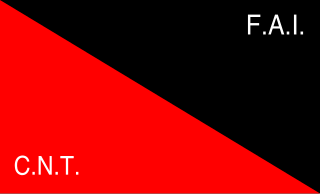
Revolutionary Catalonia was the period in which the autonomous region of Catalonia in northeast Spain was controlled or largely influenced by various anarchist, communist, and socialist trade unions, parties, and militias of the Spanish Civil War era. Although the constitutional Catalan institution of self-government, the Generalitat of Catalonia, remained in power and even took control of most of the competences of the Spanish central government in its territory, the trade unions were de facto in command of most of the economy and military forces, which includes the Confederación Nacional del Trabajo which was the dominant labor union at the time and the closely associated Federación Anarquista Ibérica. The Unión General de Trabajadores, the POUM and the Unified Socialist Party of Catalonia were also prominent.
The Friends of Durruti Group was a Spanish anarchist group commonly known for its participation in the May Days. Named after Buenaventura Durruti, it was founded on 15 March 1937 by Jaume Balius i Mir and Félix Martínez, who had become disillusioned with the policies of the CNT-FAI's leadership. During the May Days in Barcelona, they actively agitated among the anti-government forces, advocating for the formation of a "revolutionary junta", in close collaboration with Spanish Trotskyists. Following the suppression of the uprising, the group began publishing the newspaper El Amigo del Pueblo, in which they denounced the CNT-FAI for "collaborationism", resulting in their expulsion from the organisation. Their 1938 pamphlet Towards a Fresh revolution, which reaffirmed their proposals for a revolutionary junta, became an influential text within the anarchist current of platformism. But the group ultimately failed to make a broader impact within the Spanish movement and collapsed by the end of the war.

The Confederación Nacional del Trabajo is a Spanish confederation of anarcho-syndicalist labor unions, which was long affiliated with the International Workers' Association (AIT). When working with the latter group it was also known as CNT-AIT. Historically, the CNT has also been affiliated with the Federación Anarquista Ibérica ; thus, it has also been referred to as the CNT-FAI. Throughout its history, it has played a major role in the Spanish labor movement.

Joan Peiró i Belis was a Catalan anarchist activist, writer, editor of the anarchist newspaper Solidaridad Obrera, two-time Secretary General of the Confederación Nacional del Trabajo and Minister of Industry of the Spanish government during the Spanish Civil War.
Eusebio Rodríguez Salas was a Spaniard known for being the Commissar-General of the police forces of Catalonia who played a central role in the ignition of the Barcelona May Days.
Lorenzo Íñigo Granizo was a Spanish metalworker and anarchist trade unionist. He played an important role during the Spanish Civil War (1936–39) and later became head of the anarchist trade union federation, the Confederación Nacional del Trabajo (CNT).

Juan López Sánchez was a Spanish construction worker, anarchist and member of the Confederación Nacional del Trabajo, and one of the founders of the Federación Sindicalista Libertaria. During the Spanish Civil War (1936–1939) he was Minister of Commerce under Francisco Largo Caballero. After the war he spent several years in exile before returning to Spain where he lived without persecution and participated in the "vertical" trade union movement authorized by the dictatorship of General Francisco Franco.

Horacio Martínez Prieto (1902–1985) was a Basque anarcho-syndicalist, of the libertarian possibilist tendency, and on two occasions the General Secretary of the CNT.
The confederal militias were a movement of people's militia organized during the Spanish Civil War by the dominant organizations of anarchism in Spain: the National Confederation of Labor (CNT) and the Iberian Anarchist Federation (FAI).
Pedro Herrera Camarero was a Spanish anarcho-syndicalist.
Anarchism in Portugal first appeared in the form of organized groups in the mid-1880s. It was present from the first steps of the workers' movement, revolutionary unionism and anarcho-syndicalism had a lasting influence on the General Confederation of Labour, founded in 1919.
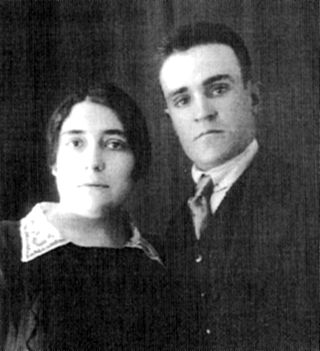
Juan Manuel Molina Mateo, also known as Juanel, was a Spanish anarcho-syndicalist militant of the National Confederation of Labor and a founding member of the Iberian Anarchist Federation.

Mariano Rodríguez Vázquez, popularly known by his nickname Marianet, was a Catalan anarcho-syndicalist politician that served as Secretary General of the Confederación Nacional del Trabajo (CNT) during the Spanish Civil War.
Treintism was a political movement within libertarian socialism in the Second Spanish Republic. Initially a faction within the National Confederation of Labor (CNT), the Treintists were, after the publication of the Manifesto of the Thirty in September 1931, expelled from the CNT over the course of the years 1931 and 1932 and formed the Syndicalist Party in 1932. The Treintists and the labor unions associated with them, the Opposition Syndicates, rejoined the CNT in 1936. The movement fell into political irrelevance with the victory of the Nationalist forces of Francisco Franco in the Spanish Civil War.
The Secretary General of the Confederación Nacional del Trabajo is the head of the Confederación Nacional del Trabajo, a Spanish confederation of anarcho-syndicalist labor unions. The position is elected by a congress or plenary session of the confederation. The position's powers are limited to technical and administrative affairs.
References
- ↑ Manuscript: "37 / 10A" (ln). Typed: "Comrade Germinal de Souza (Secretary of the Peninsular of the FAI" (tn); "year 1938" (tn); "neg. Leica nº 5414" (tn)
- 1 2 Christie 2000, p. 47n1.
- ↑ Alexander 1999, p. 87.
- ↑ Guimarães & Freire 2010, p. 38.
- ↑ Alexander 1999, p. 978.
- ↑ Alexander 1999, pp. 1045–1046.
- ↑ Alexander 1999, p. 1046.
- ↑ Guimarães & Freire 2010, pp. 39–40.