 | This article needs additional citations for verification .(December 2021) |
Gilbert Norwood (born 23 November 1880 in Ecclesall Bierlow, Sheffield; died 18 October 1954 in Toronto) was a British classical philologist and essayist.
| | This article needs additional citations for verification .(December 2021) |
Gilbert Norwood (born 23 November 1880 in Ecclesall Bierlow, Sheffield; died 18 October 1954 in Toronto) was a British classical philologist and essayist.
Gilbert Norwood studied at St John's College of Cambridge University with John Edwin Sandys and Richard Claverhouse Jebb. After completing his Bachelor's degree (1903), he was employed as an Assistant Lecturer in Classics at the University of Manchester. He also completed his master's at Cambridge (1906) and was a Fellow at St. John's College from 1906 to 1909.
In 1908, Norwood was awarded a Professorship at University College in Cardiff (Professor of Greek). He stayed there for almost twenty years until 1926 when he was offered a professorship at University College in Toronto (Canada).
Norwood worked in Toronto until the end of his life. In 1928 he was appointed Professor of Classics and Director of Classical Studies. In the following years he received various international awards: in 1933 he received his doctorate from the University of Wales (Cardiff), in 1943 he was elected a member of the Royal Society of Canada, and in 1943/1944 he was invited to the University of California, Berkeley as Sather Professor, in 1944/1945 he was visiting professor at the University of Chicago. Norwood retired in 1951.
Norwood's research focus was the ancient stage poetry, especially the Greek tragedy (Euripides) and comedy (Aristophanes) as well as the Roman comedy (Plautus and Terence). He published English translations of several pieces, monographic overviews of the genres and numerous essays on individual problems.

Euripides was a tragedian of classical Athens. Along with Aeschylus and Sophocles, he is one of the three ancient Greek tragedians for whom any plays have survived in full. Some ancient scholars attributed ninety-five plays to him, but the Suda says it was ninety-two at most. Of these, eighteen or nineteen have survived more or less complete. There are many fragments of most of his other plays. More of his plays have survived intact than those of Aeschylus and Sophocles together, partly because his popularity grew as theirs declined—he became, in the Hellenistic Age, a cornerstone of ancient literary education, along with Homer, Demosthenes, and Menander.

In Greek mythology, Medea is the daughter of King Aeëtes of Colchis. In the myth of Jason and the Argonauts, she aids Jason in his search for the Golden Fleece. She later marries him, but eventually kills his children and his other bride. Medea is known in most stories as a sorceress and is often depicted as a priestess of the goddess Hecate. She first appears in Hesiod's Theogony around 700 BCE, but is best known from Euripides's tragedy Medea and Apollonius of Rhodes's epic Argonautica.

Euterpe was one of the Muses in Greek mythology, presiding over music. In late Classical times, she was named muse of lyric poetry. She has been called "Giver of delight" by ancient poets.

The Bacchae is an ancient Greek tragedy, written by the Athenian playwright Euripides during his final years in Macedonia, at the court of Archelaus I of Macedon. It premiered posthumously at the Theatre of Dionysus in 405 BC as part of a tetralogy that also included Iphigeneia at Aulis and Alcmaeon in Corinth, and which Euripides' son or nephew is assumed to have directed. It won first prize in the City Dionysia festival competition.

In Greek mythology, Pentheus was a king of Thebes. His father was Echion, the wisest of the Spartoi. His mother was Agave, the daughter of Cadmus, the founder of Thebes, and grandson of the goddess Harmonia. His sister was Epeiros and his son was Menoeceus.
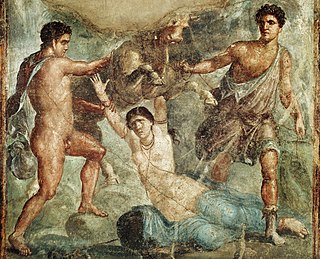
Dirce was a queen of Thebes as the wife of Lycus in Greek mythology.

In Greek mythology, Harmonia is the goddess of harmony and concord. Her Roman counterpart is Concordia. Her Greek opposite is Eris, whose Roman counterpart is Discordia.
In Greek mythology, Evadne was a name attributed to the following individuals:

In Greek mythology, Capaneus was a son of Hipponous and either Astynome or Laodice, and husband of Evadne, with whom he fathered Sthenelus. Some call his wife Ianeira.

George Gilbert Aimé Murray was an Australian-born British classical scholar and public intellectual, with connections in many spheres. He was an outstanding scholar of the language and culture of Ancient Greece, perhaps the leading authority in the first half of the twentieth century. He is the basis for the character of Adolphus Cusins in his friend George Bernard Shaw's play Major Barbara, and also appears as the chorus figure in Tony Harrison's play Fram.

Rhesus is an Athenian tragedy that belongs to the transmitted plays of Euripides. Its authorship has been disputed since antiquity, and the issue has invested modern scholarship since the 17th century when the play's authenticity was challenged, first by Joseph Scaliger and subsequently by others, partly on aesthetic grounds and partly on account of peculiarities in the play's vocabulary, style and technique. The conventional attribution to Euripides remains controversial.

Eric Robertson Dodds was an Irish classical scholar. He was Regius Professor of Greek at the University of Oxford from 1936 to 1960.
The Iambic trimeter, in classical Greek and Latin poetry, is a meter of poetry consisting of three iambic metra per line. In English poetry, it refers to a meter with three iambic feet.
Edith Hall, is a British scholar of classics, specialising in ancient Greek literature and cultural history, and professor in the Department of Classics and Ancient History at Durham University. She is a Fellow of the British Academy. From 2006 until 2011 she held a chair at Royal Holloway, University of London, where she founded and directed the Centre for the Reception of Greece and Rome until November 2011. She resigned over a dispute regarding funding for classics after leading a public campaign, which was successful, to prevent cuts to or the closure of the Royal Holloway Classics department. Until 2022, she was a professor at the Department of Classics at King's College London. She also co-founded and is Consultant Director of the Archive of Performances of Greek and Roman Drama at Oxford University, Chair of the Gilbert Murray Trust, and Judge on the Stephen Spender Prize for poetry translation. Her prizewinning doctoral thesis was awarded at Oxford. In 2012 she was awarded a Humboldt Research Prize to study ancient Greek theatre in the Black Sea, and in 2014 she was elected to the Academy of Europe. She lives in Cambridgeshire.
William Ayres Arrowsmith was an American classicist, academic, and translator.
In Greek and Roman mythology, Glaucus, usually surnamed as Potnieus, was a son of Sisyphus whose main myth involved his violent death as the result of his horsemanship. He was the king of the Boeotian city of Potniae or sometimes of Corinth. Glaucus was the subject of a lost tragedy by Aeschylus, Glaucus Potnieus(Glaucus at Potniae), fragments of which are contained in an Oxyrhynchus Papyrus.
Ian C. Johnston is a Canadian author and translator, a retired university-college instructor and a professor emeritus at Vancouver Island University.
Helene P. Foley is an American classical scholar. She is Professor of Classical Studies at Barnard College, Columbia University and a member of the Institute for Research on Women, Gender and Sexuality at Columbia. She specialises in ancient Greek literature, women and gender in antiquity, and the reception of classical drama.
Anne Pippin Burnett was an American classical scholar and academic who specialised in Greek literature, especially tragedy and the lyric poetry of the archaic and early classical periods.
Barbara Elizabeth Goff is a Classics Professor at the University of Reading. She specialises in Greek tragedy and its reception; women in antiquity; postcolonial classics and reception of Greek political thought.