
Gloppedalsura, or Gloppura, is a scree in Gloppedalen, Rogaland, Norway, in the Gjesdal and Bjerkreim municipalities. It is one of the largest screes in Scandinavia and Northern Europe. [1] [2]
Gloppedalsura, or Gloppura, is a scree in Gloppedalen, Rogaland, Norway, in the Gjesdal and Bjerkreim municipalities. It is one of the largest screes in Scandinavia and Northern Europe. [1] [2]
During the invasion of Norway, 250 Norwegian soldiers used the scree as a natural fortress and held back two German battalions. One Norwegian soldier lost his life in the battle. Losses on the German side are uncertain and varies between 12 and 44 soldiers.
Hurtigruten, formally Kystruten Bergen-Kirkenes, is a Norwegian public coastal route transporting passengers that travel locally, regionally and between the ports of call, and also cargo between ports north of Tromsø.

The Oslofjord is an inlet in the south-east of Norway, stretching from an imaginary line between the Torbjørnskjær and Færder lighthouses and down to Langesund in the south to Oslo in the north. It is part of the Skagerrak strait, connecting the North Sea and the Kattegat sea area, which leads to the Baltic Sea. The Oslofjord is not a fjord in the geological sense — in Norwegian the term fjord can refer to a wide range of waterways. The bay is divided into the inner and outer Oslofjord at the point of the 17 by 1 kilometre Drøbak Sound.
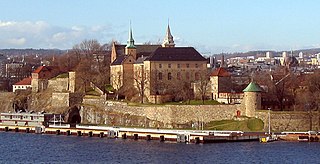
Akershus Fortress or Akershus Castle is a medieval castle in the Norwegian capital Oslo that was built to protect and provide a royal residence for the city. Since the Middle Ages the fortress has been the namesake and centre of the main fief and later main county of Akershus, which was originally one of Norway's four main regions and which included most of Eastern Norway. The fortress itself was located within the Akershus main county until 1919, and also within the smaller Akershus sub county until 1842.

The Norwegian campaign was an attempted Allied occupation of northern Norway, during the early stages of World War II.
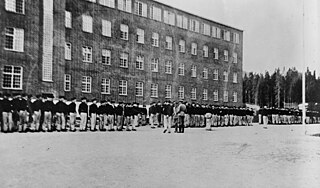
Grini prison camp was a Nazi concentration camp in Bærum, Norway, which operated between 1941 and May 1945. Ila Detention and Security Prison is now located here.
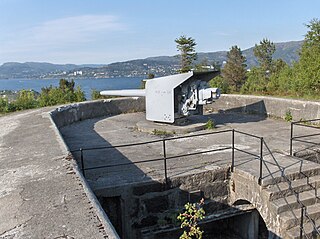
Kvarven Fort was a mountain fort strategically located by the main shipping channel of the Byfjorden leading to Bergen, Norway.

The Norwegian armed forces in exile were remnants of the armed forces of Norway that continued to fight the Axis powers from Allied countries, such as Britain and Canada, after they had escaped the German conquest of Norway during World War II.

Det Norske Teatret is a theatre in Oslo. The theatre was founded in 1912, after an initiative from Hulda Garborg and Edvard Drabløs. It opened in 1913, touring with two plays, Ervingen by Ivar Aasen and Rationelt Fjøsstell by Hulda Garborg. Its first official performance was Ludvig Holberg's comedy Jeppe på berget, with Haakon VII of Norway and the prime minister of Norway among the spectators. Hulda Garborg was the first board manager, and Rasmus Rasmussen was the first theatre director. The theatre primarily performs plays written in or translated into Nynorsk.
The 1943 University of Oslo fire was a fire in the ceremony hall of the University of Oslo in 1943. Its direct consequences were the closing of the university, and the arrest of 1,166 people; these were chiefly male students. Of these, 644 were sent to German "readjustment" camps, where 17 people died. Initial beliefs that the fire was either a Reichstag fire or perpetrated by communists were wrong; members of the Norwegian resistance movement were responsible.

Norway's Resistance Museum also known as the Norwegian Home Front Museum is a museum located at the Akershus Fortress in Oslo.

Bredtveit Prison is a prison located in the neighborhood of Bredtvet in Oslo, Norway. During World War II it was a concentration camp.

Operation Leader was a successful air attack conducted against German shipping in the vicinity of Bodø, Norway, on 4 October 1943, during World War II. The raid was executed by aircraft flying from the United States Navy aircraft carrier USS Ranger, which was attached to the British Home Fleet. The American airmen located many German and Norwegian ships in this area and are believed to have destroyed five and damaged another seven. Two German aircraft searching for the Allied fleet were shot down as well. Three American aircraft were destroyed in combat during the operation and another crashed while landing.
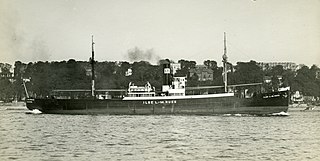
Ilse L.-M. Russ was a 1,600 GRT cargo ship that was built in 1926 by Flensburger Schiffbau Gesellschaft, Flensburg. She was seized by the Allies in May 1945 at Kiel, passed to the Ministry of War Transport (MoWT) and renamed Empire Conqueror. In 1946, she was allocated to the Norwegian Government and renamed Ekornes. She was sold into merchant service in 1947 and renamed Elfrida. She served until December 1959 when she sprang a leak and sank off the coast of Norway.

The National Gallery is a gallery in Oslo, Norway. Since 2003 it is administratively a part of the National Museum of Art, Architecture and Design.
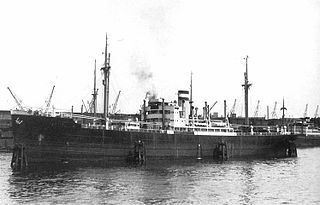
MSPalatia was a German liner, built in 1928. After serving for several years on the Hamburg America Line's route to the Caribbean, she was sold to the Soviet Union in 1940. Following the outbreak of war between Nazi Germany and the Soviet Union in June 1941, she was captured by the Germans and pressed into Kriegsmarine service.

Holmenkollen National Arena is a Nordic skiing and biathlon venue located at Holmenkollen in Oslo, Norway. It consists of the large ski jumping hill Holmenkollbakken, the normal hill Midtstubakken and a stadium for cross-country skiing and a shooting range for biathlon. Since 1892, it has hosted the annual Holmenkollen Ski Festival, which is part of the world cup tournaments in ski jumping, cross-country skiing, Nordic combined, as well as annual Biathlon World Cup races. It has previously hosted the 1952 Winter Olympics, and the FIS Nordic World Ski Championships in 1930, 1966, 1982 and 2011.

The German School of Oslo is a German-language school in Oslo, Norway and is led by Oliver Schaefer. It is located in Sporveisgata 20 at Bislett, and was opened in 1980. In the beginning, the school was located in the basement of the German Protestant Community of Oslo in Eilert Sundts gate 37, before it moved to Majorstuen School. In 1998, the DSO moved from Majorstuen to the disused Hegdehaugen Upper Secondary School, where it has been ever since.

The Norwegian railway network consists of 2,552 kilometers (1,586 mi) of electrified railway lines, constituting 62% of the Norwegian National Rail Administration's 4,114 kilometers (2,556 mi) of line. In 2008, electric traction accounted for 90% of the passenger kilometers, 93% of the tonne kilometers and 74% of the energy consumption of all trains running in Norway, with the rest being accounted for by diesel traction.
The Capture of Egersund took place on 9 April 1940, and saw German soldiers of a bicycle squadron land at the Norwegian port town of Egersund, as part of the German invasion of Norway during the Second World War. The Germans seized the town without armed resistance, capturing the small Norwegian army and navy force there and achieving their main objective of cutting the undersea telegraph cable between Norway and the United Kingdom.

SS Kommandøren was a steel-hulled passenger/cargo steamship built in Norway in 1891. She served as a communications link between the regional capital of Western Norway, Bergen, and the various communities of Sogn og Fjordane county.
Coordinates: 58°46′05″N6°16′44″E / 58.7681°N 6.2788°E
 | This Rogaland location article is a stub. You can help Wikipedia by expanding it. |