| Godhuli | |
|---|---|
| Directed by | Girish Karnad B. V. Karanth |
| Produced by | B. M.Venkatesh Chandulal Jain |
| Written by | B. V. Karanth Girish Karnad Sharad Joshi (dialogue) |
| Based on | Tabbaliyu Neenaade Magane by S.L.Bhairappa |
| Starring | Kulbhushan Kharbanda Om Puri Naseeruddin Shah |
| Cinematography | Apurba Kishore Bir [1] |
Release date | 1977 |
| Country | India |
| Language | Hindi |
Godhuli (English: The Hour of the Gods) is a 1977 Hindi drama film co-directed by Girish Karnad and B. V. Karanth, starring Kulbhushan Kharbanda, Om Puri and Naseeruddin Shah. [2]
Hindi or Modern Standard Hindi, is a standardised and Sanskritised register of the Hindustani language. In India, the official standardized variety of the language is based primarily on the Khariboli dialect of Delhi and other nearby areas of northern India. Hindi, written in the Devanagari script, is one of the two official languages of the Government of India, along with the English language. It is one of the 22 scheduled languages of the Republic of India. Contrary to the popular belief, Hindi is not the national language of India because no language was given such a status in the Indian constitution.
Girish Karnad was an Indian actor, film director, Kannada writer, playwright and a Rhodes Scholar, who predominantly worked in South Indian cinema and Bollywood. His rise as a playwright in the 1960s, marked the coming of age of modern Indian playwriting in Kannada, just as Badal Sarkar did in Bengali, Vijay Tendulkar in Marathi, and Mohan Rakesh in Hindi. He was a recipient of the 1998 Jnanpith Award, the highest literary honour conferred in India.
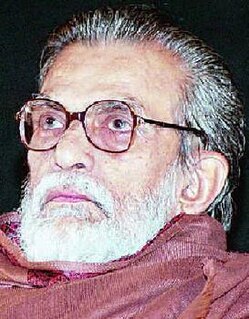
Babukodi Venkataramana Karanth was a noted film and theatre personality from India. Throughout his life he was director, actor and musician of modern Indian theatre both in Kannada as well as Hindi, and one of the pioneers of Kannada and Hindi new wave cinema. He was born in Dakshina Kannada.
It is based on the Kannada novel Tabali neenade Magane, written by S.L. Byrappa as an allegory for nation-building and the clash of modernity with tradition in rural India. It portrays the story of a modern agriculturist who returns from US after studying agriculture and brings his American wife to the village. [3] [4] The film was made in Hindi and Kannada versions: Tabbaliyu Neenade Magane . [5] [2]
Tabbaliyu Neenade Magane is a 1977 Indian Kannada-language film directed by Girish Karnad and B. V. Karanth, with Naseeruddin Shah, Lakshmi Krishnamurthy, Manu and Paula Lindsay in pivotal roles. The film is based on S. L. Bhyrappa's Kannada novel of the same name. The Hindi version of the film was called Godhuli.
Godhuli was included the 1984 International Film Festival of India (IFFI). [2] At the 25th National Film Awards, S. P. Ramanathan won the Best Audiography. [6] [7] It won the Filmfare Award for Best Screenplay at the 27th Filmfare Awards for Girish Karnad and B.V. Karanth. [8]

The International Film Festival of India (IFFI), founded in 1952, is one of the most significant film festivals in Asia. Held annually, currently in the state of Goa, on the western coast of the country, the festival aims at providing a common platform for the cinemas of the world to project the excellence of the film art; contributing to the understanding and appreciation of film cultures of different nations in the context of their social and cultural ethos; and promoting friendship and cooperation among people of the world. The festival is conducted jointly by the Ministry of Information and Broadcasting, Directorate of Film Festivals and the Government of Goa.
The 25th National Film Awards, presented by Directorate of Film Festivals, the organisation set up by Ministry of Information and Broadcasting, India to felicitate the best of Indian Cinema released in the year 1977. Ceremony took place in April 1978.
The National Film Award for Best Audiography is one of the National Film Awards presented annually by the Directorate of Film Festivals, the organisation set up by Ministry of Information and Broadcasting, India. It is one of several awards presented for feature films and awarded with Rajat Kamal.
Set in an underdeveloped village in the vast rural hinterland, the story opens with Public Works Department workers taking measurements for construction of a road that is to pass through which is a common cow grazing ground and has a memorial dedicated to the son of the village landlord, who is respected by the populace, leading to upheaval and resistance. Venkatesh, village priest and teacher (Naseeruddin Shah), cautions restraint and counsels negotiations with Government agencies.
But this minor irritant is grossly exacerbated with the arrival of Nandan Gowda (Kulbhushan Kharbanda), son of the headman with his American wife, Lydia (Paula Lindsay). Bristling with ideas of modern farming and dairy development, he starts on the wrong note by drawing water from the baoli that is adjacent to the village temple, and which is considered auspicious by the villagers. Further, rumours spread about Lydia being a beef eater, primarily by a hot-headed, somewhat mischievous, holier than thou Gowda family lackey (Om Puri). To develop his dairy business, Nandan fetches some cows from his house, which is opposed by his mute mother, who fears their slaughter.
Incidents move fast as an aging cow is sent for the slaughter house. An incensed Venkatesh curses for termination of Lydia's pregnancy and end of the Gowda clan. Matters reach the village panchayat, which hands a stiff punishment to Nandan, who performs the same in deference to his love for the land. His mother, shattered by the entire experience, does gau daan, donation of cows to the village priest, to ensure their protection, before she dies.
A teary eyed Nandan wants to participate in the funeral procession but is unable to do so as his wife suffers labour pains (even as Om Puri gets his head shaved). Curse of the priest comes true, when the newborn's survival is at stake because Lydia is incapable of breast feeding. A lactating mid-wife comes to their rescue.
The beleaguered Nandan is all set to pack up for good and while packing is underway his infant son's survival is threatened been hungry for two days. A servant suggests that the milk of a cow now owned by Venkatesh can save the child's life who initially refuses but relents after intervention by the villagers. The incident chastens the priest who repents and handovers all his cows to Nandan while urging him to bring back the ones sold to the dairy.
Nandan rushes but is unable to identify his cows amidst other ones calls them by their names in the midst of incessant bellowing.
Kulbhushan Kharbanda is an Indian actor who works in Hindi and Punjabi films. He is best known for his role as the antagonist Shakaal in Shaan (1980), inspired by the character Blofeld from James Bond movies. Starting off with the Delhi-based theatre group 'Yatrik' in the 1960s, he moved to films with Sai Paranjpye's Jadu Ka Shankh in 1974. He worked in several parallel cinema films before working in the mainstream Hindi film industry. He appeared in Mahesh Bhatt's classic Arth (1982), Ek Chadar Maili Si (1986), and in all three parts of Deepa Mehta's Elements trilogy: Fire (1996), Earth (1998), and Water (2005).
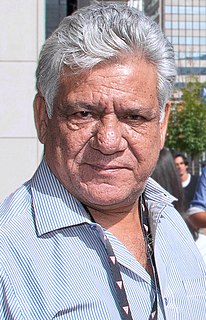
Om Prakash Puri, was an Indian actor who appeared in mainstream commercial Hindi films, as well as independent and art films. He is best known for his author-backed roles in films like Aakrosh (1980), Arohan (1982), Ardh Satya and television films like Sadgati (1981) and Tamas (1987) and also light-hearted roles in Jaane Bhi Do Yaaro (1983) and Chachi 420 (1997). He had various collaborations with director Shyam Benegal and Govind Nihalani. Puri also appeared in non-Indian productions in the United States, Britain and Pakistan.
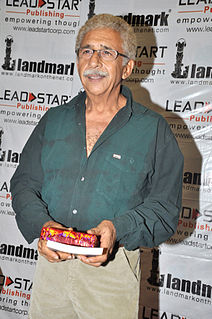
Naseeruddin Shah is an Indian film and stage actor and director in the Hindi language film industry. He is considered among the finest actors of India and is a prominent figure in Indian parallel cinema. He has won numerous awards in his career, including three National Film Awards, three Filmfare Awards and an award at the Venice Film Festival. The Government of India has honoured him with the Padma Shri and the Padma Bhushan awards for his contributions to Indian cinema.
The Filmfare Award for Best Supporting Actor is given by Filmfare as part of its annual Filmfare Awards for Hindi films, to recognise a male actor who has delivered an outstanding performance in a supporting role. Although the awards started in 1954, awards for the best supporting actor category started only the following year 1955. As of 2016, Pran, Amrish Puri, Amitabh Bachchan, Abhishek Bachchan and Anil Kapoor lead the list, with three wins each. Anil Kapoor currently also holds the record of being the youngest recipient of the award, whereas Rishi Kapoor holds the record for being the eldest.

Bhavni Bhavai is a 1980 Gujarati film directed by Ketan Mehta, starring Naseeruddin Shah, Om Puri, Smita Patil, Mohan Gokhale, Benjamin Gilani. It tells the story of untouchability through folklore and Bhavai.

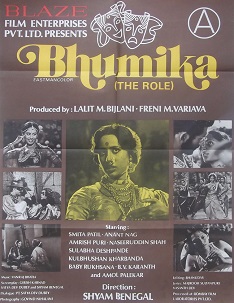
Bhumika is a 1977 Indian film directed by Shyam Benegal. The film stars Smita Patil, Amol Palekar, Anant Nag, Naseeruddin Shah and Amrish Puri.
Manthan is a 1976 Hindi film directed by Shyam Benegal, inspired by the pioneering milk cooperative movement of Verghese Kurien, and is written jointly by him and Vijay Tendulkar. It is set amidst the backdrop of the White Revolution of India. Aside from the great measurable success that this project was, it also demonstrated the power of "collective might" as it was entirely crowdfunded by 500,000 farmers who donated Rs. 2 each. Manthan is the first crowdfunded Indian film.
Govind Nihalani is an Indian film director, cinematographer, screenwriter and producer, known for his works in Hindi cinema. He has been the recipient of six National Film Awards, and five Bollywood Filmfare Awards. In 1996, his script for Drohkaal was adapted by Kamal Hassan for its Tamil remake, Kuruthipunal, which subsequently became India's official entry for the 68th Academy Awards Best Foreign Language Film category.
China Gate is a 1998 Indian action film directed by Rajkumar Santoshi. It was released on 27 November 1998.
Junoon is a 1978 Indian Hindi language film produced by Shashi Kapoor and directed by Shyam Benegal. The film is based on Ruskin Bond's fictional novella, A Flight of Pigeons, set around the Indian Rebellion of 1857. The film's soundtrack was composed by Vanraj Bhatia, and cinematography by Govind Nihalani.
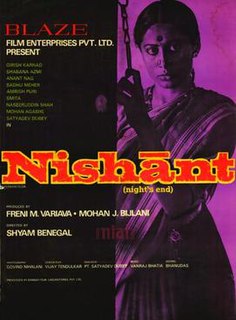
Nishant is a 1975 Hindi drama film directed by Shyam Benegal, based on an original screenplay by noted playwright Vijay Tendulkar, with dialogues by Satyadev Dubey.
Pukar is a 2000 Indian action drama film co-written and directed by Rajkumar Santoshi and Cinematography by Ashok Mehta, Santosh Sivan, Baba Azmi and Chota K. Naidu. It stars Anil Kapoor, Madhuri Dixit, Namrata Shirodkar, Danny Denzongpa, Shivaji Satam and Om Puri. The film was critically acclaimed but did average business at the box office. It won two National Film Awards, including the Nargis Dutt Award for Best Feature Film on National Integration and the National Film Award for Best Actor for Anil Kapoor's performance as Major Jaidev Rajvansh. The score and soundtrack were composed by A. R. Rahman.
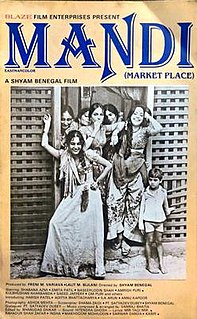
Mandi is a 1983 Hindi film directed by Shyam Benegal. The rights to this film are owned by Shah Rukh Khan's Red Chillies Entertainment.
Kaadu (Forest) is a 1973 Indian Kannada film written and directed by Girish Karnad. The screenplay was based on a novel of the same name by Srikrishna Alanahalli. It stars Master G. S. Nataraj, Amrish Puri and Nandini Bhaktavatsala in the lead roles. The film won awards at the 21st National Film Awards and the 21st Filmfare Awards South.
Chan Pardesi is a Punjabi language film released in 1981. It was directed by Chitrarth Singh and starred Raj Babbar, Rama Vij, Amrish Puri, Kulbhushan Kharbanda and Om Puri. Chan Pardesi was a seminal film that debuted many future Bollywood legends both in front of and behind the camera, and was Raj Babbar's first ever film. Chan Pardesi won India's National Film Award in 1980 and went on to become a big commercial success when it eventually found distribution in 1981.

J. Chandulal Jain was a popular Kannada film director and producer of almost 40 films, notably, Thaaye Devaru, Bhootayyana Maga Ayyu, Tabbaliyu Neenade Magane, Bhakta Siriyala, and many more. He also produced movies in Hindi such as Godhuli and Pyaar Karke Dekho. His film Idu Saadhya was shot in just 48 hours.
Zamana (Time) is a 1985 Indian Bollywood film, written by Salim-Javed, directed by Ramesh Talwar, and starring Rajesh Khanna, Rishi Kapoor, Poonam Dhillon and Ranjeeta. Kulbhushan Karbanda, Girish Karnad, Avataar Gill, Mac Mohan, Satyen Kapu, Om Puri and Pillo Wadia form the supporting cast. The film wasa flop at the box office.
Tabbaliyu Neenade Magane(meaning: You've become orphan, son) is a novel written by novelist S.L. Bhyrappa. This book is about a conflict of a culture with modern views of an educated person in a village of India. Author introduced the characters and develop them throughout the book who represent the different views and fight for moral truth and scientific truths. This book is suitable to the people who wants to know about village life and background of cow as a God in India.
Game is a 1993 Indian Bollywood action crime drama film directed by Anil Mattoo and produced by Romesh Sharma and starring Naseeruddin Shah, Aditya Pancholi, Rahul Roy and Sangeeta Bijlani in the pivotal roles.
The International Standard Book Number (ISBN) is a numeric commercial book identifier which is intended to be unique. Publishers purchase ISBNs from an affiliate of the International ISBN Agency.