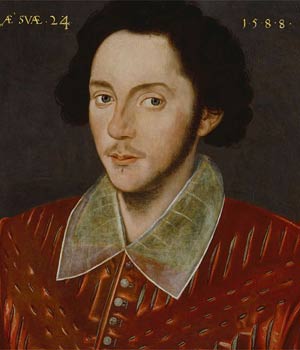
The Grafton portrait is an anonymous Elizabethanpanel painting, depicting a young man who has been suggested to be William Shakespeare. It bears the inscriptions 'Ae suae 24' and '1.5.8.8', indicating that the subject was in his 24th year in 1588.[1][2]
While Shakespeare scholarPeter Ackroyd and some other experts suggest that it is a portrait of the young William Shakespeare, the John Rylands Library has refrained from identifying the subject.[7] A nine-month specialist analysis of the oil painting by the National Portrait Gallery concluded that there was no evidence to suggest that it could be a portrait of Shakespeare other than the age of the subject, and the initials 'WS' on the back which they concluded were added in the 19th century.[8] Curator Tarnya Cooper also suggested that the style of clothing depicted, including a costly silk scarlet jacket, was incompatible with Shakespeare's likely financial situation in 1588.[8][9] She says that the portrait has "fuelled the kind of Shakespeare in Love theories of the 21st Century, of a beautiful young man with a sensitive and passionate face, of a character with an incredible emotional range".[10]
This page is based on this Wikipedia article Text is available under the CC BY-SA 4.0 license; additional terms may apply. Images, videos and audio are available under their respective licenses.