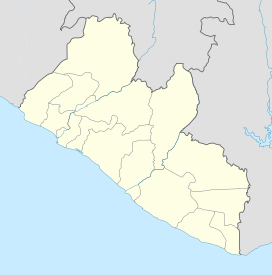
Liberia, officially the Republic of Liberia, is a country on the West African coast. It is bordered by Sierra Leone to its northwest, Guinea to its north, Ivory Coast to its east, and the Atlantic Ocean to its south and southwest. It has a population of around 5 million and covers an area of 111,369 square kilometers (43,000 sq mi). English is the official language, but over 20 indigenous languages are spoken, reflecting the country's ethnic and cultural diversity. The country's capital and largest city is Monrovia.
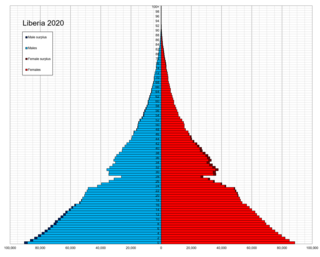
As of 2006, Liberia has the highest population growth rate in the world. 43.5% of Liberians were below the age of 15 in 2010. With recent civil wars being fought along ethnic lines, Liberia is a multiethnic and multicultural country.

The Politics of Liberia takes place in a framework of a presidential representative democratic republic modeled on the government of the United States, whereby the President is the head of state and head of government; unlike the United States, however, Liberia is a unitary state as opposed to a federation and has a pluriform multi-party system rather than the two-party system that characterizes US politics. Executive power is exercised by the government. Legislative power is vested in both the government and the two chambers of the legislature.
The Krahn are an ethnic group of Liberia and Ivory Coast. This group belongs to the Kru language family and its people are sometimes referred to as the Wee, Guéré, Sapo, or Wobe. It is likely that Western contact with the Kru language is the primary reason for the development of these different names.
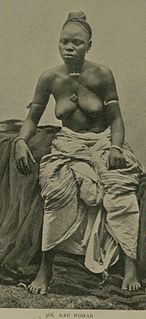
The Kru, Kroo, Krou or Kuru are a West African ethnic group who are indigenous to western Ivory Coast and eastern Liberia. They migrated and settled along various points of the West African coast, notably Freetown, Sierra Leone, but also the Ivorian and Nigerian coasts. The Kru people are a large ethnic group that is made up of many tribes from Liberia to Ivory Coast. These tribes include Bété, Bassa, Krumen, Guéré, Grebo, Klao, Krahn people and, Jabo people. The kru people were more valuable as traders and sailors on slave ships than as slave labor. To ensure their status as “freemen,” they initiated the practice of tattooing their foreheads and the bridge of their nose with indigo dye to distinguish them from slave labor.

Taï National Park is a national park in Côte d'Ivoire that contains one of the last areas of primary rainforest in West Africa. It was inscribed as a World Heritage Site in 1982 due to the diversity of its flora and fauna. Five mammal species of the Taï National Park are on the Red List of Threatened Species: pygmy hippopotamus, olive colobus monkeys, leopards, chimpanzees and Jentink's duiker.

The Bwindi Impenetrable National Park (BINP) is in southwestern Uganda. The park is part of the Bwindi Impenetrable Forest and is situated along the Democratic Republic of the Congo (DRC) border next to the Virunga National Park and on the edge of the Albertine Rift. Composed of 321 square kilometres (124 sq mi) of both montane and lowland forest, it is accessible only on foot. BINP is a United Nations Educational, Scientific and Cultural Organization-designated World Heritage Site.

Grand Gedeh is a county in the eastern portion of the West African nation of Liberia. One of 15 counties that constitute the first-level of administrative division in the nation, it has three districts. Zwedru serves as the capital with the area of the county. Measuring 10,484 square kilometres (4,048 sq mi), it is larger than 28 independent countries including Lebanon, Trinidad and Tobago, Cape Verde, Malta and Mauritius and the combined area of the US states of Delaware and Rhode Island. As of the 2008 Census, it had a population of 126,146, making it the ninth most populous county in Liberia. Grand Gedeh has lower tropical forests which has mid size hills composed of various valleys and water courses. These forests receive a very high rainfall ranging from 3,000 mm (120 in) to 4,100 mm (160 in) per year.

Grand Kru County is a county in the southeastern portion of Liberia. One of 15 counties that comprise the first-level of administrative division in the nation, it has eighteen districts. Organized in 1984, its capital is Barclayville. The area of the county measures 3,895 square kilometres (1,504 sq mi). As of the 2008 Census, it had a population of 57,106, making it the least populous county in Liberia.

River Gee is a county in the southern portion of Liberia. One of 15 counties that constitute the first-level of administrative division in the nation, it has six districts. Fish Town serves as the capital with the area of the county measuring 5,113 square kilometres (1,974 sq mi). As of the 2008 Census, it had a population of 66,789, making it the third-least populous county in Liberia. It was created in 2000.

Kibale National Park is a national park in western Uganda, protecting moist evergreen rainforest. It is 766 square kilometres (296 sq mi) in size and ranges between 1,100 metres (3,600 ft) and 1,600 metres (5,200 ft) in elevation. Despite encompassing primarily moist evergreen forest, it contains a diverse array of landscapes. Kibale is one of the last remaining expanses to contain both lowland and montane forests. In eastern Africa, it sustains the last significant expanse of pre-montane forest.

Zwedru is the capital of Grand Gedeh County, one of the 15 counties in Liberia. Zwedru is located in Tchien District of Grand Gedeh County, near the Cavalla River in the country's south-eastern region and near the border with Côte d'Ivoire. It is located 350 miles southeast from the capital city of Monrovia. The town is a stronghold of the Krahn tribe.
Fish Town is the capital city of River Gee County, Liberia. As of the 2008 national census, the population stood at 3,328.

The Grebo or Glebo people are an ethnic group or subgroup within the larger Kru group of Africa, a language and cultural ethnicity, and to certain of its constituent elements. Within Liberia members of this group are found primarily in Maryland County and Grand Kru County in the southeastern portion of the country, but also in River Gee County and Sinoe County. The Grebo population in Côte d'Ivoire are known as the Krumen and are found in the southwestern corner of that country.
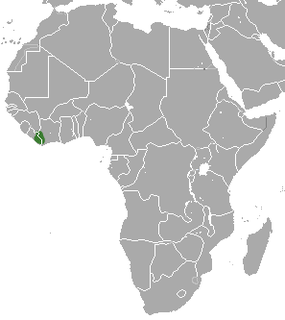
The Liberian mongoose is a mongoose species native to Liberia and Ivory Coast. It is the only member of the genus Liberiictis. Phylogenetic analysis shows it is closely related to other small, social mongooses and that the banded mongoose is its closest relative.
Sapo National Park is a national park in Sinoe County, Liberia. It is the country's largest protected area of rainforest, was the first national park established in the country, and contains the second-largest area of primary tropical rainforest in West Africa after Taï National Park in neighbouring Côte d'Ivoire. Agriculture, construction, fishing, hunting, human settlement, and logging are prohibited in the park.
Liberian Americans are an ethnic group of Americans of full or partial Liberian ancestry. This can include Liberians who are descendants of Americo-Liberian people in America. The first wave of Liberians to the United States, after the slavery period, was after of the First Liberian Civil War in the 1990s and, then, after the Second Liberian Civil War in the early 2000s.
Joshua Milton Blahyi, better known by his nom de guerre General Butt Naked, is a Liberian evangelical preacher, writer and former warlord best known for his actions during the First Liberian Civil War. During the conflict, Blahyi led a group of soldiers which fought on the side of rebel group United Liberation Movement of Liberia for Democracy (ULIMO) before converting to Christianity and becoming a pastor in 1996.
Plahn Nyarn District is one of 16 districts of Sinoe County, Liberia. As of 2008, the population was 6,805.

Environmental issues in Liberia include the deforestation of tropical rainforest, the hunting of endangered species for bushmeat, the pollution of rivers and coastal waters from industrial run-off and raw sewage, and the burning and dumping of household waste.