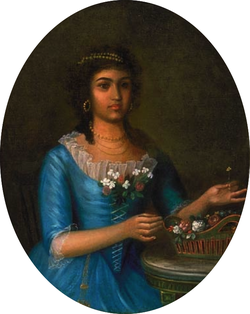
Michel Dragon was a Greek merchant and lieutenant who served in the Spanish Army during the American Revolution, fighting with the Patriots for the independence of the United States of America. He migrated to New Orleans from Athens in the late 1700s and married a freed African slave named Marie Francoise Chauvin Beaulieu de Montplasir. Their mixed-race daughter Marianne Celeste Dragon married another Greek man who became an American war hero named Andrea Dimitry. They established one of the oldest Creole families in New Orleans, known as the Dimitry Family, in 1800.[1] By the middle of the 19th century, the family numbered over 150 individuals.[2] Some members of the family continue to preserve their Greek heritage to this day. By the 1850s, more Greeks appeared in the region, including the Greek consul in New Orleans, Nicholas Marino Benachi (1812–1886).[3] The oldest Mardi Gras krewe, known as Mistick Krewe of Comus, was founded in 1856, venerating the Ancient Greek god of festivity. During this period, the U.S. census measured over 150 Greeks living in New Orleans.[4] Most of the mixed-race Greek American Dimitry family fought on the side of the Confederacy. In 1861, the Greeks of New Orleans also formed a militia regiment to fight for the Confederate side in the American Civil War. It was called The Greek Company A, Louisiana Militia.[5]
Greek American Revolutionairy War Hero Michel Dragon settled in New Orleans in the 1700s
During the American Civil War in 1864, the Greek community in New Orleans began a small church community, and in 1866, they erected the first Greek Orthodox Church in North America, called Holy Trinity Church on 1222 North Dorgenois Street. By the early 1900s, a massive influx of Greek immigrants arrived in the region, including restaurateurs, bakers, fruit sellers, seafood merchants, and skilled craftsmen like carpenters. New Orleans was one of four cities honored with a Greek consulate, along with Boston, Pittsburgh, and Minneapolis, in 1918.
Greek Freighter in New Orleans in 2011
Meanwhile, New York, San Francisco, and Chicago featured larger general consulates.[6]
In 1953, the royal monarchs of Greece, King Paul and Queen Frederica of Greece, visited New Orleans for forty-eight hours, attending religious services at the Greek Orthodox Church of the Holy Trinity, and the royals also toured the city.[7] The Port of New Orleans was a vital shipping destination because of its strategic location at the mouth of the Mississippi River, providing access to a waterway system connecting 37 states. In the 1970s, over 20,000 Greek sailors visited the city yearly, and the French Quarter featured a Greek entertainment district.[4] Some businesses still remain in the district, and the city features a yearly Greek festival, offered by Holy Trinity Greek Orthodox Cathedral.
The earliest known Greek settlement in New Orleans began with Michel Dragon during the late 1700s, before the city became part of the United States of America. Dragon married a free African slave named Marie Francoise Chauvin Beaulieu de Montplasir. His mixed-race daughter Marianne Celeste Dragon married another Greek settler from the island of Hydra named Andrea Dimitry. Together, they established one of the oldest Creole families known as the Dimitry Family in 1800.[1] The Greek couple had over ten children, establishing a community in the region. Each of their children also had an average of ten children. The name the family took has its origin in Ancient Greece, and it venerates the Greek Goddess of harvest, Demeter. Today, their ancestors in New Orleans number in the tens of thousands.[2]
Paul Pandely, a gentleman of English and Greek descent, whose grandmother, Elizabeth English, was of royal lineage and part of the House of Stuart, married Marianne, and Andrea's oldest daughter, Euphrosine Dimitry, who was also of Greek descent. Their marriage was considered mixed race.[1] Marianne and Andrea's second child, Aimèe Manualla Dimitry's daughter, Marie Philomene Elizabeth Dietz, married the Greek nephew of Andrea Dimitry from Hydra, Greece, named John Dimitry. John was a captain in New Orleans.[8]
New Orleans became home to the world-renowned Mardi Gras and established Mardi Gras krewes. Greek themes inspired some of the krewes, such as the Krewe of Bacchus, Krewe of Orpheus, and Krewe of Muses. The Titans, Athena, and Proteus are also venerated in the region during the historical festival. The oldest krewe known as Mistick Krewe of Comus was founded in 1856, venerating the Ancient Greek god of festivity. Nicolas Benachi arrived in New Orleans sometime in the 1850s. He was a representative of the Rallis family. Nicolas was also the Greek consul in the region.[3]
Mistick Krewe of Comus Mardi Gras preparation 1878, oldest Krewe named after Ancient Greek god of festivity Comus
The Rallis Brothers was a massive Greek family-run business spanning the entire world, perhaps the most successful expatriate Greek merchant business of the Victorian era.[4]
By the time of the death of Andrea Dimitry, a Greek vessel was in the port of New Orleans, Louisiana. The officers and crew of a Greek vessel attended the funeral in unison, and the flags of their ship were flown at half mast during the day.[9] In 1861, the Greeks of New Orleans also formed a militia regiment to fight for the Confederate side in the American Civil War. It was called The Greek Company A, Louisiana Militia.[5] They also founded a Greek church during the American Civil War, which was erected in 1866, called Holy Trinity Greek Orthodox Cathedral, New Orleans.[4]
In 2008, a float named Cult of Lafcadio appeared during Mardi Gras in honor of Lafcadio Hearn.
Greek newspaper journalist and translator Lafcadio Hearn, born in Lefkada, Greece, appeared in New Orleans from 1877 to 1887. Hearn created and published nearly two hundred woodcuts of daily life and people in New Orleans, making the Daily City Item the first Southern newspaper to introduce cartoons and giving the paper an immediate boost in circulation. Hearn gave up carving the woodcuts after six months when he found the strain was too great for his eye.[10]
By the early 1900s, Greek immigrants arrived in the region, and in 1918, a second Greek consulate was established in New Orleans, representing the restaurateurs, bakers, fruit sellers, seafood merchants, and skilled craftsmen like carpenters.[6]
Ellis Stratakos, the son of a Greek candy shop owner, was a Greek American Jazz musician who grew up in New Orleans, frequenting black jazz clubs in the Crescent City to study and learn the new popular rebellious genre of music. He was part of a large number of bands and toured the South with countless Jazz musicians of the time, some included: Louis Prima, Ray Bauduc, and Irving Fazola. One of his notable gigs was at the rooftop dance lounge of the Jung Hotel in New Orleans with a band called Ellis Stratakos & His Hotel Jung Orchestra.[11]
King Paul and Queen Frederica of Greece: The reigning Greek monarchs visited New Orleans for 48 hours in 1953, attending religious services at the Greek Orthodox Church of the Holy Trinity and touring the city. The royals were designated honorary citizens of New Orleans.[7]
Holy Trinity Greek Orthodox Cathedral, New Orleans
Holy Trinity of New Orleans in 1911
The original community of Holy Trinity Greek Orthodox Church came together in 1864, and the first church building was built in 1866, named Holy Trinity Church on 1222 North Dorgenois Street. Notable donations were given by Nicholas Benachi, Demetrios Botassis, and John Botassis. There was also support from the oldest Greek American family in New Orleans, known as the Dimitry family. The original Holy Trinity church (which later added a library, cemetery, school, and parish house was replaced by a brick cathedral in 1950. In 1960, 100 years after Benachi's first efforts towards founding an Orthodox Church in New Orleans, Holy Trinity was consecrated as a cathedral. By 1976, the church was sold to Saint Luke's Episcopal Church, and the community relocated to 1200 Robert E. Lee Boulevard (now known as 1200 Allen Toussaint Boulevard in the 70122 zip code. The community used a temporary facility at the location until a community center was completed in 1980, and the current church, Holy Trinity Church Greek Orthodox Cathedral, was erected and consecrated in December 1985. The Byzantine iconography inside the interior of the church was completed by Lawrence Manos. The church features a very large yearly Greek festival.[4][12][13][14]
French Quarter's Greek entertainment district
The Port of New Orleans was a vital shipping destination for the Greek Merchant Marines because its strategic location at the mouth of the Mississippi River provided access to a waterway system connecting 37 states. By the 1970s, there was a Greek cultural space spanning 200 blocks on Decatur Street in the upper French Quarter. The bars and clubs catered to nearly 20,000 Greek sailors visiting the Port of New Orleans yearly. Some of the clubs were the Athenian Room, the Greek Club, Zorba's, the Acropolis, Mediterranean Room, and the Greek and Italian Seamen's Club. The people spoke Greek, ate Greek foods, listened to live bouzouki bands, and danced the traditional zeybekiko. Some of the businesses are still active today.[4]
12"The Greek Merchants"(PDF). The Daily Picayune, Volume 35. , No. 297. New Orleans, Louisiana: The Daily Picayune. January 7, 1872. p. 15, col. 7. Archived(PDF) from the original on November 30, 2025. Retrieved November 30, 2025.
123456Richard Campanella (May 7, 2014). "Tracing Greek geography from Bayou Road to the banks of Bayou St. John". Nola.com. Archived(PDF) from the original on November 30, 2025. Retrieved November 30, 2025. Together with their families, these Greek New Orleanians numbered around 150 by 1850, the first year in which the Census recorded birthplace, thus allowing tabulation.
12"Hellenic Consul at New Orleans"(PDF). The Times Picayune, Volume 82. , No. 198. New Orleans, Louisiana: The Times Picayune. August 11, 1918. p. 28, col. 6. Archived(PDF) from the original on November 30, 2025. Retrieved November 30, 2025.
This page is based on this Wikipedia article Text is available under the CC BY-SA 4.0 license; additional terms may apply. Images, videos and audio are available under their respective licenses.