
Yonge Street is a major arterial route in the Canadian province of Ontario connecting the shores of Lake Ontario in Toronto to Lake Simcoe, a gateway to the Upper Great Lakes. Until 1999, the Guinness Book of World Records repeated the popular misconception it was 1,896 km (1,178 mi) long, making it the longest street in the world; this was due to a conflation of Yonge Street with the rest of Ontario's Highway 11. Yonge Street is only 56 kilometres (35 mi) long.

Lincoln Park is a designated community area on the North Side of Chicago, Illinois. Lying to the west of Lincoln Park, Chicago's largest park, it is one of the most affluent neighborhoods in Chicago.

Newtonbrook is a neighbourhood in Toronto, Ontario, Canada. In the 19th century, it was a separate municipality. It is located in the area around Yonge Street and Finch Avenue in the district of North York between the east and west branches of the Don River. North York was a city that was merged with five other municipalities to form the amalgamated "new" City of Toronto in 1998.
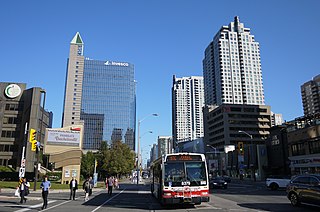
Willowdale is a neighbourhood in the city of Toronto, Ontario, Canada, located in the district of North York. It developed from three postal villages: Newtonbrook, Willowdale and Lansing.

Eglinton is a subway station on Line 1 Yonge–University of the Toronto subway. It is central to the Yonge–Eglinton neighbourhood in Midtown Toronto. Eglinton station is the seventh busiest station of the Toronto Transit Commission (TTC).

The Battle of Montgomery's Tavern was an incident in the Upper Canada Rebellion. The abortive revolutionary insurrection inspired by William Lyon Mackenzie was crushed by British authorities and Canadian volunteer units near a tavern on Yonge Street, Toronto.
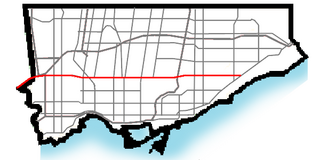
Eglinton Avenue is a major east-west arterial thoroughfare in Toronto and Mississauga in the Canadian province of Ontario. The street begins at Highway 407 at the western limits of Mississauga, as a continuation of Lower Baseline in Milton. It traverses the midsection of both cities and ends at Kingston Road. Eglinton Avenue is the only street to cross all six former boroughs of Metropolitan Toronto.

Sheppard Avenue is an east–west principal arterial road in Toronto, Ontario, Canada. The street has two distinct branches near its eastern end, with the original route being a collector road leading to Pickering via a turnoff, and the main route following a later-built roadway which runs south to Kingston Road. To avoid name duplication, the Toronto portion of the northern branch was renamed Twyn Rivers Drive. The section of the street entirely in Toronto is (34.2 km) in length, while the Pickering section and Twyn Rivers Dr. is (5.4 km) long.

Steeles Avenue is an east–west street that forms the northern city limit of Toronto and the southern limit of York Region, Ontario, Canada. It stretches 77.3 km (48.0 mi) across the western and central Greater Toronto Area from Appleby Line in Milton in the west to the Toronto-Pickering city limits in the east, where it continues east into Durham Region as Taunton Road, which itself extends 58 km (36 mi) across the length of Durham Region to its boundary with Northumberland County.
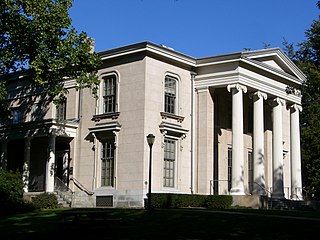
Hillhouse Avenue is a street in New Haven, Connecticut, famous for its many nineteenth century mansions, including the president's house at Yale University. Both Charles Dickens and Mark Twain have described it as "the most beautiful street in America." Much of the avenue is included in the Hillhouse Avenue Historic District, which extends to include houses on adjacent streets.

Commonwealth Avenue is a major street in the cities of Boston and Newton, Massachusetts. It begins at the western edge of the Boston Public Garden, and continues west through the neighborhoods of the Back Bay, Kenmore Square, Boston University, Allston, Brighton and Chestnut Hill. It continues as part of Route 30 through Newton until it crosses the Charles River at the border of the town of Weston.

Eglinton was a small farming village located at what is today the intersection of Yonge Street and Eglinton Avenue in York County, Ontario, Canada. It was first settled in the early 19th century and became the agricultural hub for the area just north of the city of Toronto. During the early 19th century, the area was part of the largest cattle-grazing region in Upper Canada. The region was the first in North America to extend the use of cowbells to all cattle. Prior to this, it had been standard practice for a cowbell to be attached only to the best and leading animal in a group of livestock. To honour this proud and storied heritage, the City of Toronto named a local street Cowbell Lane.

York University Heights, also known as Northwood Park, is a neighbourhood in Toronto, Ontario, Canada. It is one of Toronto's northernmost neighbourhoods, located along the northern boundary of Steeles Avenue in the former city of North York. The neighbourhood is so named because it contains the main campus of York University. This area is most popular with immigrants of Italian and Chinese descent who have established communities in the area. It is located between Sheppard Avenue and Steeles Avenue east of Black Creek.
John Street is an east-west collector and arterial road in the city of Markham, Ontario, Canada. It is one of the oldest roads in the city of Markham and forms the backbone of the 200-year-old community of Thornhill.

The Lower Woodward Avenue Historic District, also known as Merchant's Row, is a mixed-use retail, commercial, and residential district in downtown Detroit, Michigan, located between Campus Martius Park and Grand Circus Park Historic District at 1201 through 1449 Woodward Avenue and 1400 through 1456 Woodward Avenue. The district was listed on the National Register of Historic Places in 1999.

Washington Avenue Historic District is the historic center of Cedarburg, Wisconsin, the location of the early industry and commerce that was key to the community's development. The historic district was listed on the National Register of Historic Places (NRHP) in 1986.
Notting Gate is a neighbourhood located in Cumberland Ward, in the suburb of Orleans in Ottawa, Ontario, Canada. Located south of Innes Road, east of Portobello Boulevard, west of Trim Road, and north of Brian Coburn Boulevard. According to the Canada 2011 Census, this area had a population of 4,232.
