Life
Guillaume was the son of Thomas II de Gadagne and Peronette Berti, making him great-nephew to Thomas I of Gadagne, known as "Thomas the rich". On 23 November 1561 he married Jeanne de Sugny (died 19 January 1601), a descendant of an old family from Forez - they had three sons (Claude, Nicolas and Gaspard) and five daughters (Lucrèce, Diane, Hilaire, Anne and Gabrielle, the last of whom was later stepmother to Melchior Mitte de Chevrières).
He and his brother Thomas III de Gadagne owned the Hôtel de Gadagne (now the Musées Gadagne) in Lyon, but Guillaume's main residence was at château de Bouthéon (in what is now the Loire department), which he bought in 1561 - he is thus often known as "Monsieur de Bothéon". He was seneschal of Lyon from 1554 and lieutenant general of the inhabitants of Lyon, Forez and Beaujolais from 1554 to 1555 and again from 1588.
Henry II of France made him one of his 28 gentleman of the privy chamber. He fought with distinction at the battle of Dreux, receiving the collar of the Order of Saint Michael as a reward from Charles IX of France. He was made a king's councilor by Henry III of France and the same year he was also the deputy for the nobility of Forez at the Estates General of 1588 to 1589.
For his loyalty in the French Wars of Religion, in 1597 Henry IV of France granted him the cross of the Order of the Holy Spirit, the highest French chivalric award at the time. In 1600, when Henry's future wife Maria de Medici was due to pass through Lyon, the king asked Guillaume to lead the preparations for her arrival. Guillaume and his wife were buried at the Église Notre-Dame-de-Confort in Lyon on 5 February 1601.

Catherine de' Medici was an Italian (Florentine) noblewoman born into the Medici family. She was Queen of France from 1547 to 1559 by marriage to King Henry II and the mother of French kings Francis II, Charles IX, and Henry III. The years during which her sons reigned have been called "the age of Catherine de' Medici" since she had extensive, albeit at times varying, influence on the political life of France.

The House of Bourbon is a dynasty that originated in the Kingdom of France as a branch of the Capetian dynasty, the royal House of France. Bourbon kings first ruled France and Navarre in the 16th century. A branch descended from the French Bourbons came to rule Spain in the 18th century and is the current Spanish royal family. Further branches, descended from the Spanish Bourbons, held thrones in Naples, Sicily, and Parma. Today, Spain and Luxembourg have monarchs of the House of Bourbon. The royal Bourbons originated in 1272, when Robert, the youngest son of King Louis IX of France, married the heiress of the lordship of Bourbon. The house continued for three centuries as a cadet branch, serving as nobles under the direct Capetian and Valois kings.
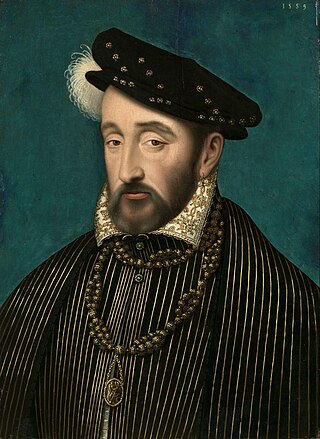
Henry II was King of France from 1547 until his death in 1559. The second son of Francis I and Duchess Claude of Brittany, he became Dauphin of France upon the death of his elder brother Francis in 1536.

Marie de' Medici was Queen of France and Navarre as the second wife of King Henry IV. Marie served as regent of France between 1610 and 1617 during the minority of her son Louis XIII. Her mandate as regent legally expired in 1614, when her son reached the age of majority, but she refused to resign and continued as regent until she was removed by a coup in 1617.

Henri I de Lorraine, Duke of Guise, Prince of Joinville, Count of Eu, sometimes called Le Balafré ('Scarface'), was the eldest son of François, Duke of Guise, and Anna d'Este. His maternal grandparents were Ercole II d'Este, Duke of Ferrara, and Renée of France. Through his maternal grandfather, he was a descendant of Lucrezia Borgia and Pope Alexander VI.

Antoine, sometimes called Antoine of Bourbon, was King of Navarre from 1555 until his death in 1562 through his marriage to Queen Jeanne III. He was the first monarch of the House of Bourbon, of which he became head in 1537. Despite being first prince of the blood in France, Navarre lacked political influence and was dominated by King Henry II of France's favourites, the Montmorency and Guise families. When Henry II died in 1559, Navarre found himself sidelined in the Guise-dominated government, and then compromised by his brother's treason. When Henry's son, King Francis II of France, soon died in turn, Navarre returned to the centre of politics, becoming Lieutenant-General of France and leading the army of the crown in the first of the French Wars of Religion. He died of wounds sustained during the Siege of Rouen. He was the father of King Henry IV, France's first Bourbon king.
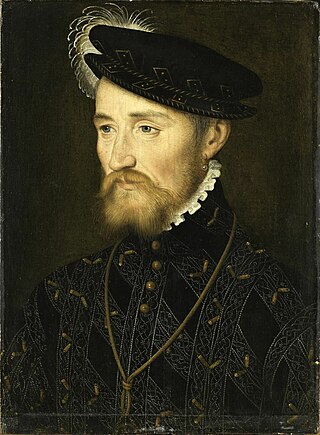
François de Lorraine, 2nd Duke of Guise, 1st Prince of Joinville, and 1st Duke of Aumale, was a French general and statesman. A prominent leader during the Italian War of 1551–1559 and French Wars of Religion, he was assassinated during the siege of Orleans in 1563.

Henri II de Bourbon, Prince of Condé was a French prince who was the head of the House of Bourbon-Condé, the senior-most cadet branch of the House of Bourbon. From the age of 2 to 12, Henri was the presumptive heir to the French throne. Henri was the father of general Louis, le Grand Condé.

Jacques de Savoie, duc de Nemours was a French military commander, governor and Prince Étranger. Having inherited his titles at a young age, Nemours fought for king Henri II during the latter Italian Wars, seeing action at the siege of Metz and the stunning victories of Renty and Calais in 1554 and 1558. Already a commander of French infantry, he received promotion to commander of the light cavalry after the capture of Calais in 1558. A year prior he had accompanied François, Duke of Guise on his entry into Italy, as much for the purpose of campaigning as to escape the king's cousin Antoine of Navarre who was threatening to kill him for his extra-marital pursuit of Navarre's cousin.

Henry Norris, 1st Baron Norreys of Rycote in Oxfordshire, was an English politician and diplomat, who belonged to an old Berkshire family, many members of which had held positions at the English court.

Jean Louis de Nogaret de La Valette (1554–1642), created Duke of Épernon, was a powerful member of the French nobility at the turn of the 17th century. He was deeply involved in plots and politics throughout his life.

The Prince-Bishopric of Verdun was a state of the Holy Roman Empire. It was located at the western edge of the Empire and was bordered by France, the Duchy of Luxembourg, and the Duchy of Bar. Some time in the late 990s, the suzerainty of the County of Verdun passed from Herman of Ename of the House of Ardenne–Verdun to the Bishopric of Verdun.

François de Joyeuse was a French churchman and politician.

François de Tournon was a French Augustinian friar, an archbishop, diplomat, courtier, and cardinal. From 1536 he was also a military supply officer of French forces operating in Provence, Savoy and Piedmont. In the same year he founded the Collège de Tournon. For a period he was effectively France's foreign minister. He was a prominent leader in the fight against Lutheranism and Calvinism, especially at the French Royal Court, and what he perceived as the growing Huguenot menace to both doctrinal orthodoxy and the social order. He took a prominent role in the Estates General of 1560, the Colloquy of Poissy and the Colloquy of Saint-Germain in 1562. He participated in the papal conclaves of 1534, 1549, and 1559.

Nicolas IV de Neufville, seigneur de Villeroy was a secretary of state under four kings of France: Charles IX, Henry III, Henry IV, and Louis XIII. The most distinguished of all sixteenth-century French secretaries, Villeroy rose to prominence during the French Wars of Religion, a period of almost insoluble difficulties for the French monarchy and government. Despite faithfully serving Henry III, Villeroy found himself sacked by him without explanation in 1588, along with all the king's ministers. He was reinstated by Henry IV in 1594 and became more important than ever before. He remained in office until his death in 1617 during the reign of Louis XIII.

Guillaume Desautels (1529-1599) was a French poet of the sixteenth century associated with La Pléiade.

Jacqueline de Longwy, Countess of Bar-sur-Seine, Duchess of Montpensier, Dauphine of Auvergne was a French noblewoman, and a half-niece of King Francis I of France. She was the first wife of Louis III de Bourbon, Duke of Montpensier, and the mother of his six children. She had the office of Première dame d'honneur to the queen dowager regent of France, Catherine de' Medici, from 1560 until 1561.
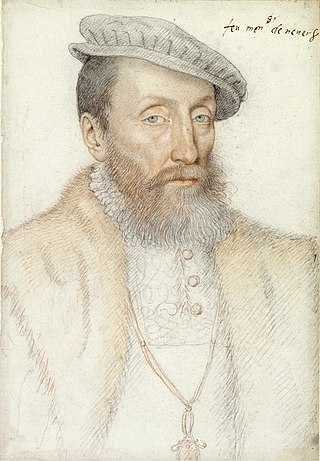
François I de Clèves, was a French Prince étranger and military commander during the Italian Wars. He was the first duke of Nevers, his county being elevated to a duchy in 1539. In deference to the large amount of land he held in Champagne, and lands he was set to inherit there from his mother, François was made governor of Champagne in 1545.

Claude d'Urfé was a French royal official of the 16th century. He acted as governor and bailiff of Forez after that county became a royal domain. He was a friend and confidant of Francis I and fought alongside him in the Wars of Italy as well as under his son Henry II. He was also governor of the dauphin and the king's other children. He was also a major patron for building works in the Italian Renaissance style in Forez, such as his Italian-style extension to his château of Bastie d'Urfé. His grandson was the author Honoré d'Urfé.

Thomas II de Gadagne, known as Thomas the Magnificent was an Italian banker active in France.


