Hamburg state election, 2015

Last updated
Hamburg state election, 2015
Flag of Hamburg.svg
  2011 15 February 2015 [1] 2020 

All 121 seats of the Hamburg Parliament.
61 seats needed for a majority

  First party Second party Third party
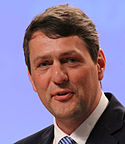
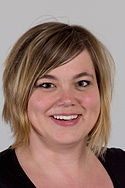
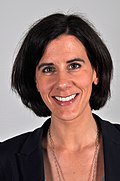
  Olaf Scholz - Burgerschaftswahl in Hamburg 2015 02.jpg Dietrich Wersich CDU Parteitag 2014 by Olaf Kosinsky-1.jpg Fegebank, Katharina - 1889.jpg
Leader Olaf Scholz Dietrich Wersich Katharina Fegebank
Party SPD CDU Green
Seats before 62 28 14
Seats won 58 20 15
Seat changeDecrease2.svg4Decrease2.svg8Increase2.svg1
Popular vote 1,611,274 561,377 432,713
Percentage 45.6% 15.9% 12.3%
SwingDecrease2.svg2.8%Decrease2.svg6.0%Increase2.svg1.1%

  Fourth party Fifth party Sixth party
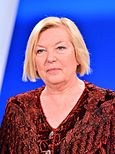
  Dora Heyenn - Burgerschaftswahl in Hamburg 2015 03.jpg 2011-06-23-Katja-Suding-06.jpg Jorn kruse portrat1.jpg
Leader Dora Heyenn Katja Suding Jörn Kruse
Party Left FDP AfD
Seats before 8 9 Did Not Exist
Seats won 11 9 8
Seat changeIncrease2.svg3Steady2.svg0 N/A
Popular vote 300,567 262,157 214,833
Percentage 8.5% 7.4% 6.1%
SwingIncrease2.svg2.1%Increase2.svg0.7% N/A

Mayor before election

Olaf Scholz
SPD

Elected Mayor

Olaf Scholz
SPD

Coat of arms of Hamburg.svg
This article is part of a series on the
politics and government of
Hamburg

On 15 February 2015, a state election was held in Hamburg, Germany, for the 21st legislative period of the Hamburg Parliament after World War II.

Hamburg City in Germany

Hamburg is the second-largest city in Germany with a population of over 1.8 million.

Germany Federal parliamentary republic in central-western Europe

Germany, officially the Federal Republic of Germany, is a country in Central and Western Europe, lying between the Baltic and North Seas to the north, and the Alps to the south. It borders Denmark to the north, Poland and the Czech Republic to the east, Austria and Switzerland to the south, France to the southwest, and Luxembourg, Belgium and the Netherlands to the west.

Hamburg Parliament Parliament of the state and city of Hamburg, Germany

The Hamburg Parliament is the unicameral legislature of the German state of Hamburg according to the constitution of Hamburg. As of 2011 there were 121 members in the parliament, representing a relatively equal amount of constituencies. The parliament is situated in the city hall Hamburg Rathaus and part of the Government of Hamburg.

Contents

Issues and campaign

Polls

Institute Date SPD
CDU
LINKE
GRÜNE
FDP
AfD
All others
FGW [2] 11–12 February 2015 47% 17% 8.5% 12% 6% 5% 4.5%
FGW [3] 3–5 February 2015 45% 19% 9.5% 11% 6% 5% 4.5%
Infratest dimap [4] 3–4 February 2015 46% 18% 9% 11% 5.5% 5.5% 5%
Infratest dimap [5] 23–27 January 2015 44% 20% 9% 13% 5% 6% 3%

Results


< 2011    Flag of Hamburg.svg    Next >

e    d  Summary of the 2015 Parliament of Hamburg election results
PartyPopular voteSeats
Votes%+/–Seats+/–
Social Democratic Party of Germany
Sozialdemokratische Partei Deutschlands – SPD|| 1,611,274
45.6 Decrease2.svg2.8 58 Decrease2.svg4
Christian Democratic Union
Christlich Demokratische Union Deutschlands – CDU|| 561,377
15.9 Decrease2.svg6.0 20 Decrease2.svg8
Alliance '90/The Greens
Bündnis 90/Die Grünen|| 432,713
12.3 Increase2.svg1.1 15 Increase2.svg1
Left
Die Linke|| 300,567
8.5 Increase2.svg2.1 11 Increase2.svg3
Free Democratic Party
Freie Demokratische Partei – FDP|| 262,157
7.4 Increase2.svg0.7 9 Steady2.svg0
Alternative for Germany
Alternative für Deutschland – AfD|| 214,833
6.1 N/A 8 N/A
Pirate Party Germany
Piratenpartei Deutschland|| 54,802
1.6 Decrease2.svg0.5 0 Steady2.svg0
Die PARTEI
Partei für Arbeit, Rechtsstaat, Tierschutz, Elitenförderung und basisdemokratische Initiative|| 31,710
0.9 Increase2.svg0.2 0 Steady2.svg0
New Liberals
Neue Liberale|| 18,464
0.5 N/A 0 N/A
Ecological Democratic Party
Ökologisch-Demokratische Partei - ÖDP|| 13,621
0.4 Increase2.svg0.1 0 Steady2.svg0
National Democratic Party of Germany
Nationaldemokratische Partei Deutschlands - NPD|| 11,293
0.3 Decrease2.svg0.6 0 Steady2.svg0
Other parties 17,286 0.5 Decrease2.svg1.0 0 Steady2.svg
Turnout733,55156.5Decrease2.svg0.8
Electorate1,299,411100.00
Source: Statistikamt Nord

See also

The number of elections in Hamburg varies. Hamburg has a state election every four years, the elections for the state parliament. There are also elections to the federal diet of Germany, the local elections of the diet of the boroughs (Bezirksversammlungen) and every five years to the European Parliament. All elections take place by universal adult suffrage and are regulated by law.

The state elections in Hamburg, Germany for the parliament of Hamburg (Hamburgische Bürgerschaft) in the years of 1919–1933. The term Weimar Republic is used to signify the democratic and republican period of Germany from 1919 to 1933.

Related Research Articles

Klaus Wowereit German politician

Klaus Wowereit is a German politician, member of the SPD, and was the Governing Mayor of Berlin from 21 October 2001 to 11 December 2014. In 2001 state elections his party won a plurality of the votes, 29.7%. He served as President of the Bundesrat in 2001/02. His SPD-led coalition was re-elected in the 2006 elections; after the 2011 elections the SPD's coalition partner changed from the Left to the Christian Democratic Union. He was also sometimes mentioned as a possible SPD candidate for the Chancellorship of Germany (Kanzlerkandidatur), but that never materialized.

New states of Germany

The new federal states of Germany are the five re-established states in the former East Germany that acceded to the Federal Republic of Germany with its 10 states upon German reunification on 3 October 1990.
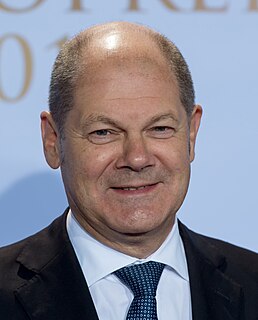
Olaf Scholz German politician, federal minister of finance and vice chancellor

Olaf Scholz is a German politician serving as Federal Minister of Finance and Vice Chancellor under Chancellor Angela Merkel from the CDU since 14 March 2018. He served as First Mayor of Hamburg from 7 March 2011 to 13 March 2018 and Acting Leader of the Social Democratic Party (SPD) from 13 February to 22 April 2018.

2008 Hamburg state election election

On 24 February 2008 state elections were held in Hamburg, Germany, for the 19th legislative period of the Hamburg Parliament. The four parties having more than 5 percent are the conservative CDU, the social-democratic SPD, the left-wing Die Linke and the ecological Green Party (GAL). CDU and GAL formed a coalition and Ole von Beust continued as Minister-President.

The government of Hamburg is divided into executive, legislative and judicial branches. Hamburg is a city-state and municipality, and thus its governance deals with several details of both state and local community politics. It takes place in two ranks – a citywide and state administration, and a local rank for the boroughs. The head of the city-state's government is the First Mayor and President of the Senate. A ministry is called Behörde (office) and a state minister is a Senator in Hamburg. The legislature is the state parliament, called Hamburgische Bürgerschaft, and the judicial branch is composed of the state supreme court and other courts. The seat of the government is Hamburg Rathaus. The President of the Hamburg Parliament is the highest official person of the Free and Hanseatic City of Hamburg. This is a traditional difference to the other German states. The president is not allowed to exert any occupation of the executive.

The forsa Institute for Social Research and Statistical Analysis, forsa for short, is one of the leading market research and opinion polling companies in Germany. It was founded in 1984 by Manfred Güllner in Cologne and is now headquartered in Berlin with a branch in Dortmund; it formerly also had an office in Riga, Latvia.

Elbphilharmonie concert hall

The Elbphilharmonie is a concert hall in the HafenCity quarter of Hamburg, Germany, on the Grasbrook peninsula of the Elbe River. It is one of the largest and acoustically most advanced concert halls in the world. It is popularly nicknamed Elphi.

Dorothee Stapelfeldt German politician

Dorothee Stapelfeldt is a German politician, representative of the Social Democratic Party of Germany (SPD) and member of the Hamburg Parliament.

Old states of Germany

The old states of Germany are the 10 states in West Germany.

2011 Mecklenburg-Vorpommern state election election

The Mecklenburg-Vorpommern state election was conducted on 4 September 2011, to elect members to the Landtag of Mecklenburg-Vorpommern. The State Landtag was controlled by a grand coalition of the Social Democratic Party and the Christian Democratic Union prior to the election.

2012 North Rhine-Westphalia state election

The North Rhine-Westphalia state election, 2012 was a snap election held on 13 May 2012, to elect members to the Landtag of the German state of North Rhine-Westphalia, after the former Landtag was dissolved on 14 March 2012. The red-green minority government led by Minister-President Hannelore Kraft was returned with a 19-seat majority and were able to continue governing the state.

A state election occurred in Schleswig-Holstein on 6 May 2012. All 69 seats in the Landtag of Schleswig-Holstein were contested in this election.

This is a list of opinion polling results for the 2013 German federal election, held on 22 September 2013.
2013 Lower Saxony state election

A state election was held in Lower Saxony on 20 January 2013 to elect the 137 members of the Landtag.

Annkathrin Kammeyer German Social Democratic politician

Annkathrin Kammeyer is a German Social Democratic politician and Member of the Hamburg Parliament since 7 March 2011.

Simone Lange German politician

Simone Lange is a German Social Democratic Party politician who has served as elected mayor of Flensburg since 2017.

2016 Mecklenburg-Vorpommern state election

The Mecklenburg-Vorpommern State Elections, 2016 were held on 4 September 2016, to elect members to the 7th Landtag of Mecklenburg-Vorpommern. All 71 seats in the Landtag were contested and around 1.3 million voters were eligible to cast ballots. Postal voting began in August ahead of the September 4 polling day. State elections in Mecklenburg-Vorpommern use the Hare-Niemeyer method of proportional representation to allocate seats in the Landtag.

Carsten Brosda German politician

Carsten Brosda is a German politician (SPD). Since February 2017 he has been Senator and head of the Hamburg Authority for Culture and Media in the Senates Scholz II and Tschentscher.
Melanie Leonhard German politician and author

Melanie Leonhard is a German politician (SPD) and historian. Since October 2015, she is Hamburg Senator for Labor, Social Affairs, Family and Integration and since March 2018 State Chairwoman of the SPD Hamburg. From 2011 until the appointment to the Senates Scholz II and Tschentscher, she was SPD Member of the Hamburg Parliament.

Detlef Scheele German politician

Detlef Scheele is a German politician (SPD). On 1 April 2017, he became Chairman of the German Federal Employment Agency.

References

  1. http://www.bundeswahlleiter.de/en/kuenftige_wahlen/
  2. "Absolute Mehrheit für Scholz und SPD noch möglich". heute.de (in German). 2015-02-05. Archived from the original on 2015-06-13. Retrieved 2015-02-08.
  3. "CDU in Hamburg nur noch bei 19 Prozent". welt.de (in German). 2015-02-05. Retrieved 2015-02-08.
  4. "Umfrage: SPD baut Vorsprung weiter aus". NDR.de (in German). 2015-02-05. Retrieved 2015-02-08.
  5. "Umfrage: SPD legt zu, AfD und FDP drin". NDR.de (in German). 2015-01-29. Retrieved 2015-02-08.