
China, officially the People's Republic of China (PRC), has full diplomatic relations with 180 out of the other 192 United Nations member states, Cook Islands, Niue and the State of Palestine. As of 2024, China has had the most diplomatic missions of any state.

The Renmin University of China (RUC) is a public university in Haidian, Beijing, China. The university is affiliated with the Ministry of Education, and co-funded by the Ministry of Education and the Beijing Municipal People's Government. The university is part of Project 211, Project 985, and the Double First-Class Construction.
The Boao Forum for Asia, initiated by 25 Asian countries and Australia, is a non-profit organisation that hosts high-level forums for leaders from government, business and academia in Asia and other continents to share their vision on the most pressing issues in this region and the world at large. BFA is modelled on the World Economic Forum held annually in Davos, Switzerland. Its fixed address is in Bo'ao, Hainan province, China, although the Secretariat is based in Beijing. The forum, sometimes known as the “Asian Davos”, takes its name from the town of Boao, located in China's southern Hainan province, which has been the permanent venue for its annual conference since 2002.

China–Kenya relations refer to the bilateral relations between the People's Republic of China and Kenya. The two countries established relations in 1963, suspended ties temporarily in 1967, but ultimately re-established diplomatic relations in 1978. Since then, they have significantly expanded their economic and investment agreements, such that China is currently Kenya's largest trading partner. While the robust trade, investment, and Chinese-led infrastructure projects have benefitted Kenya's overall development and have been labelled by both governments as "win-win" collaborations, local media and foreign analysts have increasingly criticized both the potential consequences of Kenya's loans from China as well as Kenya's overall economic dependence on foreign capital and products. The most ambitious collaboration, the Standard Gauge Rail that was planned to connect Nairobi, Kenya, Uganda, South Sudan, and Rwanda using Chinese financing and contractors, has attracted even more controversy due to financial complications, questions on the legality of its tender process, and the alleged collateralization of Kenya's Mombasa port.

The bilateral relations between the Federal Republic of Nigeria and People's Republic of China were formally established on February 10, 1971 - a decade after Nigeria gained its independence from the British Empire. Relations between Nigeria and China have expanded on growing bilateral trade and strategic cooperation. China is also one of Nigeria's important trading and export partners.
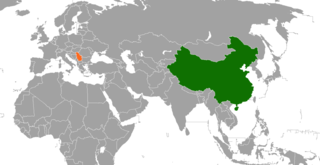
China-Serbian relations are foreign relations between the People's Republic of China and the Republic of Serbia. Relations have been maintained since SFR Yugoslavia's recognition of PR China on October 1, 1949, while diplomatic relations between the two countries were formally established by the exchange of diplomatic notes between the two Foreign Ministers on January 2, 1955. China has an embassy in Belgrade and also maintains an office in Priština based on consent of the Government of Serbia from November 2006. Serbia has an embassy in Beijing and a consulate-general in Shanghai. In 2017, Serbia and China mutually abolished the requirement of obtaining an entry visa for its citizens.
There may have been minor settlement of Chinese people in Kenya as early as the 15th century; however, modern migration from the People's Republic of China to Kenya only dates to the late 1990s and early 2000s. There are estimated to be 50,000 Chinese people in the country.
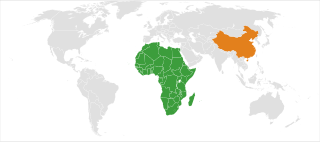
Sino–African relations, also referred to as Africa–China relations or Afro–Chinese relations, are the historical, political, economic, military, social, and cultural connections between China and the African continent.
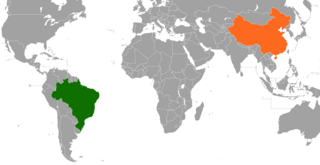
Brazil–China relations are the current and historical relationship between Brazil and China. Relations between Brazil and China began in the early nineteenth century and continued until 1949, when they were disrupted by the creation of the People's Republic of China (PRC). Diplomatic relations between the PRC and Brazil officially began in 1974 with agreement on the establishment and operation of Brazil's embassy in Beijing and China's embassy in Brasília. Since then, bilateral ties have developed mostly based on non-interference, equality, and mutual benefit (win-win).

Algeria and China have traditionally strong relations, celebrating the 60th anniversary of the establishment of diplomatic relations in 2018. In 2010, relations were considered the strongest of all Arab-Chinese relations behind Sudanese-Chinese relations. While relations are firmly grounded in commercial ties, diplomatic relations have notably extended into socio-cultural and political spheres.
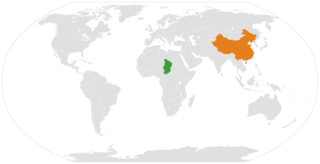
Chad–China relations refers to the current and historical relationship between the Republic of Chad and the People's Republic of China. Bilateral relations were initially established in 1972 but were severed by China in 1997 due to Chad's recognition of the Republic of China (Taiwan). Relations resumed in August 2006 when Chad ended its relationship with Taiwan and pledged adherence to the One China Policy. The ties between the two nations are primarily economic, although there is some cooperation in security. The economic ties are profitable for both countries, with China providing aid and investment in exchange for natural resources to fuel its economic growth.

People's Republic of China – Zambia relations refers to the current and historical relationship between the People's Republic of China (PRC) and Zambia.

India–Kenya relations are bilateral diplomatic relations between the Republic of India and the Republic of Kenya.

China–Madagascar relations refer to the bilateral relations between China and Madagascar. China and Madagascar established diplomatic relations on November 6, 1972. China has an embassy in Antananarivo and Madagascar has an embassy in Beijing.
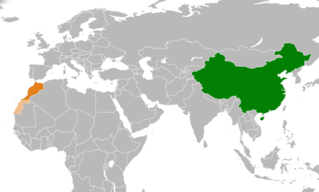
China–Morocco relations refer to the bilateral relations between China and Morocco. China and Morocco established diplomatic relations on November 1, 1958. Morocco establishes 'strategic partnership' with China in 2016, stronger partnership with China is sign that Morocco is seeking political and economic partners far from its traditional markets.
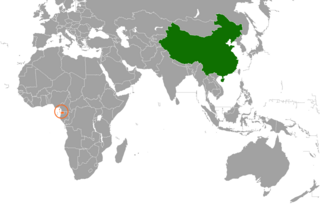
China–Equatorial Guinea relations refer to the foreign relations between China and Equatorial Guinea. China and Equatorial Guinea established diplomatic relations on October 15, 1970. Following a coup-d’état which brought current president Teodoro Obiang Nguema Mbasogo to power, diplomatic relations were temporarily suspended and resumed again in 1985.

The Yenching Academy is a postgraduate college of Peking University, located in Beijing, China. It hosts the Yenching Scholarship, a fully funded prestigious global scholarship program, designed "to cultivate leaders who will advocate for global progress and cultural understanding." The academy offers Yenching Scholars, selected annually from around the world, with full scholarships for one or two years of study leading to a master's degree from Peking University.

Kenya–United Kingdom relations are bilateral relations between Kenya and the United Kingdom. The interactions between the two states have been positive and friendly since Kenya's independence in 1963. Both the UK and Kenya are members of the Commonwealth of Nations and engage with each other regularly on matters of military, economic and cultural importance. Kenya retains many aspects of British culture and governance, such as continuing to use English within administration, education and the law, driving on the left, hosting a diaspora community of Britons, and having a large Protestant population. The British military continues to play an important role in the country with Kenya hosting the UK's largest base in Africa, which provides vital anti-terrorism training to the Kenyan police. The British royal family, in particular Elizabeth II had very close personal ties to the country. Elizabeth II was in Kenya when she received news that her father King George VI had died, and had made multiple state visits throughout her reign. To mark the 2022 Platinum Jubilee, Prince Edward visited the country to reinforce ties and celebrate Kenya's historic and current relationship with the UK. British tourism and finance are significant contributors to the Kenyan economy, with 100,000 British people visiting the country ever year for its national parks and wildlife.
The China–Arab States Cooperation Forum is a formal dialogue initiative between China and the Arab League established in 2004. It serves as the primary multilateral coordination mechanism between China and the Arab states.
Li Jiping is a former Chinese banker who served as vice governor of the China Development Bank between 2008 and 2016 when he retired. As of March 2024 he was under investigation by China's anti-graft watchdog.
