Related Research Articles

Hollywood Boulevard is a major east–west street in Los Angeles, California. It runs through the Hollywood, East Hollywood, Little Armenia, Thai Town, and Los Feliz districts. Its western terminus is at Sunset Plaza Drive in the Hollywood Hills and its eastern terminus is at Sunset Boulevard in Los Feliz. Hollywood Boulevard is famous for running through the tourist areas in central Hollywood, including attractions such as the Hollywood Walk of Fame and the Ovation Hollywood shopping and entertainment complex.

Miracle Mile is a neighborhood in the city of Los Angeles, California.

Sunset Junction is an informal name for a portion of the Silver Lake district of Los Angeles, California. It was home to the Sunset Junction Street Fair from 1980 through 2010. It is in the southwestern part of the district along Sunset Boulevard.

Crenshaw Boulevard is a north-south thoroughfare in Los Angeles, California, United States, that runs through Crenshaw and other neighborhoods along a 23-mile route in the west-central part of the city.

Ovation Hollywood is a shopping center and entertainment complex at the intersection of Hollywood Boulevard and Highland Avenue in the Hollywood neighborhood of Los Angeles, California, United States.
I. Magnin & Company was a San Francisco, California-based high fashion and specialty goods luxury department store. Over the course of its existence, it expanded across the West into Southern California and the adjoining states of Arizona, Oregon, and Washington. In the 1970s, under Federated Department Stores ownership, the chain entered the Chicago, and Washington, D.C., metropolitan areas. Mary Ann Magnin founded the company in 1876 and named the chain after her husband Isaac.

Hartfield-Zodys was an American retail corporation begun in 1960. It operated the Hartfield chain of women's ready-to-wear apparel in the Los Angeles area, and starting in 1960, the Zodys chain of discount retail stores (1960–1986), which operated locations in California, Arizona, Nevada, New Mexico, and Michigan.
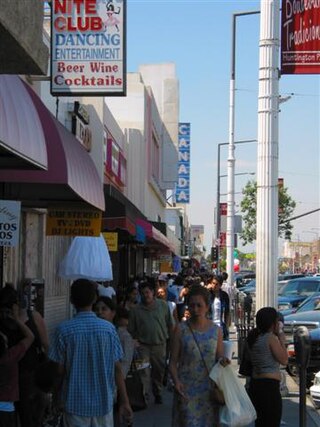
Pacific Boulevard is a street and principal commercial thoroughfare in the city of Huntington Park, California and the Los Angeles County neighborhood of Walnut Park. It runs from Vernon and Santa Fe Avenues in Vernon to Cudahy Street in Walnut Park before changing to Long Beach Boulevard. The Pacific Boulevard commercial district is the third highest grossing commercial district in the County of Los Angeles. The Christmas Lane Parade, seen in millions of homes via television throughout the United States and parts of Europe, has run down Pacific Boulevard since 1946. As many as 300,000 people attend the annual Carnaval Primavera held on Pacific Boulevard each year. Pacific Boulevard is well known to Latino residents of the L.A. area, and a magnet for commerce, culture, and night life.

The Broadway Hollywood Building is a building in Los Angeles' Hollywood district. The building is situated in the Hollywood Walk of Fame monument area on the southwest corner of the intersection referred to as Hollywood and Vine, marking the intersection of Hollywood Boulevard and Vine Street. It was originally built as the B. H. Dyas Building in 1927. The Broadway Hollywood Building is referred to by both its main address of 6300 Hollywood Boulevard and its side address of 1645 Vine Street.

Harris & Frank was a clothing retailer and major chain in the history of retail in Southern California, which at its peak had around 40 stores across Southern California and in neighboring states and regions. Its history dates back to a clothing store founded by Leopold Harris in Los Angeles in 1856 near the city's central plaza, only eight years after the city had passed from Mexican to American control. Herman W. Frank joined Harris in partnership 32 years later in 1888.
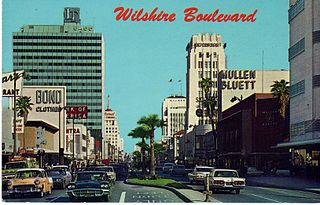
Phelps-Terkel was a Los Angeles based department store specializing in men's clothing.

Myer Siegel was a Los Angeles–based department store, founded by Myer Siegel (1866–1934), specializing in women's clothing.

7th Street is a street in Los Angeles, California running from S. Norton Ave in Mid-Wilshire through Downtown Los Angeles. It goes all the way to the eastern city limits at Indiana Ave., and the border between Boyle Heights, Los Angeles and East Los Angeles.
Hollywood Boulevard Commercial and Entertainment District is a historic district that consists of twelve blocks between the 6200 and 7000 blocks of Hollywood Boulevard in Los Angeles, California. This strip of commercial and retail businesses, which includes more than 100 buildings, is recognized for its significance with the entertainment industry, particularly Hollywood and its golden age, and it also contains excellent examples of the predominant architecture styles of the 1920s and 1930s. It was entered into the National Register of Historic Places in 1984.
La Monarca Bakery is a Mexican bakery-cafe that operates twelve-retail locations in Los Angeles California, United States.
Pico/Rimpau is an area of Mid-City, Los Angeles, at the junction of Pico Boulevard, Rimpau Street, San Vicente Boulevard, Venice Boulevard, Vineyard Avenue and West Boulevard. This area is the location of several key former and current transportation hubs and retail shopping centers for the Los Angeles area.

Boston Stores, originally and later still often called The Boston Store, was a chain of department stores based in Inglewood, California, just southwest of Central Los Angeles, that operated from 1934 through 1996.
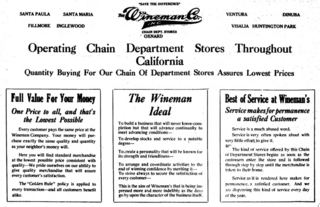
Wineman's was a chain of department stores in Southern and Central California which started in Ventura in 1890, and later became iconic local department stores of Oxnard and, later, Huntington Park.

Retail in Southern California dates back to its first dry goods store that Jonathan Temple opened in 1827 on Calle Principal, when Los Angeles was still a Mexican village. After the American conquest, as the pueblo grew into a small town surpassing 4,000 population in 1860, dry goods stores continued to open, including the forerunners of what would be local chains. Larger retailers moved progressively further south to the 1880s-1890s Central Business District, which was later razed to become the Civic Center. Starting in the mid-1890s, major stores moved ever southward, first onto Broadway around 3rd, then starting in 1905 to Broadway between 4th and 9th, then starting in 1915 westward onto West Seventh Street up to Figueroa. For half a century Broadway and Seventh streets together formed one of America's largest and busiest downtown shopping districts.
The Western and Franklin Avenue Line was a Pacific Electric streetcar line which traveled from Los Angeles to Hollywood. It operated from 11th and Hill Streets via Hill, Sunset, Santa Monica Boulevard, Western Avenue, Franklin Avenue, Argyle Avenue, Yucca Street, and Vine Street to end at Hollywood and Vine Boulevards. It operated from 1908 to 1940. The Brush Canyon Line branched from this line at Bronson.
References
- ↑ "[Myer Siegel and Company]". 1933. Retrieved 19 April 2024.
- ↑ "Redesigning of Large Building Here Planned". The Los Angeles Times. 10 March 1935. p. 59. Retrieved 19 April 2024. "Modern Entrance to Store: Record-Breaking Crowds Visited Newest Store of Brooks Clothing Company. (644 S. Broadway opening, resulting in closure of this store)". Daily News. 29 October 1935. p. 6. Retrieved 19 April 2024.
- ↑ "[Chapeau De Mode, Hollywood Boulevard, Los Angeles] (3 views)". 1920. Retrieved 19 April 2024.
- ↑ "[City National Bank, 1630 Pacific Boulevard, Huntington Park] (2 views)". 1929. Retrieved 19 April 2024.
- ↑ "[Exterior front general view Al Levy's Tavern, 1623 Vine Street, Hollywood]". 1936. Retrieved 19 April 2024.
- ↑ Koffler, Enid (1983). "Lido Hotel, 1447-1457 Fourth Street, Santa Monica, Calif" . Retrieved 19 April 2024.
- ↑ "Apparel Shop To Open in New Quarters". Los Angeles Evening Citizen News. 8 April 1938. p. 13. Retrieved 19 April 2024.
- ↑ "Hollywood Shop Adds Two Units". The Los Angeles Times. 15 June 1941. p. 68. Retrieved 19 April 2024.