
Boise County is a rural mountain county in the U.S. state of Idaho. As of the 2020 United States Census, the population was 7,610. The county seat is historic Idaho City, which is connected through a series of paved and unpaved roads to Lowman, Centerville, Placerville, Pioneerville, Star Ranch, Crouch, Garden Valley, and Horseshoe Bend.

Manhattan's Chinatown is a neighborhood in Lower Manhattan, New York City, bordering the Lower East Side to its east, Little Italy to its north, Civic Center to its south, and Tribeca to its west. With an estimated population of 90,000 to 100,000 people, Chinatown is home to the highest concentration of Chinese people in the Western Hemisphere. Manhattan's Chinatown is also one of the oldest Chinese ethnic enclaves. The Manhattan Chinatown is one of nine Chinatown neighborhoods in New York City, as well as one of twelve in the New York metropolitan area, which contains the largest ethnic Chinese population outside of Asia, comprising an estimated 893,697 uniracial individuals as of 2017.

Idaho City is a city in and the county seat of Boise County, Idaho, United States, located about 36 miles (58 km) northeast of Boise. The population was 485 at the 2010 census, up from 458 in 2000.
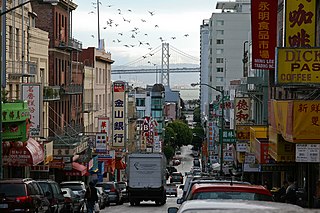
The Chinatown centered on Grant Avenue and Stockton Street in San Francisco, California, is the oldest Chinatown in North America and one of the largest Chinese enclaves outside Asia. It is also the oldest and largest of the four notable Chinese enclaves within San Francisco. Since its establishment in 1848, it has been important and influential in the history and culture of ethnic Chinese immigrants in North America. Chinatown is an enclave that has retained its own customs, languages, places of worship, social clubs, and identity. There are two hospitals, several parks and squares, numerous churches, a post office, and other infrastructure. Recent immigrants, many of whom are elderly, opt to live in Chinatown because of the availability of affordable housing and their familiarity with the culture. San Francisco's Chinatown is also renowned as a major tourist attraction, drawing more visitors annually than the Golden Gate Bridge.
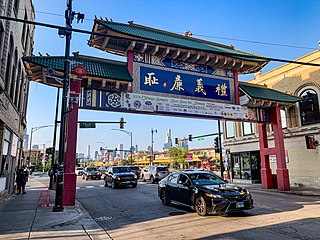
Chinatown is a neighborhood on the South Side of Chicago, along S. Wentworth Avenue between Cermak Road and W. 26th St. Over a third of Chicago's Chinese population resides in this ethnic enclave, making it one of the largest concentrations of Chinese-Americans in the United States. It formed around 1912, after settlers moved south from near the Loop, where the first enclaves were established in the 19th century.

The Boise–Nampa, Idaho Metropolitan Statistical Area (MSA) is an area that encompasses Ada, Boise, Canyon, Gem, and Owyhee counties in southwestern Idaho, anchored by the cities of Boise and Nampa. It is the main component of the wider Boise–Mountain Home–Ontario, ID–OR Combined Statistical Area, which adds Elmore and Payette counties in Idaho and Malheur County, Oregon. It is the state's largest officially designated metropolitan area and includes Idaho's three largest cities: Boise, Nampa, and Meridian. Nearly 40 percent of Idaho's total population lives in the area.

This article discusses Chinatowns in the Americas, urban areas with a large population of people of Chinese descent. The regions include: Canada, the United States, and Latin America.

The Chinatown neighborhood in Oakland, California(Chinese: 屋崙華埠), is traditionally Chinese which reflects Oakland's diverse Chinese American, and more broadly Asian American community. It is frequently referred to as "Oakland Chinatown" in order to distinguish it from nearby San Francisco's Chinatown. It lies at an elevation of 39 feet.

Polly Bemis was a Chinese American pioneer who lived in Idaho in the late 19th and early 20th century. Her story became a biographical novel, and was the subject of the 1991 film Thousand Pieces of Gold.

Chinatown, Boston is a neighborhood located in downtown Boston, Massachusetts, US. It is the only surviving historic ethnic Chinese enclave in New England since the demise of the Chinatowns in Providence, Rhode Island and Portland, Maine after the 1950s. Because of the high population of Asians and Asian Americans living in this area of Boston, there is an abundance of Chinese and Vietnamese restaurants located in Chinatown. It is one of the most densely populated residential areas in Boston and serves as the largest center of its East Asian and Southeast Asian cultural life. Chinatown borders the Boston Common, Downtown Crossing, the Washington Street Theatre District, Bay Village, the South End, and the Southeast Expressway/Massachusetts Turnpike. Boston's Chinatown is one of the largest Chinatowns outside of New York City.
The history of Idaho is an examination of the human history and social activity within the state of Idaho, one of the United States of America located in the Pacific Northwest area near the west coast of the United States and Canada. Other associated areas include southern Alaska, all of British Columbia, Washington, Oregon, western Montana and northern California and Nevada.

The Chinese Odd Fellows Building is a two-story, thirty-by-sixty foot, privately owned brick commercial building in the historical Chinatown of Boise, Idaho. It is located on West Front Street between South Capital Boulevard and South 6th Street near the Basque Block. The building features a corbel table of projecting bricks with stepped segments.
Chinatowns are enclaves of Chinese people outside of China. The first Chinatown in the United States was San Francisco's Chinatown in 1848, and many other Chinatowns were established in the 19th century by the Chinese diaspora on the West Coast. By 1875, Chinatowns had emerged in eastern cities such as New York City, Boston, and Philadelphia. The Chinese Exclusion Act of 1882 barred Chinese immigration to the United States, but the Magnuson Act of 1943 repealed it, and the population of Chinatowns began to rise again. In the 2010s, the downturn in the U.S. economy caused many Chinese Americans to return to China.
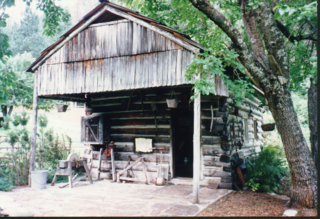
Polly Bemis House was the home of pioneers to Idaho County, Idaho, USA, Charles Bemis and his wife Polly Bemis, who lived alongside the Salmon River in the late 19th and early 20th century. Polly was a Chinese American former teenage slave whose story became a biographical novel and was fictionalized in the 1991 film A Thousand Pieces of Gold.

Elizabeth Street is a street in Manhattan, New York City, which runs north-south parallel to and west of the Bowery. The street is a popular shopping strip in Manhattan's Nolita neighborhood.
As of 2012, 21.4% of the population in San Francisco was of Chinese descent, and there were at least 150,000 Chinese American residents. The Chinese are the largest Asian American subgroup in San Francisco. San Francisco has the highest percentage of residents of Chinese descent of any major U.S. city, and the second largest Chinese American population, after New York City. The San Francisco Area is 7.9% Chinese American, with many residents in Oakland and Santa Clara County. San Francisco's Chinese community has ancestry mainly from Guangdong province, China and Hong Kong, although there is a sizable population of ethnic Chinese with ancestry from other parts of mainland China and Taiwan as well.
Quartzburg is an unincorporated town in Boise County, in the U.S. state of Idaho.
Chinese Americans in the Pacific Northwest have been around since as early as the 1850s. Chinese Americans arrived in the Greater Seattle area in as early as 1851. Oregon had also seen an influx of Chinese Immigrants as early as 1851, because of mining opportunities. Idaho saw an influx of Chinese Immigrants in the late-19th century, and by 1870 saw a population of around 4,000 Chinese immigrants. The influx of Chinese immigrants in the Pacific Northwest and the rest of the Western United States led to retaliation by whites, leading to anti-Chinese sentiment in the United States. These sentiment then led to the Chinese Exclusion Act of 1882, which expelled many Chinese Americans in the Pacific Northwest. Chinese exclusion is also driven by the failure of restriction. The United States had passed the Chinese Exclusion Act of 1882 to slow immigration, and mend Sinophobia in the west. However, the enforcement of the exclusion act was lackluster. The United States Department of Treasury had found itself with no money to enforce this law. Thus, nullifying the purpose of the exclusion act. Additionally, under the Chinese Exclusion Act of 1882, Chinese people could migrate to the United States if they were return immigrants. Consequently, Chinese immigrants began claiming that they were return immigrants so that they could work in the United States. This also made the Chinese Exclusion Act 1882 useless. This led the United States government to pass the Scott Act of 1888. This excluded all Chinese immigration because it was cheaper, and it appeased the racial tensions in the west.

Chinatown, Toronto known also as Downtown Chinatown or West Chinatown is a Chinese ethnic enclave located in the city's downtown core of Toronto, Ontario, Canada. It is centred at the intersections of Spadina Avenue and Dundas Street, West.
The historic Chinatown in downtown Boise, Idaho existed around the 1870s to 1960s. The area was located along Idaho Street, and east from 8th Street along Front Street and Grove Street. Over the years, Boise's Chinatown consisted of multiple Chinese owned residencies and businesses including restaurants, merchandise stores, laundries, two herbal medicine shops operated by three generations of the Ah-Fong family, a Chinese Masonic Hall, and a Hip Sing Tong and Hop Sing Tong.
