The idea of building a tower on the Humberg (already in those days a favourite hill among the citizens of Kaiserslautern, for its view) was taken up in 1896. For this purpose, inhabitants of the city founded the Humberg Association, with the aim of financing the building of an observation tower. Among the founding members were the well-known sewing machine factory owner Pfaff, the mayor, Dr. Orth, distinguished businessmen, Pfeiffer and Karcher, and malt manufacturer, Gelbert.
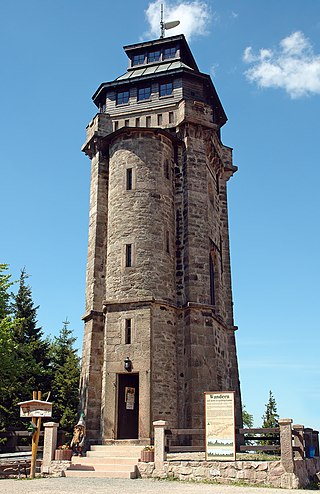
The tower was built to plans by the Municharchitect, Ludwig Ritter von Stempel, who had already made a name for himself with some public buildings in the city. The Humberg Tower is a monumental construction of sandstone blocks, typical of the Wilhelminian period. Building began in the spring of 1899.[1] The building material was quarried on the spot from the stone plateau of the Humberg. The tower was ceremonially opened on 2 September 1900. The tower is 35.77 metres (119 feet) high and its observation platform is 28.16 metres (93 feet) above the ground. The spiral staircase inside has 130 steps; in addition, there are a further 33 steps in the outside stairs at the base.
In 1909, the existing Humberg Association was dissolved. The tower and the association's capital came into the possession of the city of Kaiserslautern. In 2001, the Humberg Tower Association of Kaiserslautern e.V. was founded with the aim of preserving the tower and its attractiveness as a goal for hikers.
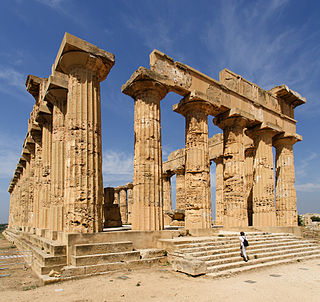
Selinunte was a rich and extensive ancient Greek city on the south-western coast of Sicily in Italy. It was situated between the valleys of the Cottone and Modione rivers. It now lies in the comune Castelvetrano, between the frazioni of Triscina di Selinunte in the west and Marinella di Selinunte in the east.
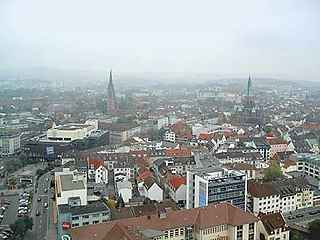
Kaiserslautern is a city in southwest Germany, located in the state of Rhineland-Palatinate at the edge of the Palatinate Forest. The historic centre dates to the 9th century. It is 459 kilometres from Paris, 117 km from Frankfurt am Main, 666 kilometers from Berlin, and 159 km from Luxembourg.
The Fernsehturm in central Berlin was constructed between 1965 and 1969 by the government of the German Democratic Republic, or East Germany, as both a functional broadcasting facility and a symbol of Communist power.
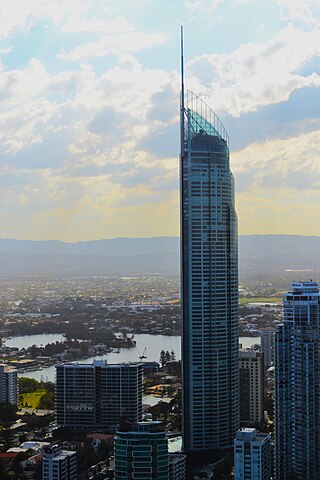
Q1 Tower is a 322.5-metre (1,058 ft) supertall skyscraper in Queensland, Australia. The residential tower on the Gold Coast was the world's tallest residential building from 2005 to 2011. As of September 2022, it is the 14th tallest residential tower in the world, the tallest building in Australia, the second tallest building in the Southern Hemisphere, and the third-tallest free-standing structure in the Southern Hemisphere, behind the Autograph Tower in Jakarta, Indonesia, and the Sky Tower in Auckland, New Zealand. The Q1 officially opened in November 2005.
The Müggelturm is a popular day-trip destination in Köpenick, in southeastern Berlin, Germany. It is located to the south of the Müggelsee lake in the Müggelberg hills atop the Kleiner Müggelberg. Berlin's highest natural elevation is the nearby Großer Müggelberg at 115 m.
Hindmarsh Island is an inland river island located in the lower Murray River near the town of Goolwa, South Australia.
Yokohama Marine Tower is a 106 metres high lattice tower with an observation deck at a height of 100 metres in Naka Ward, Yokohama, Japan.
The Rousse TV Tower is a 204-metre-high TV tower built of reinforced concrete at Rousse, Bulgaria. Originally, the structure was constructed as a 206-metre-high TV tower with a cafe/restaurant on top and was the tallest one on the Balkan peninsula until 2001. In the 1990s an additional antenna was added bringing the height to 210 metres. And, in March 2007, the antenna was reconstructed bringing its height to 204 metres.
The George Washington Masonic National Memorial is a Masonic building and memorial located in Alexandria, Virginia, outside Washington, D.C. It is dedicated to the memory of George Washington, the first President of the United States and a Mason. The tower is fashioned after the ancient Lighthouse of Alexandria in Egypt. The 333-foot (101 m) tall memorial sits atop Shooter's Hill at 101 Callahan Drive. Construction began in 1922, the building was dedicated in 1932, and the interior finally completed in 1970. In July 2015, it was designated a National Historic Landmark for its architecture, and as one of the largest-scale private memorials to honor Washington.
An observation tower is a structure used to view events from a long distance and to create a full 360 degree range of vision to conduct long distance observations. Observation towers are usually at least 20 metres (66 ft) tall and are made from stone, iron, and wood. Many modern towers are also used as TV towers, restaurants, or churches. The towers first appeared in the ancient world, as long ago as the Babylonian Empire.
The Torre Colpatria is a 50-story skyscraper in the downtown area of Bogotá, Colombia. It is the fourth tallest building in the country. Constructed from 1973 to 1978 and opened in 1979, it has a total height of 196 metres (643 ft), becoming the tallest skyscraper of Colombia and holding that title until 2016, when the south tower of the BD Bacatá was topped off. The main headquarters of the Colpatria Bank are located in the building, and also a great number of other banks and financial corporations have offices in it. The building lies at the intersection of 26th street and 7th avenue, in the heart of the city's downtown.
McMorran Arena is an entertainment complex in Port Huron, Michigan consisting of a 4,800-seat multi-purpose arena and a theater. It was designed by Alden B. Dow and built in 1960 for $3.5 million. The exterior of the complex is faced with red brick with limestone accents.
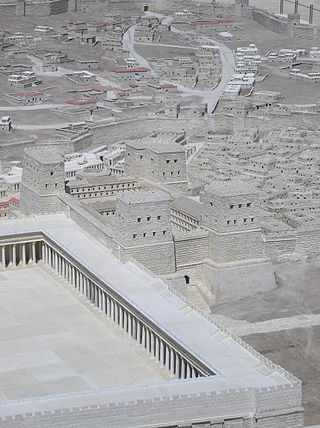
The Antonia Fortress was a citadel built by Herod the Great and named for Herod's patron Mark Antony, as a fortress whose chief function was to protect the Second Temple. It was built in Jerusalem at the eastern end of the so-called Second Wall, at the north-western corner of the Temple Mount.
The Miglin-Beitler Skyneedle was a proposed 125-floor skyscraper intended for Chicago, Illinois, United States, by Lee Miglin and J. Paul Beitler's firm Miglin-Beitler Developments and designed by architect César Pelli. The site of the proposed Skyneedle now is host to a parking garage. If it had been built when it was planned, the 1,999 ft (609 m) tall Miglin-Beitler Skyneedle would have been the tallest building in the world at the time of its completion.
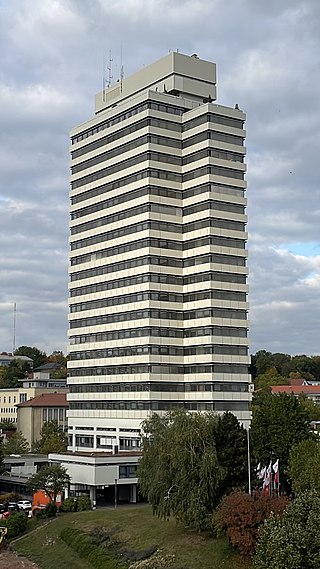
Located in Kaiserslautern Germany, Kaiserslautern Town Hall is one of the tallest town halls in the European Union. The building was put in service in 1968. Kaiserslautern City Hall has 25 stories above ground, of which the three uppermost ones are only used as storage room or for operational devices. The building is 84 meters tall and has four elevators. It is the tallest building in Kaiserslautern and on the 21st floor is a restaurant and public observation deck.
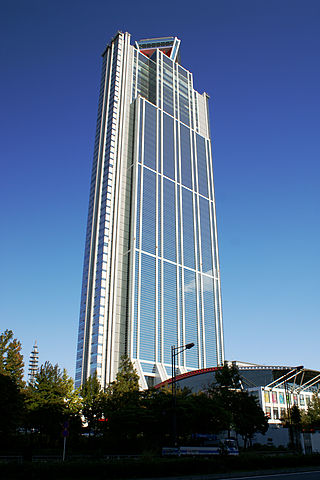
The Osaka Prefectural Government Sakishima Building, or Cosmo Tower, is the second tallest building in Osaka, and the third-tallest building in Japan. The former name is Osaka World Trade Center Building, or WTC Cosmo Tower until June, 2010. It is located in Nanko Cosmo Square near the Osaka harbor, Suminoe-ku, Osaka, and is the same height as the Rinku Gate Tower Building in Rinku Town.
The Luitpold Tower was erected in 1909 on the summit of one of the highest hills in the Palatine Forest, the 610-metre-high Weißenberg as an observation tower. It is made of bunter sandstone.
The Betzenberg is a 285-metre-high hill in the German city of Kaiserslautern. It rises about 50 metres above the city and gives its name to the quarter in which it stands. It was well known because it also gave its name to what is now the Fritz Walter Stadium.
The Heidenberg is a 420-metre-high hill in the southeastern Wasgau, the region that covers the southern part of the Palatinate Forest in Germany and the northern Vosges in France. The Heidenberg's north flank is in the parish of Busenberg, its south flank in the parish of Erlenbach bei Dahn.
This page is based on this Wikipedia article Text is available under the CC BY-SA 4.0 license; additional terms may apply. Images, videos and audio are available under their respective licenses.