
Biomedical engineering (BME) or medical engineering is the application of engineering principles and design concepts to medicine and biology for healthcare purposes. BME is also traditionally logical sciences to advance health care treatment, including diagnosis, monitoring, and therapy. Also included under the scope of a biomedical engineer is the management of current medical equipment in hospitals while adhering to relevant industry standards. This involves procurement, routine testing, preventive maintenance, and making equipment recommendations, a role also known as a Biomedical Equipment Technician (BMET) or as clinical engineering.
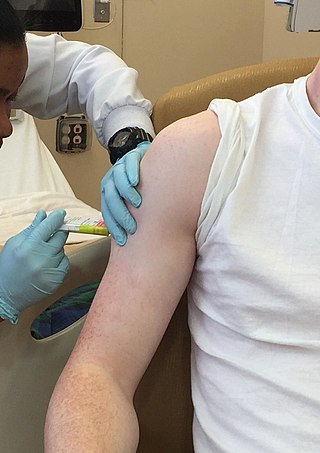
Clinical trials are prospective biomedical or behavioral research studies on human participants designed to answer specific questions about biomedical or behavioral interventions, including new treatments and known interventions that warrant further study and comparison. Clinical trials generate data on dosage, safety and efficacy. They are conducted only after they have received health authority/ethics committee approval in the country where approval of the therapy is sought. These authorities are responsible for vetting the risk/benefit ratio of the trial—their approval does not mean the therapy is 'safe' or effective, only that the trial may be conducted.

Health informatics is the field of science and engineering that aims at developing methods and technologies for the acquisition, processing, and study of patient data, which can come from different sources and modalities, such as electronic health records, diagnostic test results, medical scans. The health domain provides an extremely wide variety of problems that can be tackled using computational techniques.
An orphan drug is a pharmaceutical agent developed to treat medical conditions which, because they are so rare, would not be profitable to produce without government assistance. The conditions are referred to as orphan diseases.

Human subject research is systematic, scientific investigation that can be either interventional or observational and involves human beings as research subjects, commonly known as test subjects. Human subject research can be either medical (clinical) research or non-medical research. Systematic investigation incorporates both the collection and analysis of data in order to answer a specific question. Medical human subject research often involves analysis of biological specimens, epidemiological and behavioral studies and medical chart review studies. On the other hand, human subject research in the social sciences often involves surveys which consist of questions to a particular group of people. Survey methodology includes questionnaires, interviews, and focus groups.
The National Eye Institute (NEI) was established in 1968. It is located in Bethesda, Maryland, United States. The NEI is one of 27 institutes and centers of the US National Institutes of Health (NIH), an agency of the US Department of Health and Human Services. The mission of NEI is to prolong and protect the vision of the American people. The NEI conducts and performs research into treating and preventing diseases affecting the eye or vision.
An adverse effect is an undesired harmful effect resulting from a medication or other intervention, such as surgery. An adverse effect may be termed a "side effect", when judged to be secondary to a main or therapeutic effect. The term complication is similar to adverse effect, but the latter is typically used in pharmacological contexts, or when the negative effect is expected or common. If the negative effect results from an unsuitable or incorrect dosage or procedure, this is called a medical error and not an adverse effect. Adverse effects are sometimes referred to as "iatrogenic" because they are generated by a physician/treatment. Some adverse effects occur only when starting, increasing or discontinuing a treatment. Adverse effects can also be caused by placebo treatments . Using a drug or other medical intervention which is contraindicated may increase the risk of adverse effects. Adverse effects may cause complications of a disease or procedure and negatively affect its prognosis. They may also lead to non-compliance with a treatment regimen. Adverse effects of medical treatment resulted in 142,000 deaths in 2013 up from 94,000 deaths in 1990 globally.
An adverse event (AE) is any untoward medical occurrence in a patient or clinical investigation subject administered a pharmaceutical product and which does not necessarily have a causal relationship with this treatment. An adverse event can therefore be any unfavourable and unintended sign, symptom, or disease temporally associated with the use of a medicinal (investigational) product, whether or not related to the medicinal (investigational) product.

Medical research, also known as experimental medicine, encompasses a wide array of research, extending from "basic research", – involving fundamental scientific principles that may apply to a preclinical understanding – to clinical research, which involves studies of people who may be subjects in clinical trials. Within this spectrum is applied research, or translational research, conducted to expand knowledge in the field of medicine.
An academic clinical trial is a clinical trial not funded by pharmaceutical or biotechnology company for commercial ends but by public-good agencies to advance medicine. These trials are a valuable component of the health care system; they benefit patients and help determine the safety and efficacy of drugs and devices, and play an important role in the checks and balances that regular commercially oriented clinical trials.
Academic detailing is "university or non-commercial-based educational outreach." The process involves face-to-face education of prescribers by trained health care professionals, typically pharmacists, physicians, or nurses. The goal of academic detailing is to improve prescribing of targeted drugs to be consistent with medical evidence from randomized controlled trials, which ultimately improves patient care and can reduce health care costs. A key component of non-commercial or university-based academic detailing programs is that they do not have any financial links to the pharmaceutical industry.

The Infectious Diseases Society of America (IDSA) is a medical association representing physicians, scientists and other health care professionals who specialize in infectious diseases. It was founded in 1963 and is based in Arlington, Virginia. As of 2018 IDSA had more than 11,000 members from across the United States and nearly 100 other countries on six different continents. IDSA's purpose is to improve the health of individuals, communities, and society by promoting excellence in patient care, education, research, public health, and prevention relating to infectious diseases. It is a 501(c)(6) organization.

In health care, a clinical trial is a comparison test of a medication or other medical treatment, versus a placebo, other medications or devices, or the standard medical treatment for a patient's condition.
Medication costs, also known as drug costs are a common health care cost for many people and health care systems. Prescription costs are the costs to the end consumer. Medication costs are influenced by multiple factors such as patents, stakeholder influence, and marketing expenses. A number of countries including Canada, parts of Europe, and Brasil use external reference pricing as a means to compare drug prices and to determine a base price for a particular medication. Other countries use pharmacoeconomics, which looks at the cost/benefit of a product in terms of quality of life, alternative treatments, and cost reduction or avoidance in other parts of the health care system. Structures like the UK's National Institute for Health and Clinical Excellence and to a lesser extent Canada's Common Drug Review evaluate products in this way.
The National Institute for Health and Care Research (NIHR) is the British government’s major funder of clinical, public health, social care and translational research. With a budget of over £1.2 billion in 2020–21, its mission is to "improve the health and wealth of the nation through research". The NIHR was established in 2006 under the government's Best Research for Best Health strategy, and is funded by the Department of Health and Social Care. As a research funder and research partner of the NHS, public health and social care, the NIHR complements the work of the Medical Research Council. NIHR focuses on translational research, clinical research and applied health and social care research.

The National Center for Health Research is a Washington, D.C.-based non-profit organization founded in 1999, providing health-related services such as providing free information and training based on research findings; educating policy makers and working with the media. The President of the organisation is Diana Zuckerman. The primary program is The Cancer Prevention and Treatment Fund, which utilises an online health hotline.

The phases of clinical research are the stages in which scientists conduct experiments with a health intervention to obtain sufficient evidence for a process considered effective as a medical treatment. For drug development, the clinical phases start with testing for drug safety in a few human subjects, then expand to many study participants to determine if the treatment is effective. Clinical research is conducted on drug candidates, vaccine candidates, new medical devices, and new diagnostic assays.
The Pediatric Trials Network (PTN) is a consortium of clinical research sites located around the United States that are cooperating in the design and conduct of clinical trials to improve health care for young patients. The network is sponsored by the Eunice Kennedy Shriver National Institute of Child Health and Human Development (NICHD).
Within the field of digital health, digital medicine is a category of pharmaceuticals which combines a prescription medication with an ingestible sensor component. Digital medicines are designed to communicate to mobile and/or web-based applications that a patient has taken a specific dose of medication at a certain time. Because of the ingestible sensor component and association with prescription pharmaceuticals, products in this category require regulatory oversight and clinical validation. Digital medicine(s) aim to improve pharmaceutical therapy by improving patient adherence.

Chloroquine and hydroxychloroquine are anti-malarial medications also used against some auto-immune diseases. Chloroquine, along with hydroxychloroquine, was an early experimental treatment for COVID-19. Neither drug prevents SARS-CoV-2 infection.
